Peptides
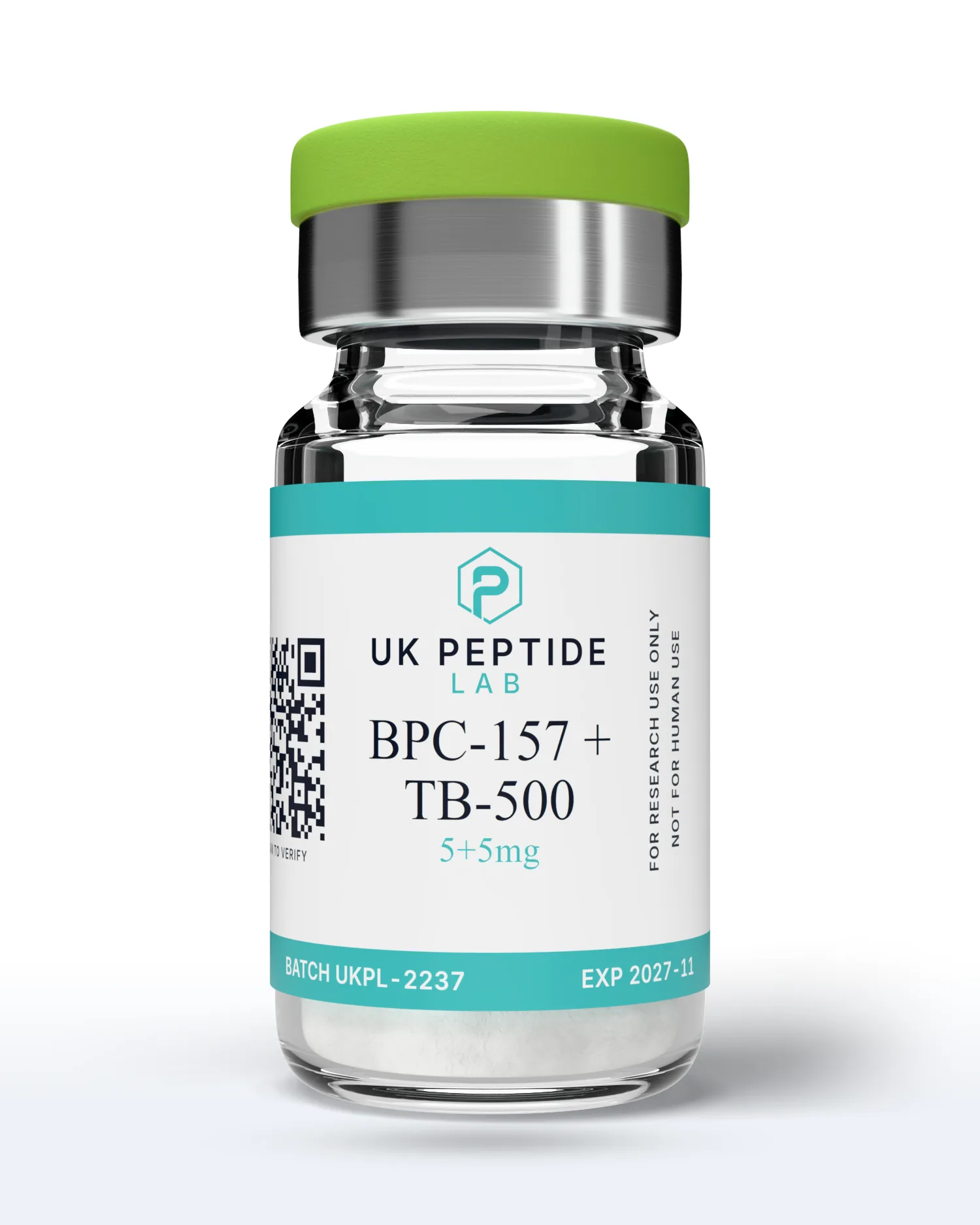
BPC-157 + TB-500
5+5mg
Pre-blended soft-tissue research peptide vial. BPC-157 and TB-500 combined.
Content-verified · Third-party tested · Batch UKPL-2237 · View certificate
- Same-day dispatch before 3pm, Mon to Fri
- Add £30.01 more for free UK delivery
- Cold-chain shipping. Always. Dry-cold pack, Royal Mail Tracked 24
- Lost, damaged or wrong? Replaced free if you tell us within 48 hours.
- Research use only. For in-vitro laboratory research. Not for use in humans or animals, or in food, drugs or diagnostics. Not evaluated by the MHRA or FDA. The buyer is responsible for handling and regulatory compliance.
Bulk Pricing
Counted across your basket, any mix of products.
| Vials in basket | Discount | Per vial |
|---|---|---|
| 1 | None | £38.99 |
| 3-4 | 5% | £37.04 |
| 5-9 | 8% | £35.87 |
| 10-50 | 12% | £34.31 |
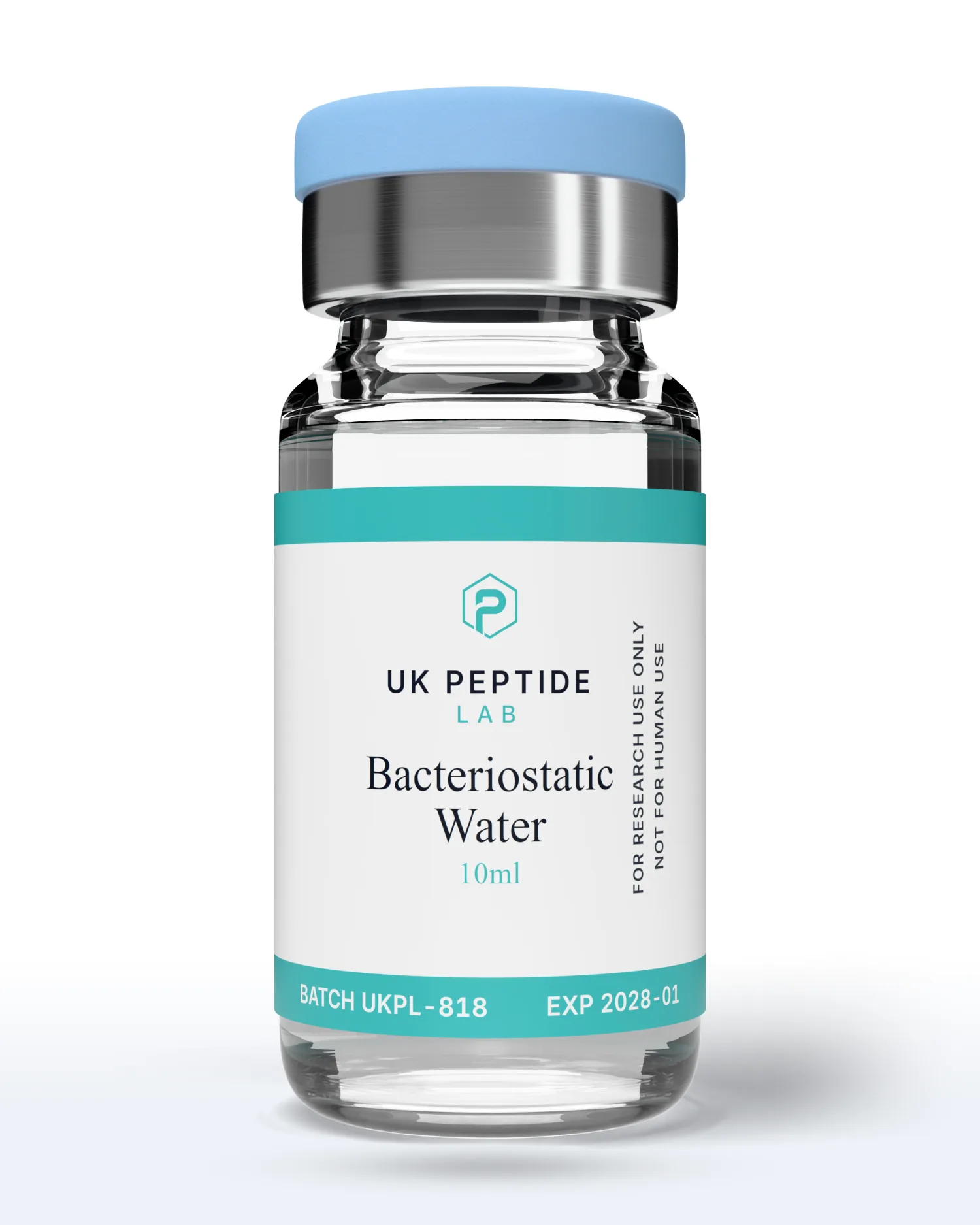
Bacteriostatic Water 10ml
Required to reconstitute lyophilised peptides.
What is BPC-157 + TB-500?
This is a pre-blended vial of BPC-157 5mg and TB-500 5mg: 10mg of BPC-157/TB-500 powder in one lyophilised vial, under batch UKPL-2237. It is also written BPC157 TB500 or BPC 157 TB 500. One vial means one reconstitution and one solution for designs that use both peptides.
Full description
TB-500 and BPC-157 are chemically unrelated. BPC-157 is a 15-residue peptide taken from a protein first found in human gastric juice. TB-500 is specified here as N-acetylated thymosin beta 4, 43 residues. Each has its own product page covering its mechanism and literature.
What matters for the blend is format. Co-formulation saves preparation steps but removes independent control of each peptide. Equal mass is also not equal moles. No controlled study has tested this combination.
BPC-157 + TB-500 Research Applications
- BPC-157 signalling: VEGFR2 upregulation and internalisation in human endothelial cells (Hsieh et al., J Mol Med, 2017).
- Thymosin beta 4 signalling: a complex with PINCH and integrin-linked kinase that activates Akt, with cardiomyocyte migration and survival in mouse heart models (Bock-Marquette et al., Nature, 2004).
- Human evidence: a 2025 scoping review found only three small pilot studies of BPC-157 in humans and no large-scale trials (McGuire et al., Curr Rev Musculoskelet Med).
Study details
The blend suits preclinical soft-tissue and cell-migration designs that would otherwise run both peptides in parallel preparations. Its value is one reconstitution and one in-use window. No property arises from co-formulation itself, and no study has compared the pair against either peptide alone.
Pre-Blended Vial vs Two Separate Vials
The blend wins on procedure. One vial needs one reconstitution and one fill volume, so there is no transfer step to add sterility risk or volume error. Both peptides share one reconstitution date. Separate vials win when the ratio must vary, when an effect has to be pinned to one peptide, or when only one is needed. Separate vials also make the molar imbalance obvious. 5mg of BPC-157 at 1419.53 g/mol is about 3.5 µmol, while 5mg of TB-500 at 4963.4 g/mol is about 1.0 µmol. The certificate for a blend also has to measure each peptide separately.
Research Overview
BPC-157 is the pentadecapeptide GEPPPGKPADDAGLV, a partial sequence of body protection compound from human gastric juice. Hsieh and colleagues (J Mol Med, 2017) linked its pro-angiogenic activity to VEGFR2 upregulation, internalisation and downstream Akt and eNOS signalling in endothelial cells. Its tendon work reports faster fibroblast outgrowth and migration in culture.
Thymosin beta 4 is the main G-actin sequestering peptide in most cells. Bock-Marquette and colleagues (Nature, 2004) showed it forms a complex with PINCH and integrin-linked kinase, activating Akt. In mice after coronary artery ligation, it raised ILK and Akt activity and early myocyte survival.
The two are often paired in preclinical tissue-repair designs because these mechanisms differ. Combination data do not exist. McGuire and colleagues (Curr Rev Musculoskelet Med, 2025) found only three human pilot studies of BPC-157 and called it investigational until well-designed trials are done. Separate vials remain the better choice when the two must be varied independently. Research use only.
Product Specifications
- Components
- BPC-157 5mg + TB-500 5mg (single vial, 10mg total peptide)
- BPC-157
- C₆₂H₉₈N₁₆O₂₂, 1419.53 g/mol, CAS 137525-51-0, GEPPPGKPADDAGLV
- TB-500 (thymosin beta 4)
- C₂₁₂H₃₅₀N₅₆O₇₈S, 4963.4 g/mol, CAS 77591-33-4, 43 residues
- Molar Ratio
- Approximately 3.5 : 1 BPC-157 to TB-500 (equal mass, not equimolar)
- Purity
- Content-verified (Janoshik #229864)
- Batch
- UKPL-2237
- Storage
- -20°C lyophilised, 2-8°C reconstituted
- Appearance
- White lyophilised powder (single vial)
- Form
- Lyophilised powder (co-formulated)
Certificate of Analysis
Third-party tested
- Batch
- UKPL-2237
- Purity
- Content-verified
- Method
- Content assay
- Lab
- Janoshik Analytical
- Tested
- Sep 2026
Need the certificate for an earlier batch? Request an older CoA
Storage and Reconstitution
Keep sealed vials at -20°C, away from light and moisture. After reconstitution, keep the solution at 2-8°C and use it within 4 weeks, or freeze single-use aliquots at -20°C. Both peptides share one reconstitution date, so the shorter in-use window governs the whole vial. Freeze-thaw cycles cut recovery of the thymosin beta 4 chain in particular.
Vials are sold on their own, without bacteriostatic water for mixing or other supplies.
How to reconstitute and handle
Treat the vial as one 10mg preparation, with the fill volume set by the concentration your protocol needs. Let the vial and the bacteriostatic water reach room temperature and swab both stoppers. Add the water slowly down the inside wall and swirl gently until dissolved. Do not shake or vortex: the thymosin beta 4 chain is shear-sensitive. The solution should be clear and colourless. The two peptides cannot be separated after reconstitution. Label the vial with fill volume, concentration and date.
- Check that the certificate reports each peptide separately, not one combined figure.
- Split reconstituted stock into single-use aliquots and avoid repeated freeze-thaw cycles.
For the full method, see the peptide reconstitution guide and the reconstitution calculator.
Research References
- Therapeutic potential of pro-angiogenic BPC157 is associated with VEGFR2 activation and up-regulation (Hsieh et al., J Mol Med, 2017)
- Thymosin beta4 activates integrin-linked kinase and promotes cardiac cell migration, survival and cardiac repair (Bock-Marquette et al., Nature, 2004)
- Regeneration or Risk? A Narrative Review of BPC-157 for Musculoskeletal Healing (McGuire et al., Curr Rev Musculoskelet Med, 2025)
Published research on BPC-157 + TB-500 is indexed on PubMed. See our full UK buyer's guide for BPC-157 + TB-500 and UK buyer's guide for Wolverine Stack.
BPC-157 + TB-500 Price (UK)
BPC-157 + TB-500 is for sale in 2 vial sizes, priced from £38.99 for 5+5mg to £54.99 for 10+10mg. Every size ships from our UK facility, each with its own batch certificate. UK delivery is £4.50 by Royal Mail Tracked 24, free over £69.
| Vial | Price | Cost per mg | Availability |
|---|---|---|---|
| BPC-157 + TB-500 5+5mgThis page | £38.99 | £3.90 | In stock |
| BPC-157 + TB-500 10+10mg | £54.99 | £2.75Best value | In stock |
Prices are in GBP per vial and match the basket. See the FAQ for delivery and payment options, and quality & testing for how each batch is checked.
Frequently Asked Questions
What is the BPC-157 and TB-500 blend?
It is one lyophilised vial holding 5mg of BPC-157 and 5mg of TB-500, 10mg in total, under one batch number and one certificate that reports each peptide separately. BPC-157 is a 15-residue peptide at 1419.53 g/mol. TB-500 is thymosin beta 4, 43 residues at 4963.4 g/mol. The blend exists to cut preparation steps in combined designs.
Is the BPC-157 TB-500 blend a 1:1 mix?
By mass, yes. By moles, no. 5mg of BPC-157 is about 3.5 µmol and 5mg of TB-500 is about 1.0 µmol, a molar ratio near 3.5 to 1. In molar terms the vial is weighted heavily towards BPC-157.
Why would a researcher use BPC-157 and TB-500 together rather than separately?
Mostly for procedure. One vial needs one reconstitution, one fill volume and no transfer step, which removes a source of contamination and volume error. Both peptides share one reconstitution date, which simplifies records. The pairing itself is common in preclinical tissue-repair designs because the two mechanisms differ.
Has the BPC-157 and TB-500 combination been studied as a combination?
No. No controlled study has tested this combination. BPC-157 research centres on VEGFR2 and focal adhesion kinase signalling, and thymosin beta 4 research on G-actin binding and integrin-linked kinase. No data show the two together do more than either alone.
How is purity reported for a TB 500 BPC 157 blend vial?
Per peptide, not as one number. The certificate has to resolve two species of about 1419 Da and 4963 Da. For batch UKPL-2237, Janoshik Analytical (report #229864, September 2026) measured 6.10mg BPC-157 and 5.64mg TB-500 in the vial. Each peptide is quantified on its own.
Where can I buy a BPC-157 and TB-500 blend in the UK?
You can buy the blend online from UK Peptide Lab: 5mg plus 5mg in one vial, batch UKPL-2237, with its third-party certificate published on the product page. Orders placed before 3pm UK time on a working day go out the same day, and UK Royal Mail Tracked delivery is free over £69. Buyers must be 18 or over.
Is the BPC-157 TB-500 blend equimolar?
No. It is equal by mass and about 3.5 to 1 by moles in favour of BPC-157. At 1419.53 g/mol and 4963.4 g/mol, 5mg of each is about 3.5 µmol against 1.0 µmol. Any protocol written in molar terms must allow for that.
Is there evidence for using BPC-157 and TB-500 together?
No controlled study has tested this combination. Each peptide has its own preclinical literature, and they are often paired in tissue-repair designs because their reported mechanisms differ. No published work shows the pair does more than either alone. The blend is a format for convenience, not evidence of a combined effect.
Related Products