Peptides
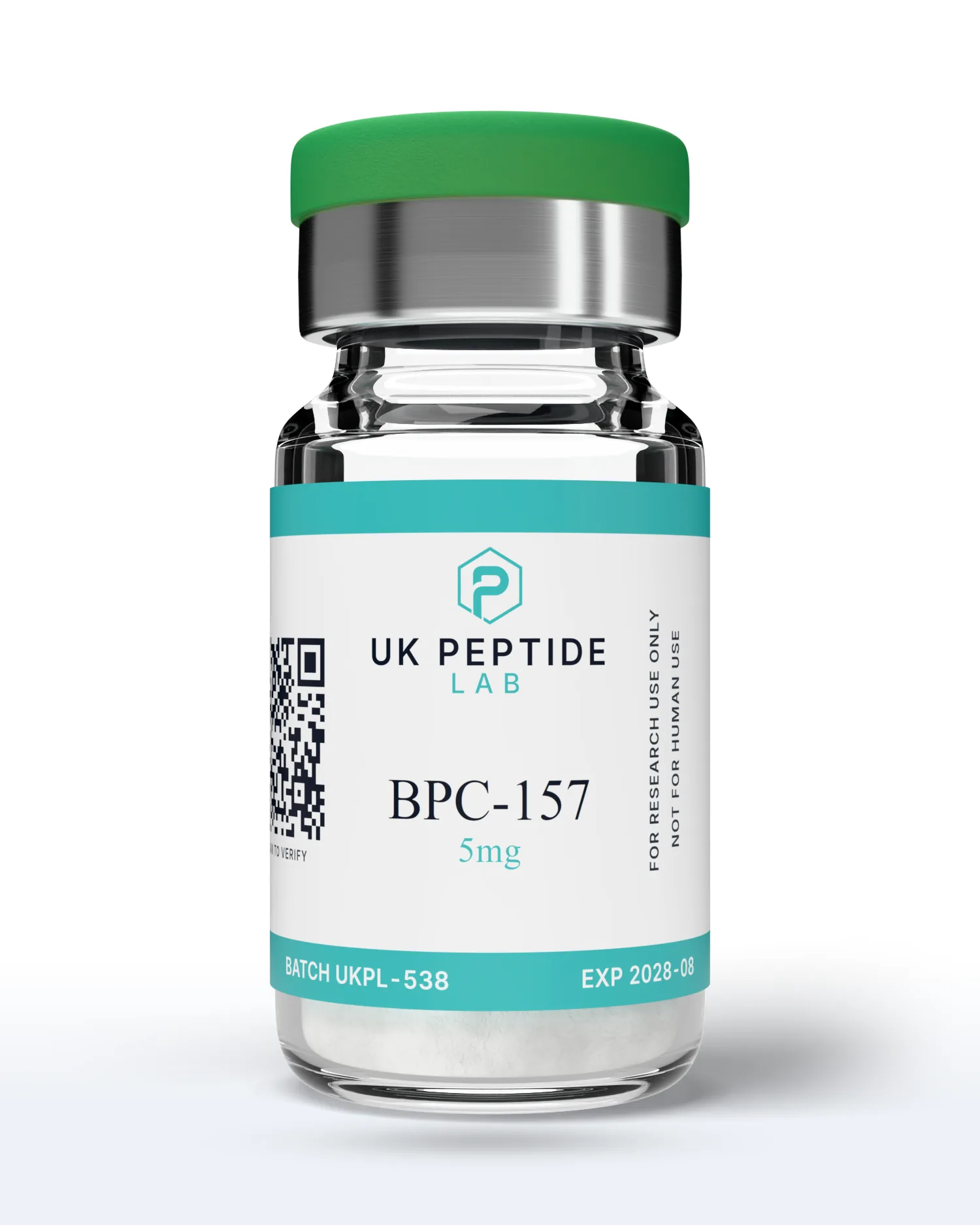
BPC-157
5mg
15 amino acid synthetic peptide derived from human gastric juice. Research grade.
99.74% purity · Third-party tested · Batch UKPL-538 · View certificate
- Same-day dispatch before 3pm, Mon to Fri
- Add £51.01 more for free UK delivery
- Cold-chain shipping. Always. Dry-cold pack, Royal Mail Tracked 24
- Lost, damaged or wrong? Replaced free if you tell us within 48 hours.
- Research use only. For in-vitro laboratory research. Not for use in humans or animals, or in food, drugs or diagnostics. Not evaluated by the MHRA or FDA. The buyer is responsible for handling and regulatory compliance.
Bulk Pricing
Counted across your basket, any mix of products.
| Vials in basket | Discount | Per vial |
|---|---|---|
| 1 | None | £17.99 |
| 3-4 | 5% | £17.09 |
| 5-9 | 8% | £16.55 |
| 10-50 | 12% | £15.83 |
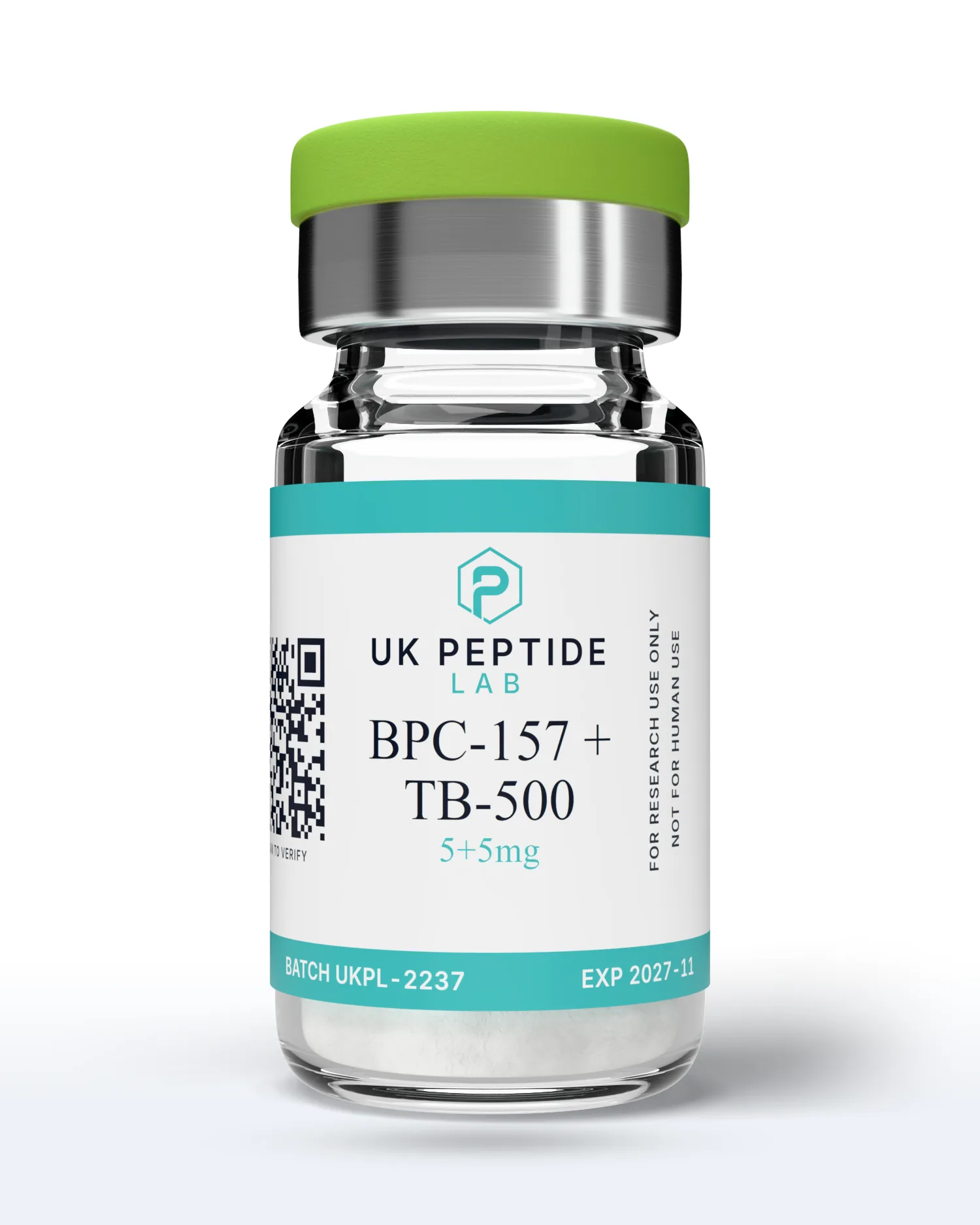
BPC-157 + TB-500 5+5mg
Pre-blended soft-tissue research peptide vial. BPC-157 and TB-500 combined.
All components in one lyophilised vial, with one certificate.
What is BPC-157?
BPC-157 is a synthetic 15-amino-acid peptide, a partial sequence of Body Protection Compound from human gastric juice. Published work on it is mostly cell and rodent research on angiogenesis, tendon fibroblasts and the gut lining. We sell it in 5mg and 10mg vials of white lyophilised powder.
Full description
BPC-157 (Body Protection Compound-157), also written BPC 157 or BPC157, is a pentadecapeptide with the sequence GEPPPGKPADDAGLV. Its molecular formula is C₆₂H₉₈N₁₆O₂₂, its molecular weight 1419.53 g/mol and its CAS number 137525-51-0.
Unlike most peptides of its length, it is stable in human gastric juice (Sikiric et al., Curr Med Chem, 2012). Its early clinical code was PL 14736.
BPC-157 Research Applications
- Angiogenesis: BPC-157 raised VEGFR2 expression and internalisation in human vascular endothelial cells and activated VEGFR2-Akt-eNOS signalling (Hsieh et al., J Mol Med, 2017).
- Tendon fibroblasts: in rat Achilles tendon cells it increased outgrowth, survival under oxidative stress and migration, with FAK and paxillin phosphorylation (Chang et al., J Appl Physiol, 2011).
- Growth hormone receptor: the same group found this receptor among the genes BPC-157 up-regulated most in these fibroblasts (Chang et al., Molecules, 2014).
- Gut models: the Sikiric group has studied it in animal models of colitis, intestinal anastomosis, short bowel syndrome and fistula (Curr Med Chem, 2012).
Study details
In the Hsieh study, BPC-157 increased vessel density in the chick chorioallantoic membrane assay and in endothelial tube formation. In rats with hind-limb ischaemia it sped the return of blood flow and raised vessel counts.
BPC-157 vs TB-500
The two share no sequence. BPC-157 has 15 residues (1419.53 g/mol); TB-500, as we sell it, is the 43-residue thymosin beta 4 chain (4963.4 g/mol). BPC-157 studies measure VEGFR2 and nitric oxide signalling in endothelial cells and focal adhesion signalling in tendon fibroblasts. Thymosin beta 4 studies measure G-actin binding and cell migration, mostly in cardiac and corneal models.
Research Overview
Hsieh and colleagues (J Mol Med, 2017) found that BPC 157 raised VEGFR2 mRNA and protein in human vascular endothelial cells, while VEGF-A was unchanged. It promoted VEGFR2 internalisation and time-dependent VEGFR2-Akt-eNOS activation. The endocytosis inhibitor dynasore blocked both effects and the gain in tube formation.
Chang and colleagues studied fibroblasts from rat Achilles tendon. BPC 157 did not change their proliferation directly. It did increase explant outgrowth, survival under hydrogen peroxide stress, cell spreading and migration, with dose-dependent FAK and paxillin phosphorylation (J Appl Physiol, 2011). The authors attribute these effects to the FAK-paxillin pathway. In a follow-up, adding growth hormone to BPC 157-treated fibroblasts raised proliferation and activated Janus kinase 2 (Molecules, 2014).
The Sikiric group has published most of the gut and nitric oxide work in animal models. Their 2012 review reports interaction with the nitric oxide system, protection of the endothelium and stimulation of the egr-1 gene (Curr Med Chem, 2012).
Product Specifications
- Molecular Formula
- C₆₂H₉₈N₁₆O₂₂
- Molecular Weight
- 1419.53 g/mol
- CAS Number
- 137525-51-0
- Sequence
- Gly-Glu-Pro-Pro-Pro-Gly-Lys-Pro-Ala-Asp-Asp-Ala-Gly-Leu-Val (GEPPPGKPADDAGLV)
- Purity
- 99.74% (RP-HPLC)
- Batch
- UKPL-538
- Storage
- -20°C lyophilised, 2-8°C reconstituted
- Appearance
- White lyophilised powder
- Form
- Lyophilised powder
Certificate of Analysis
Third-party tested
- Batch
- UKPL-538
- Purity
- 99.74%
- Specification
- ≥98.0%
- Method
- RP-HPLC
- Lab
- Marfleet Analytical Services
- Tested
- Aug 2026
Need the certificate for an earlier batch? Request an older CoA
Storage and Reconstitution
Store sealed vials at -20°C, away from light and moisture. Stored this way, the lyophilised powder has a shelf life of up to 24 months. Reconstituted solutions keep for up to 4 weeks at 2-8°C. For longer storage, freeze single-use aliquots at -20°C and avoid repeated freeze-thaw cycles.
Vials are sold on their own, without bacteriostatic water for mixing or other supplies.
How to reconstitute and handle
Let the vial reach room temperature, then swab both stoppers with alcohol. Add the bacteriostatic water slowly down the inside wall of the vial, not onto the powder. Swirl gently until the powder has dissolved, without shaking or vortexing. The liquid should be a clear, colourless solution. Label the vial with the date.
- Swab the stopper before every draw and use a fresh sterile needle each time.
For the full method, see the peptide reconstitution guide and the reconstitution calculator.
Research References
- Therapeutic potential of pro-angiogenic BPC157 is associated with VEGFR2 activation and up-regulation (Hsieh et al., J Mol Med, 2017)
- BPC 157 promotes tendon healing via tendon outgrowth, cell survival and cell migration, FAK and paxillin phosphorylation (Chang et al., J Appl Physiol, 2011)
- Pentadecapeptide BPC 157 enhances the growth hormone receptor expression in tendon fibroblasts (Chang et al., Molecules, 2014)
- Focus on ulcerative colitis: stable gastric pentadecapeptide BPC 157 (Sikiric et al., Curr Med Chem, 2012)
- Regeneration or Risk? A Narrative Review of BPC-157 for Musculoskeletal Healing (McGuire et al., Curr Rev Musculoskelet Med, 2025)
Published research on BPC-157 is indexed on PubMed. See our full UK buyer's guide for Research Peptides, UK buyer's guide for BPC-157 and UK buyer's guide for Wolverine Stack.
BPC-157 Price (UK)
BPC-157 is for sale in 2 vial sizes, priced from £17.99 for 5mg to £28.99 for 10mg. Every size ships from our UK facility, each with its own batch certificate. UK delivery is £4.50 by Royal Mail Tracked 24, free over £69.
| Vial | Price | Cost per mg | Availability |
|---|---|---|---|
| BPC-157 5mgThis page | £17.99 | £3.60 | In stock |
| BPC-157 10mg | £28.99 | £2.90Best value | In stock |
Prices are in GBP per vial and match the basket. See the FAQ for delivery and payment options, and quality & testing for how each batch is checked.
Frequently Asked Questions
How does BPC-157 work?
Cell studies point to two signalling routes. In human vascular endothelial cells, BPC-157 raised VEGFR2 and activated the VEGFR2-Akt-eNOS pathway (Hsieh et al., J Mol Med, 2017). In rat tendon fibroblasts it increased FAK and paxillin phosphorylation and cell migration (Chang et al., J Appl Physiol, 2011). Animal work from the Sikiric group also reports interaction with the nitric oxide system.
Why is BPC-157 stable in stomach acid?
The Sikiric group describes the peptide as stable in human gastric juice (Curr Med Chem, 2012). The usual explanation offered is its proline-rich sequence, with prolines at positions 3, 4, 5 and 8. That stability is why animal studies have used oral as well as parenteral designs.
Are there any human studies on BPC 157?
Very few. A 2025 review by McGuire and colleagues found three small pilot studies and no large controlled trial. The pilots covered knee pain, interstitial cystitis and intravenous safety, and the intravenous study had two participants (Lee and Burgess, 2025). As PL 14736, BPC 157 reached phase II testing for inflammatory bowel disease.
Is BPC 157 banned in sport?
Yes. BPC-157 is named in section S0, non-approved substances, of the WADA Prohibited List. It has been listed since 2022 and is prohibited at all times, in and out of competition.
Is BPC-157 legal to buy in the UK?
It can be bought in the UK as a research chemical for in-vitro laboratory use. It is not a licensed medicine in the UK, and we do not supply it for human or veterinary use. Buyers must be 18 or over and confirm research-only use at checkout.
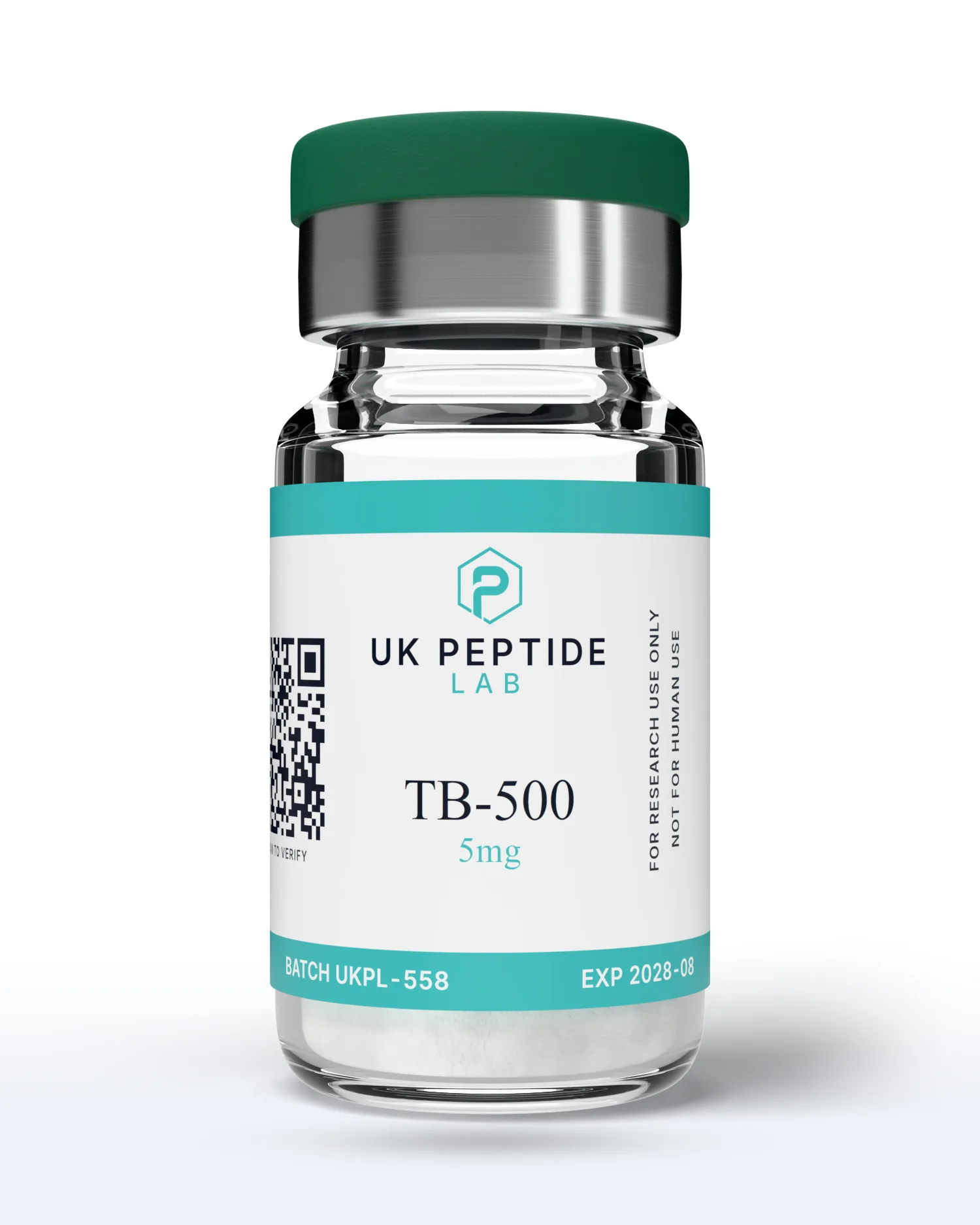
Can BPC-157 and TB-500 be studied together?
Yes. Preclinical tissue-repair studies often pair them because their reported mechanisms differ. BPC-157 findings centre on VEGFR2 and nitric oxide signalling. Thymosin beta 4 findings centre on G-actin binding and cell migration. Separate vials let a study test each compound alone as well as together.
What is in a BPC-157 vial?
BPC-157 as a white lyophilised (freeze-dried) powder: 5mg or 10mg, depending on the vial size you choose. Bacteriostatic water and syringes are sold separately.
Where can I buy BPC-157 in the UK?
You can buy BPC-157 online from us, shipped from UK stock in 5mg and 10mg vials. Every batch has a published third-party certificate. Orders placed before 3pm on a working day are dispatched the same day, and UK delivery is free over £69.
What should I look for in a BPC 157 UK supplier?
A certificate for the exact batch you receive, with a batch number that matches the vial. It should give a measured HPLC purity, the method and the testing lab. A generic PDF reused across batches proves nothing about your vial.
Is your BPC-157 5mg third-party tested?
Yes. Each batch is analysed by an independent laboratory using RP-HPLC, and the full report is published, not held back until you ask. The certificate section shows the batch number, measured purity, lab and test date.
Do you dispatch BPC157 the same day in the UK?
Yes. Order online before 3pm on a working day and BPC157 leaves the same day by Royal Mail Tracked 24, with a dry-cold pack. UK delivery is free over £69.
What is BPC 157 peptide used for in research?
BPC 157 peptide is used in cell and animal studies of angiogenesis, tendon fibroblast biology, the gut lining and nitric oxide signalling. Typical endpoints are VEGFR2 signalling, FAK and paxillin phosphorylation and growth hormone receptor expression.
Do you sell BPC-157 and TB-500 together?
Yes. The BPC-157 + TB-500 blend holds 5mg of each peptide in one lyophilised vial, and a 10+10mg version is also sold. Each blend batch has its own certificate. Separate vials suit studies that need to test the two compounds apart.
Related Products