Peptides
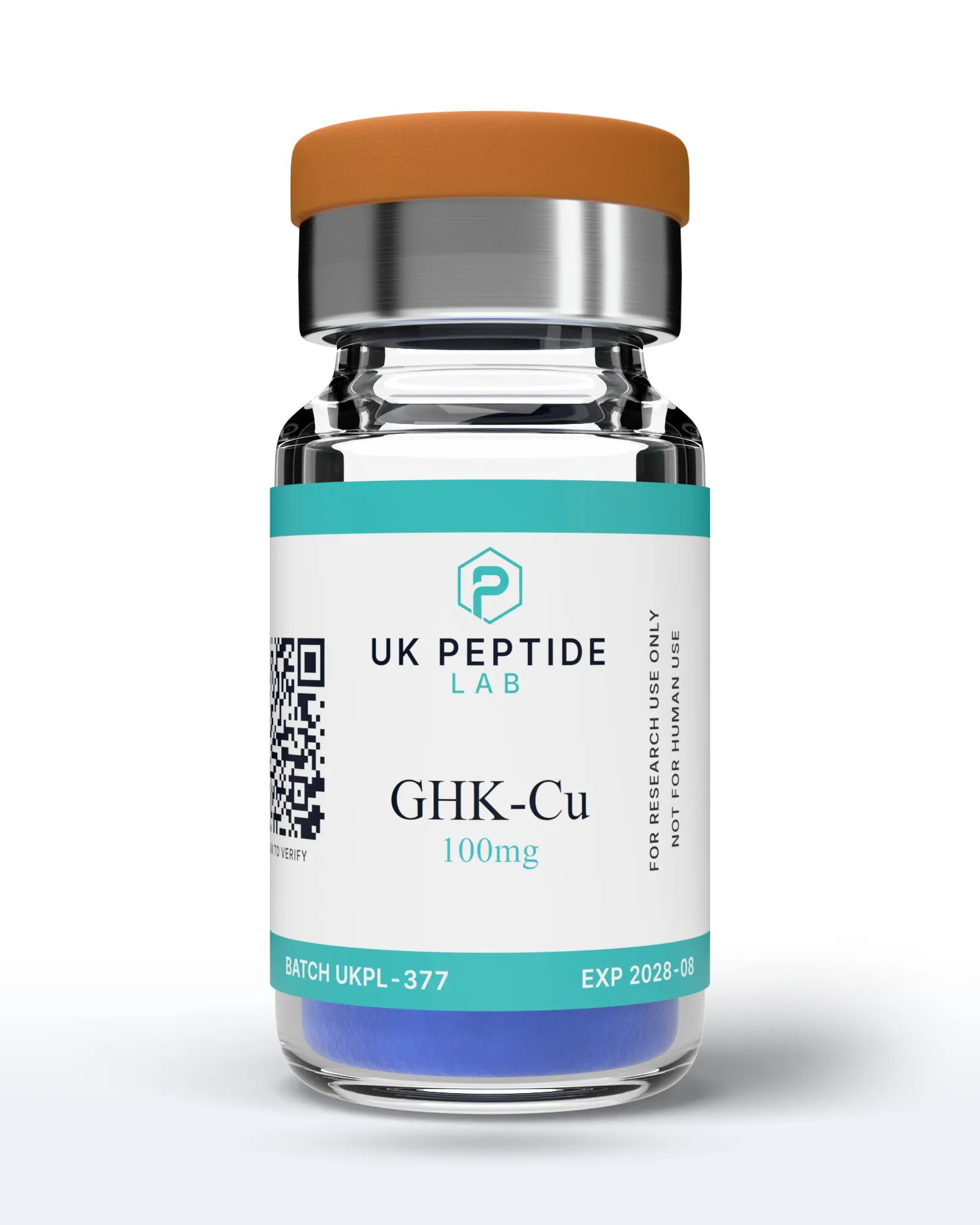
GHK-Cu
100mg
Naturally occurring copper tripeptide complex. Tissue remodelling research.
>99% purity · Third-party tested · Batch UKPL-377 · View certificate
- Same-day dispatch before 3pm, Mon to Fri
- Add £34.01 more for free UK delivery
- Cold-chain shipping. Always. Dry-cold pack, Royal Mail Tracked 24
- Lost, damaged or wrong? Replaced free if you tell us within 48 hours.
- Research use only. For in-vitro laboratory research. Not for use in humans or animals, or in food, drugs or diagnostics. Not evaluated by the MHRA or FDA. The buyer is responsible for handling and regulatory compliance.
Bulk Pricing
Counted across your basket, any mix of products.
| Vials in basket | Discount | Per vial |
|---|---|---|
| 1 | None | £34.99 |
| 3-4 | 5% | £33.24 |
| 5-9 | 8% | £32.19 |
| 10-50 | 12% | £30.79 |
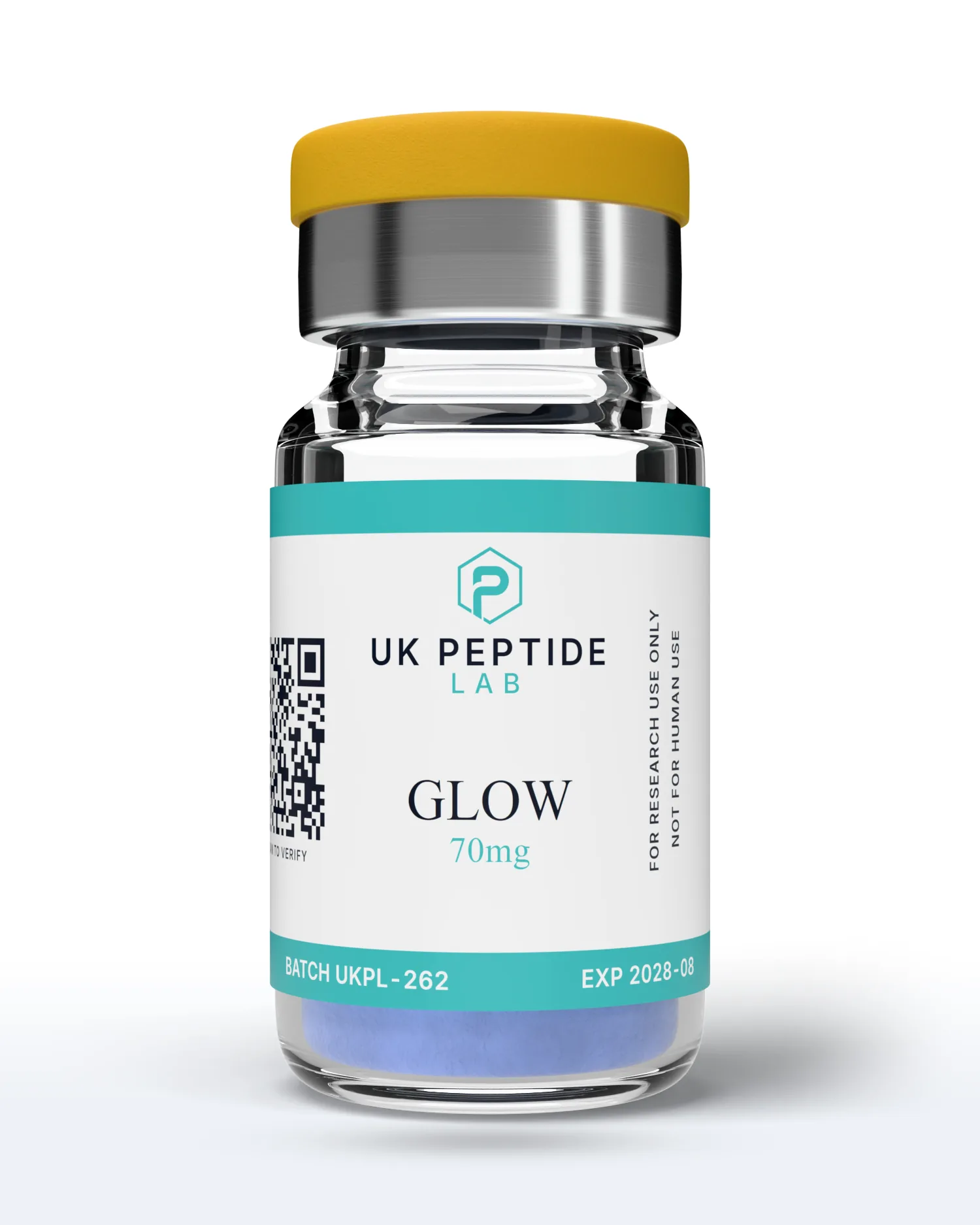
GLOW 70mg
Pre-blended regenerative research vial. BPC-157 10mg + TB-500 10mg + GHK-Cu 50mg.
All components in one lyophilised vial, with one certificate.
What is GHK-Cu?
GHK-Cu is the copper(II) complex of GHK, a three-amino-acid peptide (glycyl-L-histidyl-L-lysine) that occurs naturally in human plasma, saliva and urine. As a research compound, the GHK-Cu peptide is studied for how it carries copper into cells and for its effects on the extracellular matrix. Each GHK-Cu 100mg vial holds a blue lyophilised powder. The colour comes from the bound copper.
Full description
Loren Pickart first isolated the tripeptide GHK from human plasma in 1973. In GHK-Cu, a single Cu(II) ion sits in a square-planar pocket formed by three nitrogen atoms: the N-terminal amine, the deprotonated glycyl amide nitrogen and the histidine imidazole. The binding strength (log K about 16.4) is close to that of the copper transport site on human serum albumin. For that reason GHK-Cu is usually modelled as a copper carrier that can swap copper with the body's own pools. Pickart and colleagues reported in Nature (1980) that the tripeptide helps cultured cells take up copper.
The GHK sequence also sits inside the alpha-2(I) chain of type I collagen. Fragments like this, released when the matrix is broken down, are called matrikines. Other names for the compound include GHK copper, ghkcu and copper peptide, though "copper peptide" is also used for different sequences such as AHK-Cu.
GHK-Cu Research Applications
- Copper transport: a binding strength close to albumin's copper site, and increased copper uptake by cultured cells (Pickart et al., Nature, 1980).
- Matrix turnover: fibroblast and rat wound-chamber studies from the Maquart and Simeon groups (1988 to 2000) reported more collagen, sulfated glycosaminoglycan and small proteoglycan synthesis. Matrix metalloproteinase-2 and its inhibitors rose too.
- Gene expression: Connectivity Map analyses suggest GHK changes the expression of around 4,000 human genes in cultured cell lines. This is a screening result, not an outcome study.
- Lung models: Campbell and colleagues (Genome Medicine, 2012) found GHK ran against a gene signature linked to emphysema-related lung damage, then studied collagen remodelling in lung fibroblasts.
Study details
Most published work falls into two groups. The first is extracellular matrix biology in fibroblast culture and rat wound-chamber models, where matrix building and matrix breakdown were both reported to increase together. Related cell work reported higher integrin expression and more p63-positive cells in keratinocyte culture. The second group is transcriptomic and lung research. Recent preclinical studies have looked at GHK-Cu in mouse models of pulmonary fibrosis and silicosis, measuring oxidative stress and inflammatory signalling.
GHK-Cu vs Copper-Free GHK
GHK and GHK-Cu are two different species. GHK is the free tripeptide (C₁₄H₂₄N₆O₄, 340.4 g/mol, CAS 49557-75-7). GHK-Cu carries one bound Cu(II) ion and is 63.5 g/mol heavier, at 403.9 g/mol. The difference matters at the bench. Molar calculations change. The copper complex is blue while the free peptide is colourless. The balance between the two forms shifts with free copper, competing chelators, phosphate and reducing agents in the medium. Both forms have their own literature, so a protocol should state which one it uses and control the copper content of the medium.
Research Overview
The free tripeptide binds Cu(II) through its N-terminal amine, the deprotonated glycyl amide nitrogen and the histidine imidazole. This square-planar complex is what makes a reconstituted solution deep blue. The stability constant is a log K of about 16.4, slightly above the copper transport site of human serum albumin at about 16.2. A ternary GHK-Cu-albumin complex has also been characterised directly.
In fibroblast culture and rat wound-chamber work, the Maquart and Simeon groups reported that GHK-Cu raised the synthesis of collagen, glycosaminoglycans and small proteoglycans. It also raised matrix metalloproteinase-2 and its tissue inhibitors (Life Sci, 2000). Matrix deposition and matrix turnover going up at the same time is the result most often cited from this work.
The gene expression work uses the Broad Institute Connectivity Map. Analyses reported by Pickart and colleagues indicate GHK alters the expression of around 4,000 human genes. These are profiles from cultured cell lines. Campbell et al. (Genome Medicine, 2012) used the same resource to identify GHK as inversely correlated with an emphysema-related lung destruction signature. They then tested its effect on collagen remodelling in cultured lung fibroblasts.
Circulating GHK is reported to fall from about 200 ng/mL at age 20 to about 80 ng/mL at age 60.
Product Specifications
- Molecular Formula
- C₁₄H₂₄CuN₆O₄
- Molecular Weight
- 403.9 g/mol
- CAS Number
- 89030-95-5
- Sequence
- Gly-L-His-L-Lys, copper(II) complex
- Free Tripeptide (GHK)
- C₁₄H₂₄N₆O₄, 340.4 g/mol, CAS 49557-75-7
- Purity
- >99% (RP-HPLC)
- Batch
- UKPL-377
- Storage
- -20°C lyophilised, 2-8°C reconstituted, protect from light
- Appearance
- Blue to blue-violet lyophilised powder
- Form
- Lyophilised powder
Certificate of Analysis
Third-party tested
- Batch
- UKPL-377
- Purity
- >99%
- Method
- RP-HPLC
- Lab
- Marfleet Analytical Services Ltd
- Tested
- Aug 2026
Need the certificate for an earlier batch? Request an older CoA
Storage and Reconstitution
Keep sealed vials at -20°C, away from light and moisture. Stored this way, the lyophilised powder is stable for up to 24 months. After reconstitution, keep the solution at 2-8°C in a light-proof container and use it within 4 weeks. Copper(II) peptide complexes are sensitive to light, so use amber or foil-wrapped vessels for aliquots. Freeze-thaw cycles can disturb the copper binding as well as damage the peptide, so freeze single-use aliquots at -20°C for longer storage.
Vials are sold on their own, without bacteriostatic water for mixing or other supplies.
How to reconstitute and handle
Let the vial reach room temperature and wipe the stoppers with an alcohol swab. Add bacteriostatic water or sterile water slowly down the inside wall of the vial, then swirl gently until the blue colour is even. Do not shake or vortex, and work away from direct light. The solution should be blue to blue-violet. A colourless or green-tinged solution suggests the copper complex has broken down, and visible absorbance at around 500 to 600 nm is the usual bench check. Use glass or good-quality polypropylene labware, and avoid long contact with stainless steel or other surfaces that can strip copper from the peptide.
- Strong chelators, phosphate-rich buffers and reducing agents in an experimental medium compete for the copper and change the species actually present.
For the full method, see the peptide reconstitution guide and the reconstitution calculator.
Research References
- Growth-modulating plasma tripeptide may function by facilitating copper uptake into cells (Nature, 1980)
- GHK-Cu stimulates matrix metalloproteinase-2 expression by fibroblast cultures (Life Sci, 2000)
- A gene expression signature of emphysema-related lung destruction and its reversal by the tripeptide GHK (Genome Med, 2012)
- GHK Peptide as a Natural Modulator of Multiple Cellular Pathways in Skin Regeneration (Biomed Res Int, 2015)
Published research on GHK-Cu is indexed on PubMed. See our full UK buyer's guide for Research Peptides and UK buyer's guide for GHK-Cu.
GHK-Cu Price (UK)
GHK-Cu is for sale in 2 vial sizes, priced from £23.99 for 50mg to £34.99 for 100mg. Every size ships from our UK facility, each with its own batch certificate. UK delivery is £4.50 by Royal Mail Tracked 24, free over £69.
| Vial | Price | Cost per mg | Availability |
|---|---|---|---|
| GHK-Cu 100mgThis page | £34.99 | £0.35Best value | In stock |
| GHK-Cu 50mg | £23.99 | £0.48 | In stock |
Prices are in GBP per vial and match the basket. See the FAQ for delivery and payment options, and quality & testing for how each batch is checked.
Frequently Asked Questions
Where can I buy GHK-Cu in the UK?
You can buy GHK-Cu 100mg online from our UK stock, with same-day UK dispatch when you order before 3pm UK time. Free UK Royal Mail Tracked shipping over £69. A 50mg vial of the same compound is also available.
What purity is your GHK-Cu 100mg and is it third-party tested?
Batch UKPL-377 was tested by Marfleet Analytical Services using RP-HPLC and measured at above 99% purity. The certificate reports purity and appearance. A purity figure for a metal-peptide complex describes the peptide, so if you need the copper ratio confirmed, check it by spectrophotometry on receipt.
Is GHKCU the same thing as GHK-Cu or copper peptide?
Yes. ghkcu, GHK-Cu and GHK copper all mean the Cu(II) complex of glycyl-L-histidyl-L-lysine. "Copper peptide" is looser and is sometimes used for other copper-binding sequences such as AHK-Cu, so quoting GHK-Cu or CAS 89030-95-5 avoids confusion.
How does GHK-Cu work at a molecular level?
GHK-Cu is usually modelled as a copper carrier, not a receptor agonist. Its copper binding strength is close to that of albumin's copper site, which allows exchange with physiological copper pools. Pickart et al. (Nature, 1980) reported that the tripeptide helps cultured cells take up copper.
Why is the GHK-Cu peptide blue?
The colour comes from the copper(II) centre. Bound Cu(II) absorbs yellow-orange light at around 500 to 600 nm, so the solution looks blue. A colourless or green-tinged solution points to a problem: either the copper is missing or the complex has been disrupted or oxidised.
Does GHK-Cu really affect over 4,000 genes?
That figure comes from Connectivity Map analyses reported by Pickart and colleagues (Biomed Res Int, 2015). It reflects expression profiles in cultured cell lines, not outcome studies. Campbell et al. (Genome Medicine, 2012) used the same data to link GHK to an emphysema-related gene signature.
What is GHK-Cu copper peptide used for in research?
GHK-Cu copper peptide is used in preclinical and in-vitro research on copper transport, extracellular matrix biology (collagen and glycosaminoglycan synthesis, matrix metalloproteinase-2 expression), matrikine signalling and gene expression profiling.
Is GHK-Cu legal to buy in the UK for research?
Research peptides including GHK-Cu are legal to purchase in the UK for in-vitro laboratory research only. They are not approved for human consumption, veterinary use, cosmetic application or any therapeutic purpose. Purchasers must be aged 18 or over and must confirm research-only use at checkout.
Related Products