Metabolic Research
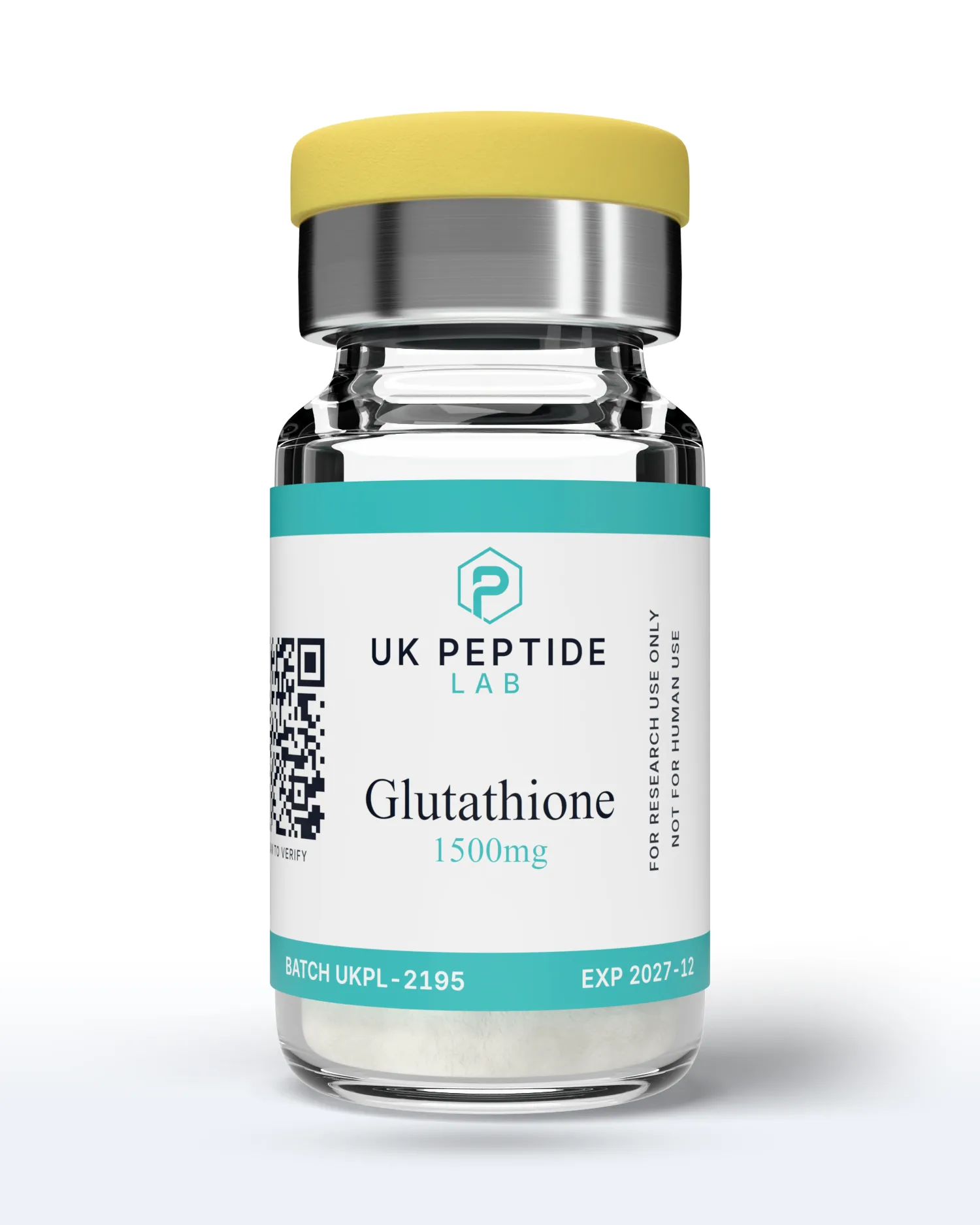
Glutathione
1500mg
Endogenous tripeptide antioxidant. Oxidative stress and detoxification pathway research.
99.119% purity · Third-party tested · Batch UKPL-2195 · View certificate
- Same-day dispatch before 3pm, Mon to Fri
- Add £30.01 more for free UK delivery
- Cold-chain shipping. Always. Dry-cold pack, Royal Mail Tracked 24
- Lost, damaged or wrong? Replaced free if you tell us within 48 hours.
- Research use only. For in-vitro laboratory research. Not for use in humans or animals, or in food, drugs or diagnostics. Not evaluated by the MHRA or FDA. The buyer is responsible for handling and regulatory compliance.
Bulk Pricing
Counted across your basket, any mix of products.
| Vials in basket | Discount | Per vial |
|---|---|---|
| 1 | None | £38.99 |
| 3-4 | 5% | £37.04 |
| 5-9 | 8% | £35.87 |
| 10-50 | 12% | £34.31 |
Bacteriostatic Water 10ml
Required to reconstitute lyophilised peptides.
What is Glutathione?
Glutathione (GSH) is the tripeptide γ-L-glutamyl-L-cysteinyl-glycine, the most abundant non-protein thiol in mammalian cells. We supply reduced glutathione as 1500mg of lyophilised powder per vial, for redox and oxidative-stress research.
Full description
Its three residues are glutamate, cysteine and glycine. Glutamate joins cysteine through its gamma-carboxyl group, not the alpha-carboxyl of an ordinary peptide bond. The formula is C₁₀H₁₇N₃O₆S, the molecular weight 307.32 g/mol and the CAS number of the reduced form 70-18-8.
Cells make it in the cytosol in two ATP-dependent steps. Glutamate cysteine ligase is the rate-limiting enzyme, glutathione synthetase the second, and cysteine supply governs the rate (Lu, Biochim Biophys Acta, 2013). Tissue levels are millimolar, highest in the liver.
Glutathione Research Applications
Typical uses are oxidative-stress models with GSH depletion as the readout, glutathione peroxidase and glutathione S-transferase assays, and GSH:GSSG measurements. Work on GSH synthesis looks at glutamate cysteine ligase and its regulation by Nrf2 through the antioxidant response element, AP-1 and NF-κB (Lu, 2013).
Reduced glutathione (GSH) vs oxidised glutathione (GSSG)
GSH is the reduced form, with a free thiol on its cysteine. GSSG is the disulfide formed when two GSH molecules are oxidised together. Glutathione reductase converts GSSG back to GSH using NADPH. The GSH:GSSG ratio is one of the most widely measured redox parameters in cell biology. Dissolved GSH oxidises in air, so solutions for ratio work need protecting from oxygen.
Research Overview
Forman, Zhang and Rinna (Mol Aspects Med, 2009) describe two protective routes: glutathione eliminates oxidants by reduction and electrophiles by conjugation. It is the substrate for glutathione peroxidases and glutathione S-transferases. Sies (Free Radic Biol Med, 1999) calls GSH the major cellular thiol in redox reactions and thioether formation.
Lu (2013) reviews how synthesis is controlled. Glutamate cysteine ligase has a catalytic subunit, GCLC, and a modifier subunit, GCLM. Both subunits and glutathione synthetase are regulated at several levels, often together. The same review links dysregulated GSH synthesis to conditions including liver fibrosis, alcoholic liver disease and drug-resistant tumour cells.
Product Specifications
- Molecular Formula
- C₁₀H₁₇N₃O₆S
- Molecular Weight
- 307.32 g/mol
- CAS Number
- 70-18-8
- Sequence
- γ-Glu-Cys-Gly (reduced form)
- Vial Content
- 1500mg
- Purity
- 99.119% (RP-HPLC)
- Batch
- UKPL-2195
- Form
- White lyophilised powder
Certificate of Analysis
Third-party tested
- Batch
- UKPL-2195
- Purity
- 99.119%
- Specification
- ≥98.0%
- Method
- RP-HPLC
- Lab
- Janoshik Analytical
- Tested
- Sep 2026
Need the certificate for an earlier batch? Request an older CoA
Storage and Reconstitution
Store glutathione powder at -20°C, away from light and moisture. Once reconstituted, keep it at 2-8°C and use it within 4 weeks. For GSH:GSSG work, make solutions fresh or aliquot and freeze them at once, and avoid repeated freeze-thaw cycles.
Vials are sold on their own, without bacteriostatic water for mixing or other supplies.
How to reconstitute and handle
Let the vial reach room temperature and swab the stopper with alcohol. Add bacteriostatic water slowly down the inside wall and swirl gently until the powder dissolves. Do not shake. Reconstitute only what you need and keep headspace small, because reduced glutathione oxidises in air.
- At 307.32 g/mol, 1500mg of glutathione is 4.88 mmol.
- When the reduced form is the measurement, protect the thiol before analysis, for example by acid precipitation.
For the full method, see the peptide reconstitution guide and the reconstitution calculator.
Research References
- Glutathione (Meister and Anderson, Annu Rev Biochem, 1983)
- Glutathione: overview of its protective roles, measurement and biosynthesis (Forman et al., Mol Aspects Med, 2009)
- Glutathione and its role in cellular functions (Sies, Free Radic Biol Med, 1999)
- Glutathione synthesis (Lu, Biochim Biophys Acta, 2013)
Published research on Glutathione is indexed on PubMed. See our full UK buyer's guide for Glutathione.
Glutathione Price (UK)
Glutathione 1500mg is for sale at £38.99 per vial, supplied from stock in the UK with a published third-party HPLC certificate. UK delivery is £4.50 by Royal Mail Tracked 24, free over £69.
| Vial | Price | Cost per mg | Availability |
|---|---|---|---|
| Glutathione 1500mgThis page | £38.99 | £0.026 | In stock |
Prices are in GBP per vial and match the basket. See the FAQ for delivery and payment options, and quality & testing for how each batch is checked.
Frequently Asked Questions
What is glutathione (GSH)?
The tripeptide γ-L-glutamyl-L-cysteinyl-glycine: C₁₀H₁₇N₃O₆S, 307.32 g/mol, CAS 70-18-8. It is the main non-protein thiol antioxidant in mammalian cells.
Is glutathione a peptide?
Yes, a tripeptide. Its first bond is a gamma-glutamyl link, so it is not an ordinary alpha-linked tripeptide.
What is the difference between reduced glutathione (GSH) and oxidised glutathione (GSSG)?
GSH is the reduced thiol form. GSSG is the disulfide of two GSH molecules. Glutathione reductase converts GSSG back to GSH with NADPH, and the GSH:GSSG ratio is a standard index of cellular redox state.
What is glutathione used for in research?
Redox biology and toxicology: oxidative-stress models, glutathione peroxidase and glutathione S-transferase assays, and xenobiotic conjugation studies.
What purity is your glutathione and is it third-party tested?
Yes, it is third-party tested. Janoshik Analytical tested batch UKPL-2195 at 99.119% purity by RP-HPLC, against a 98.0% specification. The same certificate found 1597.31mg of glutathione against the 1500mg label.
What are the three amino acids in glutathione?
Glutamate, cysteine and glycine, in the order γ-Glu-Cys-Gly. The glutamate-to-cysteine bond runs through the gamma-carboxyl group, hence the full name γ-L-glutamyl-L-cysteinyl-glycine.
Why is glutathione called the master antioxidant?
It is an informal label, not a scientific term. Glutathione is the most abundant low-molecular-weight thiol that cells make. It reduces oxidants, conjugates electrophiles and helps hold cellular redox balance (Forman et al., 2009).
Does glutathione oxidise in solution?
Yes. In air, the thiol of reduced glutathione (GSH) oxidises and two molecules join as the disulfide GSSG. Keep solutions cold and use them promptly.
Is your glutathione supplied as reduced GSH or oxidised GSSG?
Reduced glutathione (GSH), CAS 70-18-8, as 1500mg of white lyophilised powder. Once dissolved it starts to oxidise in air.
Related Products