Peptides
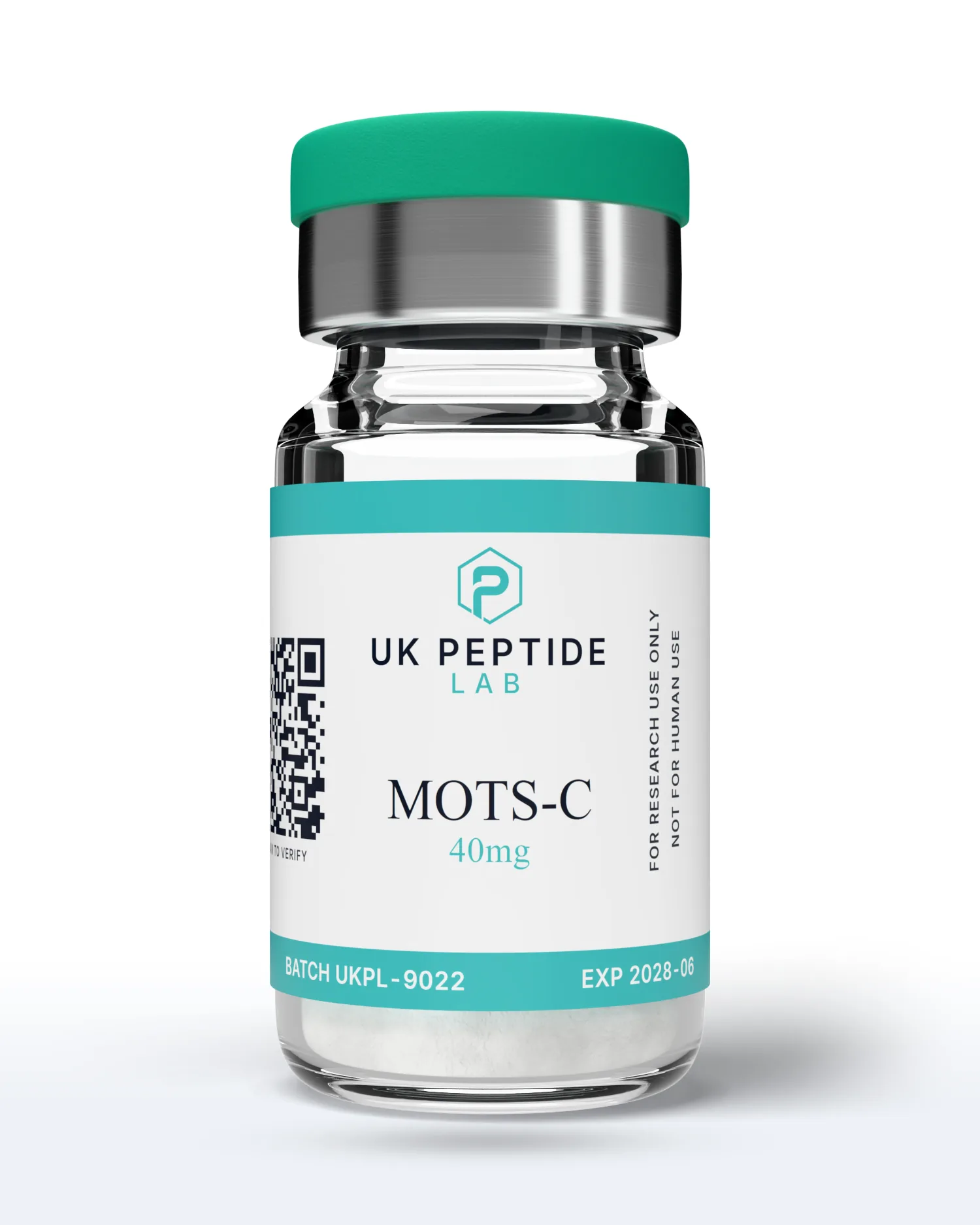
MOTS-C
40mg
16 amino acid mitochondrial-derived peptide, 40mg vial. Metabolic research compound.
98.896% purity · Third-party tested · Batch UKPL-9022 · View certificate
- Same-day dispatch before 3pm, Mon to Fri
- Qualifies for free UK delivery
- Cold-chain shipping. Always. Dry-cold pack, Royal Mail Tracked 24
- Lost, damaged or wrong? Replaced free if you tell us within 48 hours.
- Research use only. For in-vitro laboratory research. Not for use in humans or animals, or in food, drugs or diagnostics. Not evaluated by the MHRA or FDA. The buyer is responsible for handling and regulatory compliance.
Bulk Pricing
Counted across your basket, any mix of products.
| Vials in basket | Discount | Per vial |
|---|---|---|
| 1 | None | £69.99 |
| 3-4 | 5% | £66.49 |
| 5-9 | 8% | £64.39 |
| 10-50 | 12% | £61.59 |
Bacteriostatic Water 10ml
Required to reconstitute lyophilised peptides.
What is MOTS-C?
This is the largest MOTS-C vial stocked, four times the mass of the standard 10mg vial. Few UK suppliers sell a 40mg format at all.
Full description
The compound is the same in both sizes: sequence MRWQEMGYIFYPRKLR, 2174.5 g/mol, CAS 1627580-64-6. Lee et al. (Cell Metab, 2015) identified it in a short open reading frame within the mitochondrial 12S rRNA and named it MOTS-c. In their work its main target organ appeared to be skeletal muscle, where it inhibited the folate cycle and de novo purine biosynthesis, leading to AMPK activation. The mechanism and the wider mitochondrial-derived peptide literature are covered on the main MOTS-C page. This page covers the 40mg format.
MOTS-C Research Applications
- Metabolic research: MOTS-c prevented age-dependent and high-fat-diet-induced insulin resistance in mice, and diet-induced obesity (Lee et al., 2015).
- Retrograde signalling: under metabolic stress MOTS-c moves into the nucleus and regulates nuclear genes in an AMPK-dependent way, interacting with NRF2 (Kim et al., Cell Metab, 2018).
- Exercise and ageing: exercise induced endogenous MOTS-c in human skeletal muscle and in circulation. The peptide improved physical performance in young, middle-aged and old mice (Reynolds et al., 2021).
Study details
Applications match the standard vial, because the compound is the same. Vial size affects study logistics, not endpoints. Higher-throughput designs, dose-response matrices across many plates and long time-course work all consume material faster than a 10mg vial supports, and running one design against one batch removes inter-batch variance. Analytical method development is the other common case, where repeated standard preparations from a single batch stay more consistent.
The 40mg Vial vs the 10mg Vial: Oxidative Exposure Over Working Life
Both vials hold the same peptide, so the comparison is about handling. The sequence carries two methionines, one tryptophan and two tyrosines, all oxidation-labile. A vial with four times the mass is usually used over a longer period and across more stopper punctures. One reconstituted stock therefore picks up more air contact, light and freeze-thaw cycles. The 10mg vial limits that simply by finishing sooner.
The 40mg vial answers with batch continuity, one certificate across four times as much work, and a lower cost per milligram. Aliquoting at the point of reconstitution settles the argument: drawn into single-use volumes, a 40mg vial behaves like a set of small ones.
Research Overview
Forty milligrams is four times the content of the standard vial, in the same glass format. At a fixed fill volume the stock is four times more concentrated. Scale the fill volume to the target concentration instead of carrying one over from smaller vials. Record the resulting concentration against the batch.
The bigger point at this size is oxidative exposure across the vial's working life. Two methionines, one tryptophan and two tyrosines in the sequence are oxidation-labile. A vial holding four times the mass is usually accessed over a longer period and across more stopper punctures. One reconstituted stock therefore accumulates more air contact, light and freeze-thaw cycles. Aliquoting straight after reconstitution matters more here than on a small vial. Set against that are batch continuity under one certificate and a lower cost per milligram, since vial, stopper, lyophilisation and assay costs fall per vial.
Product Specifications
- Molecular Formula
- C₁₀₁H₁₅₂N₂₈O₂₂S₂
- Molecular Weight
- 2174.5 g/mol
- CAS Number
- 1627580-64-6
- Sequence
- MRWQEMGYIFYPRKLR
- Vial Content
- 40mg lyophilised peptide
- Purity
- 98.896% by HPLC
- Batch
- UKPL-9022
- Storage
- -20°C lyophilised, 2-8°C reconstituted
- Appearance
- White lyophilised powder
- Form
- Lyophilised powder
Certificate of Analysis
Third-party tested
- Batch
- UKPL-9022
- Purity
- 98.896%
- Specification
- ≥98.0%
- Method
- RP-HPLC
- Lab
- Janoshik Analytical
- Tested
- Sep 2026
Need the certificate for an earlier batch? Request an older CoA
Storage and Reconstitution
Store the sealed 40mg vial at -20°C, dry and away from light. Once reconstituted, hold the solution at 2-8°C and freeze single-use aliquots for anything beyond short-term use. On a 40mg vial that is the main defence of the material, because a stock meant to last a long protocol gains oxidative exposure with every re-entry. Minimise headspace air, keep vials and aliquots dark, and label every aliquot with the reconstitution date.
Vials are sold on their own, without bacteriostatic water for mixing or other supplies.
How to reconstitute and handle
To mix MOTS-C powder, let the vial and the bacteriostatic water reach room temperature, then swab both stoppers with alcohol. Run the water slowly down the inside glass wall, not onto the cake, and swirl gently until dissolved. Do not shake. Set the fill volume from your target concentration: 40mg in 4mL gives 10mg/mL, and 40mg in 2mL gives 20mg/mL. We specify no fill volume, since that is a protocol decision. Aliquot into single-use volumes at the point of reconstitution, not later.
- A volume carried across from 10mg work will not reproduce the same stock concentration.
- Return aliquots to cold storage promptly instead of working from a stock left out across a session.
- Swab both stoppers with alcohol before each needle entry and work aseptically.
For the full method, see the peptide reconstitution guide and the reconstitution calculator.
Research References
- The mitochondrial-derived peptide MOTS-c promotes metabolic homeostasis and reduces obesity and insulin resistance (Cell Metab, 2015)
- The mitochondrial-encoded peptide MOTS-c translocates to the nucleus to regulate nuclear gene expression in response to metabolic stress (Cell Metab, 2018)
- MOTS-c is an exercise-induced mitochondrial-encoded regulator of age-dependent physical decline and muscle homeostasis (Nat Commun, 2021)
Published research on MOTS-C is indexed on PubMed. See our full UK buyer's guide for MOTS-C.
MOTS-C Price (UK)
MOTS-C is for sale in 2 vial sizes, priced from £24.99 for 10mg to £69.99 for 40mg. Every size ships from our UK facility, each with its own batch certificate. UK delivery by Royal Mail Tracked 24 is free at this price.
| Vial | Price | Cost per mg | Availability |
|---|---|---|---|
| MOTS-C 10mg | £24.99 | £2.50 | In stock |
| MOTS-C 40mgThis page | £69.99 | £1.75Best value | In stock |
Prices are in GBP per vial and match the basket. See the FAQ for delivery and payment options, and quality & testing for how each batch is checked.
Frequently Asked Questions
What is in a MOTS-C 40mg vial?
Forty milligrams of the 16 amino acid mitochondrial-derived peptide as a white lyophilised powder, four times the content of the standard 10mg vial. Sequence MRWQEMGYIFYPRKLR, 2174.5 g/mol, CAS 1627580-64-6. The current batch is UKPL-9022, tested at 98.896% purity with its certificate published in the certificate section.
How does the MOTS-C 40mg vial differ from the 10mg vial?
Only in mass per vial. Same compound, same sequence, same lyophilised powder. Three practical differences follow. A 40mg vial reaches four times the concentration at a given fill volume. All 40mg shares one in-use window once opened. One batch certificate covers four times as much work.
Why does a MOTS-C 40mg vial need aliquoting more than a smaller vial?
Because its oxidation-sensitive residues are exposed for longer. MOTS-C carries two methionines, one tryptophan and two tyrosines. A vial with four times the mass is usually used over a longer period and across more stopper punctures, so one stock accumulates more air contact, light and freeze-thaw cycles. Single-use aliquots isolate each withdrawal from that history.
How much bacteriostatic water does a MOTS-C 40mg vial need?
That depends on the concentration your protocol specifies, so there is no fixed figure. The arithmetic is mass divided by volume: 40mg in 4mL gives 10mg/mL, and 40mg in 2mL gives 20mg/mL. Because a 40mg vial reaches four times the concentration of a 10mg vial at the same fill volume, do not carry a volume across unchanged.
Is MOTS-C 40mg the same compound as the 10mg vial?
Yes. Both hold the same 16 residue peptide, MRWQEMGYIFYPRKLR, at 2174.5 g/mol. Neither is a modified analogue. The 40mg vial is not stronger material, it holds more of it. Each size has its own batch number and its own published certificate, so the 40mg purity figure applies to that batch alone.
What purity is your MOTS-C 40mg and is it third-party tested?
Batch UKPL-9022 was tested by Janoshik Analytical at 98.896% purity by RP-HPLC, against a ≥98.0% specification, with content quantified at 42.96mg against 40mg declared. The report, #229879, can be checked online with the lab. Check that the batch number on the vial matches the certificate.
Where can I buy MOTS-C 40mg in the UK?
UK Peptide Lab has MOTS-C 40mg for sale online, dispatched from the UK on the same working day for orders before 3pm. This vial clears the £69 free UK delivery threshold on its own. Stock on the larger format is limited. Buyers must be 18 or over and confirm research-only use.
What purity is the MOTS-C 40mg vial?
Batch UKPL-9022 was tested by Janoshik Analytical at 98.896% purity by RP-HPLC, against a ≥98.0% specification. Content quantification found 42.96mg against 40mg declared. Each vial size has its own batch and certificate, so this figure is not inherited from the 10mg batch.
Why choose a 40mg vial over four 10mg vials?
For batch continuity and cost per milligram. One 40mg vial is one batch under one certificate, so a large study runs against a single purity figure. Per-vial costs such as lyophilisation, stopper and third-party assay spread across more milligrams. The counter-argument is exposure, since all 40mg shares one in-use window, which aliquoting answers.
Related Products