Peptides
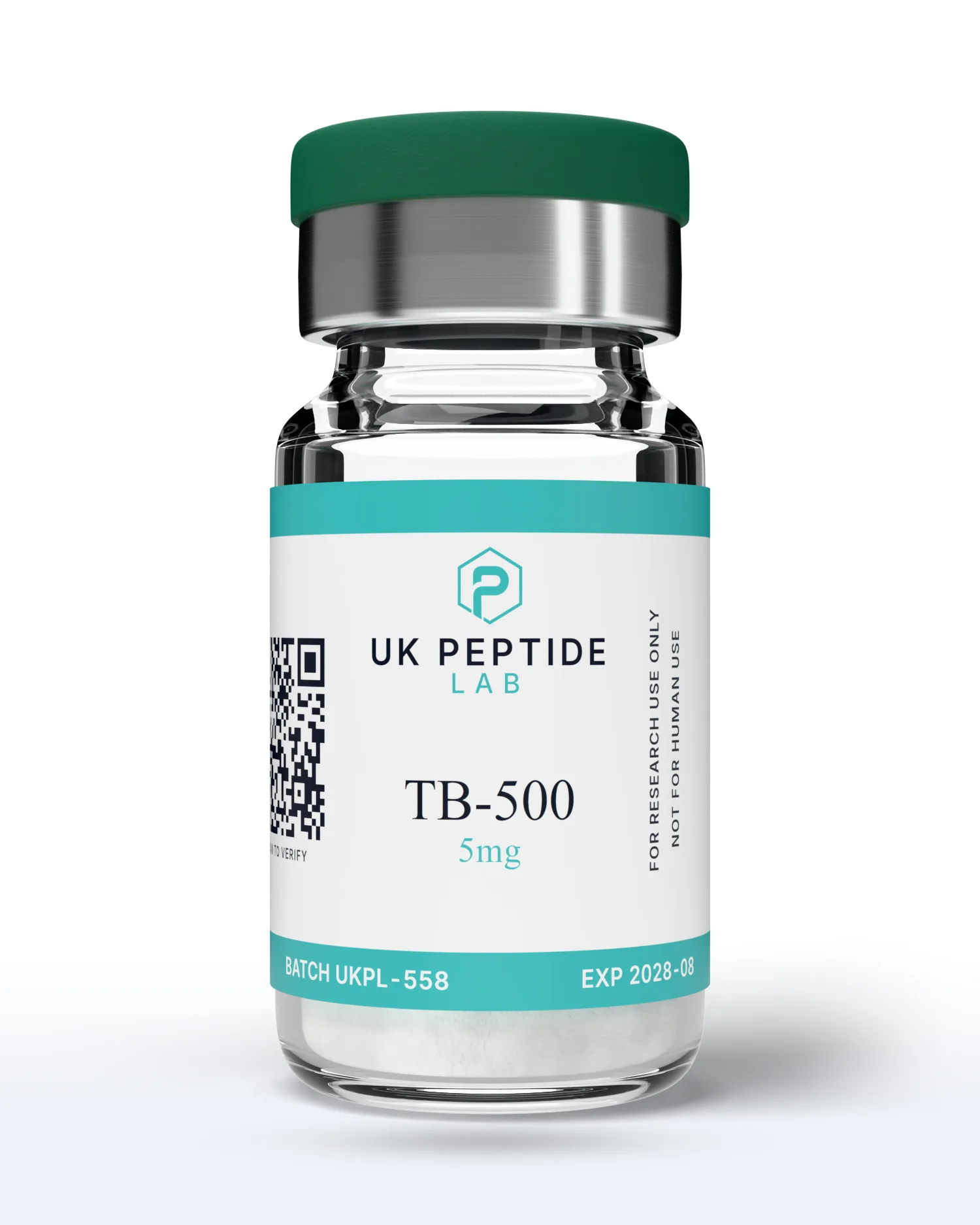
TB-500
5mg
Synthetic fraction of thymosin beta-4 protein. Cell migration research.
99.7% purity · Third-party tested · Batch UKPL-558 · View certificate
- Same-day dispatch before 3pm, Mon to Fri
- Add £45.01 more for free UK delivery
- Cold-chain shipping. Always. Dry-cold pack, Royal Mail Tracked 24
- Lost, damaged or wrong? Replaced free if you tell us within 48 hours.
- Research use only. For in-vitro laboratory research. Not for use in humans or animals, or in food, drugs or diagnostics. Not evaluated by the MHRA or FDA. The buyer is responsible for handling and regulatory compliance.
Bulk Pricing
Counted across your basket, any mix of products.
| Vials in basket | Discount | Per vial |
|---|---|---|
| 1 | None | £23.99 |
| 3-4 | 5% | £22.79 |
| 5-9 | 8% | £22.07 |
| 10-50 | 12% | £21.11 |
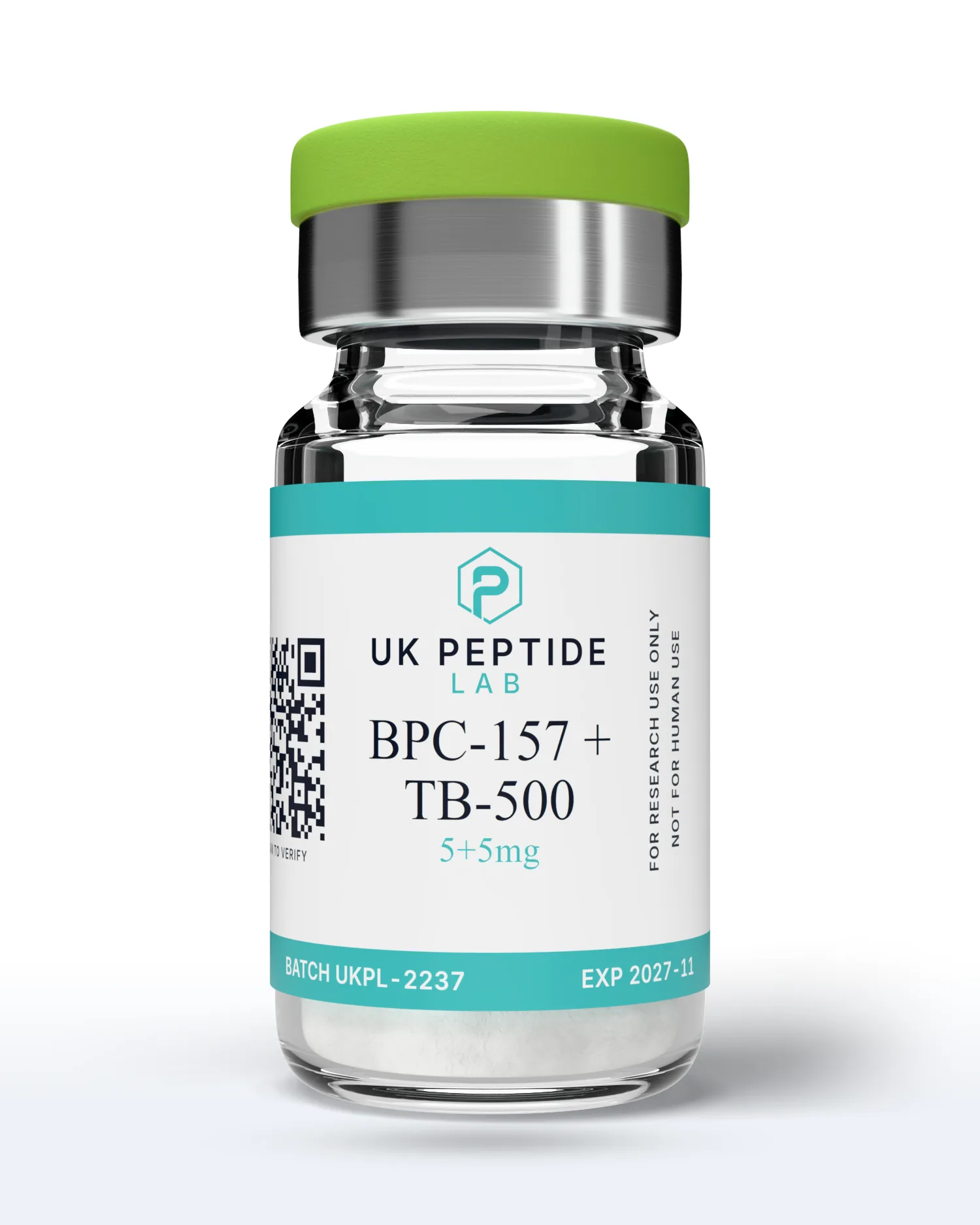
BPC-157 + TB-500 5+5mg
Pre-blended soft-tissue research peptide vial. BPC-157 and TB-500 combined.
All components in one lyophilised vial, with one certificate.
What is TB-500?
TB-500 is the name used in the research market for synthetic thymosin beta 4 (Tβ4). The material here is the full 43-amino-acid sequence, acetylated at the N-terminus. Thymosin beta 4 is the main actin-binding protein in most animal cells, so published work on it looks at how cells move and how new blood vessels form. Each TB-500 5mg vial holds a white lyophilised powder.
Full description
Thymosin beta 4 is the most abundant member of the beta-thymosin family in mammalian tissue. It is found in almost all cells and body fluids. Its best-known job is to bind single actin molecules (G-actin) and hold them in reserve. That controls how quickly the cell can rebuild its internal skeleton when it changes shape or moves. The actin-binding site is a short stretch at residues 17 to 23, with the sequence LKKTETQ.
The name TB-500 has been used for two different materials. Ho and colleagues (J Chromatogr A, 2012) describe a veterinary product sold as TB-500 whose main ingredient is the acetylated seven-residue LKKTETQ fragment. Our certificate lists CAS 77591-33-4 and a molecular weight of 4963.4 g/mol, which are the values for the full acetylated protein. You will also see it written as TB500 or Tβ4.
TB-500 Research Applications
- Actin buffering: Tβ4 binds monomeric G-actin and sets the size of the pool available for filament assembly, which links it to cell shape and motility.
- Cell migration and new vessel growth: Philp and colleagues (FASEB J, 2003) found the LKKTETQ site alone matched the full protein in endothelial migration and chick aortic arch sprouting.
- Signalling beyond actin: Bock-Marquette and colleagues (Nature, 2004) reported activation of integrin-linked kinase and Akt, with more cardiomyocyte and endothelial cell migration and survival in mouse heart studies.
- Human data: thymosin beta 4 has been tested as RGN-259 eye drops. The Phase 2 and Phase 3 trials were randomised, placebo-controlled and double-masked (Sosne et al., Cornea 2015 and Int J Mol Sci 2023). These results cover the eye formulation only. Other routes and endpoints are still preclinical.
Study details
Published models include cardiac repair after ischaemic injury, dermal wound closure and corneal epithelial repair. Typical lab endpoints are endothelial and keratinocyte migration, collagen deposition, integrin-linked kinase and Akt activation, and changes in inflammatory cytokines.
TB-500 vs BPC-157
The two are unrelated molecules. TB-500 is a 43-residue, 4963.4 g/mol protein that acts mainly through G-actin binding and cell movement. BPC-157 is a 15-residue, 1419.53 g/mol peptide taken from a protein first characterised in human gastric juice. Its literature centres on VEGFR2 signalling in endothelial cells (Hsieh et al., J Mol Med, 2017) and on the nitric oxide pathway. Because the mechanisms differ, preclinical tissue-repair studies often pair them. TB-500 tends to be chosen when actin dynamics, cardiac or corneal models are the endpoint. BPC-157 is more common in gastric mucosa work and in local tendon or ligament models.
Research Overview
Tβ4 is a 43-residue polypeptide, molecular formula C₂₁₂H₃₅₀N₅₆O₇₈S, acetylated at its N-terminal serine. It is the principal G-actin sequestering molecule in eukaryotic cells. By holding actin monomers in a form that cannot polymerise, it controls the supply the cell draws on when it moves.
Most mechanistic work traces back to the LKKTETQ motif at positions 17 to 23. Philp and colleagues (FASEB J, 2003) found this seven-residue site alone matched the full protein in human endothelial cell migration and chick aortic arch sprouting. Sosne and colleagues (FASEB J, 2010) later mapped further activities onto other short internal sequences of the parent protein.
A second line of work showed that Tβ4 does more than buffer actin. Bock-Marquette and colleagues (Nature, 2004) reported that it activates integrin-linked kinase and Akt. This promoted cardiomyocyte and endothelial cell migration and survival in mouse heart studies, including after coronary artery ligation.
Thymosin beta 4 is one of the few compounds in this class with controlled human data. As RGN-259 eye drops it went through a Phase 2 trial in severe dry eye (Sosne et al., Cornea, 2015). A Phase 3 trial in neurotrophic keratopathy followed (Sosne et al., Int J Mol Sci, 2023). Both trials were randomised, placebo-controlled and double-masked. They tell us about a topical eye formulation and nothing about other routes.
The naming problem matters when comparing sources. Doping-control work by Ho and colleagues (J Chromatogr A, 2012) describes a product sold as TB-500 whose main ingredient is the acetylated LKKTETQ fragment. The CAS number and molecular weight on a certificate show which material a supplier is describing.
Product Specifications
- Molecular Formula
- C₂₁₂H₃₅₀N₅₆O₇₈S
- Molecular Weight
- 4963.4 g/mol
- CAS Number
- 77591-33-4
- Sequence
- Ac-SDKPDMAEIEKFDKSKLKKTETQEKNPLPSKETIEQEKQAGES (43 residues, actin-binding motif LKKTETQ at positions 17-23)
- Purity
- 99.7% (RP-HPLC)
- Batch
- UKPL-558
- Storage
- -20°C lyophilised, 2-8°C reconstituted
- Appearance
- White lyophilised powder
- Form
- Lyophilised powder
Certificate of Analysis
Third-party tested
- Batch
- UKPL-558
- Purity
- 99.7%
- Specification
- ≥98.0%
- Method
- RP-HPLC
- Lab
- Marfleet Analytical Services
- Tested
- Aug 2026
Need the certificate for an earlier batch? Request an older CoA
Storage and Reconstitution
Keep sealed vials at -20°C, away from light and moisture. Stored this way, the lyophilised powder is stable for up to 24 months. After reconstitution with bacteriostatic water, keep the solution at 2-8°C and use it within 4 weeks. For longer storage, split it into single-use aliquots and freeze them at -20°C. Avoid repeated freeze-thaw cycles, which reduce recovery of intact peptide.
Vials are sold on their own, without bacteriostatic water for mixing or other supplies.
How to reconstitute and handle
Let the vial reach room temperature. Wipe the rubber stoppers of the peptide vial and the bacteriostatic water vial with an alcohol swab. Draw the water into a sterile syringe and add it slowly down the inside wall of the vial, not straight onto the powder. Swirl gently until the powder has dissolved. Do not shake or vortex: the 43-residue chain is sensitive to shear, and agitation lowers the amount of intact peptide. The solution should be clear and colourless. Label the vial with the date.
- Work aseptically. Wipe the vial stopper with 70% isopropyl alcohol before every needle insertion.
For the full method, see the peptide reconstitution guide and the reconstitution calculator.
Research References
- Thymosin beta4 activates integrin-linked kinase and promotes cardiac cell migration, survival and cardiac repair (Bock-Marquette et al., Nature, 2004)
- The actin binding site on thymosin beta4 promotes angiogenesis (Philp et al., FASEB J, 2003)
- Doping control analysis of TB-500, a synthetic version of an active region of thymosin beta 4 (Ho et al., J Chromatogr A, 2012)
Published research on TB-500 is indexed on PubMed. See our full UK buyer's guide for Research Peptides, UK buyer's guide for TB-500 and UK buyer's guide for Wolverine Stack.
TB-500 Price (UK)
TB-500 is for sale in 2 vial sizes, priced from £23.99 for 5mg to £39.99 for 10mg. Every size ships from our UK facility, each with its own batch certificate. UK delivery is £4.50 by Royal Mail Tracked 24, free over £69.
| Vial | Price | Cost per mg | Availability |
|---|---|---|---|
| TB-500 5mgThis page | £23.99 | £4.80 | In stock |
| TB-500 10mg | £39.99 | £4.00Best value | Very low stock |
Prices are in GBP per vial and match the basket. See the FAQ for delivery and payment options, and quality & testing for how each batch is checked.
Frequently Asked Questions
Where can I buy TB-500 in the UK?
You can buy TB-500 5mg online from our UK stock, as a white lyophilised powder with a published certificate of analysis for its batch. Other vial sizes and a pre-blended BPC-157 + TB-500 vial are also available.
Is your TB-500 5mg independently tested?
Yes. Each batch is analysed by an independent laboratory, and batch UKPL-558 measured 99.7% purity. You can open the full certificate from the product page before you order.
Do you dispatch TB-500 the same day in the UK?
Yes. TB-500 orders placed before 3pm UK time on a working day are dispatched the same day from our UK facility with Royal Mail Tracked delivery. Shipping is free on UK orders over £69.
What is in a TB-500 vial?
A TB-500 5mg vial contains TB-500 as a white lyophilised powder, freeze-dried for stability. No diluent, syringes or other research supplies are included. Bacteriostatic water is sold separately.
Do you sell a BPC-157 and TB-500 blend?
Yes. A pre-mixed BPC-157 + TB-500 vial is available alongside the single vials, for studies that use both compounds in one preparation. The blend has its own batch number and its own published certificate. Separate vials are the better choice when the two mechanisms need to be tested apart.
Is TB-500 the same as thymosin beta 4?
Not always. TB-500 is a trade name, and Ho and colleagues (J Chromatogr A, 2012) describe a veterinary product sold under it whose main ingredient is the seven-residue LKKTETQ fragment. Our TB-500 is listed on its certificate with CAS 77591-33-4 and a molecular weight of 4963.4 g/mol, the values for full-length thymosin beta 4.
How does TB-500 work?
Thymosin beta 4 binds monomeric G-actin and so controls how much actin is free to form filaments, which governs cell shape and movement. The LKKTETQ site alone is enough to promote endothelial cell migration in vitro (Philp et al., FASEB J, 2003). Bock-Marquette and colleagues (Nature, 2004) also reported integrin-linked kinase and Akt activation in mouse cardiac models.
What is TB-500 peptide used for in research?
TB-500 peptide is used in cell and animal-model research on actin dynamics, endothelial and keratinocyte migration, angiogenesis, and cardiac and corneal repair models. Its controlled human data are limited to a topical eye formulation.
Has thymosin beta 4 been tested in humans?
Yes, but only as a topical eye drop. As RGN-259 ophthalmic solution it went through a Phase 2 trial in severe dry eye (Sosne et al., Cornea, 2015). A Phase 3 trial in neurotrophic keratopathy followed (Sosne et al., Int J Mol Sci, 2023). Other routes and endpoints remain preclinical.
Is TB-500 banned in sport?
Yes. Thymosin beta 4 and its derivatives, TB-500 included, are named on the WADA Prohibited List among growth factors and growth factor modulators. They are prohibited at all times, in and out of competition, and are classed as non-specified substances.
Is TB-500 legal to buy in the UK?
TB-500 may be purchased in the UK as a research chemical for in vitro laboratory use only. It is not an approved or licensed medicine in the UK and is not supplied for human consumption, veterinary use, or any therapeutic purpose. Purchasers must be 18 or over and confirm research-only use at checkout.
Related Products