Peptides
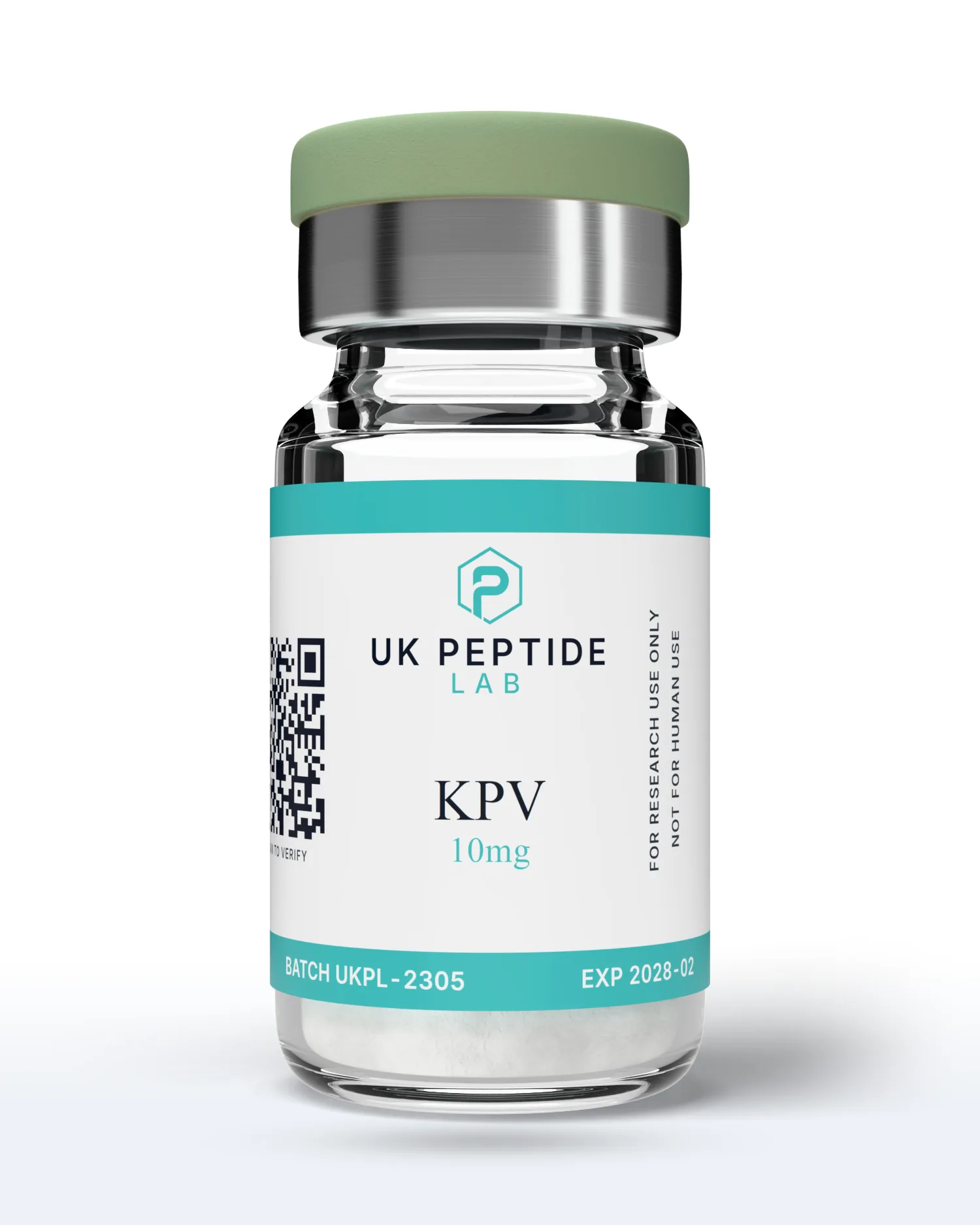
KPV
10mg
α-MSH C-terminal tripeptide. Mucosal anti-inflammatory and barrier-integrity research.
98.826% purity · Third-party tested · Batch UKPL-2305 · View certificate
- Same-day dispatch before 3pm, Mon to Fri
- Add £40.01 more for free UK delivery
- Cold-chain shipping. Always. Dry-cold pack, Royal Mail Tracked 24
- Lost, damaged or wrong? Replaced free if you tell us within 48 hours.
- Research use only. For in-vitro laboratory research. Not for use in humans or animals, or in food, drugs or diagnostics. Not evaluated by the MHRA or FDA. The buyer is responsible for handling and regulatory compliance.
Bulk Pricing
Counted across your basket, any mix of products.
| Vials in basket | Discount | Per vial |
|---|---|---|
| 1 | None | £28.99 |
| 3-4 | 5% | £27.54 |
| 5-9 | 8% | £26.67 |
| 10-50 | 12% | £25.51 |
Bacteriostatic Water 10ml
Required to reconstitute lyophilised peptides.
What is KPV?
KPV is the tripeptide Lys-Pro-Val, residues 11 to 13 of alpha-MSH, supplied as a 10mg lyophilised powder. Its route into cells is the PepT1 transporter, not a melanocortin receptor.
Full description
KPV is L-lysyl-L-prolyl-L-valine, a free acid of 342.43 g/mol, also catalogued as alpha-MSH (11-13). It lacks the His-Phe-Arg-Trp core that melanocortin receptors recognise, so it does not act like the intact hormone. Dalmasso et al. (Gastroenterology, 2008) found that nanomolar KPV inhibited NF-κB and MAP kinase signalling and reduced pro-inflammatory cytokine secretion in human intestinal epithelial cells and Jurkat T cells. The effect depended on uptake through PepT1, a di- and tripeptide transporter.
KPV Research Applications
- Signalling assays: NF-κB reporter and MAP kinase work in Caco2-BBE and HT29-Cl.19A epithelial cells and Jurkat T cells (Dalmasso et al., 2008).
- PepT1 transport: KPV competes with radiolabelled PepT1 substrates, and [³H]KPV has been used to measure uptake kinetics.
- Murine colitis: DSS- and TNBS-induced colitis (Dalmasso et al., 2008) and CD45RB(hi) transfer colitis (Kannengiesser et al., 2008).
- MC1R independence: effects in DSS colitis persisted in mice lacking a functional MC1R, so they are at least partly MC1R-independent (Kannengiesser et al., 2008).
Study details
KPV is also a common model cargo in colon-targeted delivery research, including nanoparticles and hydrogels. The evidence base is preclinical throughout, and no human clinical trial of KPV has been published.
KPV vs alpha-MSH and (CKPV)₂
Alpha-MSH is a 13 residue acetylated, amidated hormone that activates MC1R to MC5R through its His-Phe-Arg-Trp core. KPV is its last three residues and lacks that core. Mandrika et al. (Biochem Pharmacol, 2001) found KPV did not compete for MC1 receptor binding in RAW 264.7 macrophages, even at 1 mM, and did not raise cAMP. It still inhibited NF-κB translocation and nitric oxide production, with potency close to alpha-MSH. (CKPV)₂ is a cysteine-linked dimer, a different molecule with its own literature, and its findings do not transfer to KPV.
The C-terminus differs too. Native alpha-MSH ends in valine amide, while research KPV is the free acid, about 1 Da heavier. Check which species a certificate describes.
Research Overview
PepT1 (SLC15A1) is normally a small-intestinal transporter and is induced in the colon during inflammatory bowel disease (Dalmasso et al., Gastroenterology, 2008). The transporter that carries KPV is therefore upregulated in the tissue where the inflammatory models are run. In the Dalmasso uptake experiments, unlabelled KPV competed with a radiolabelled PepT1 substrate, and [³H]KPV gave the uptake kinetics. KPV added to drinking water reduced pro-inflammatory cytokine expression in DSS and TNBS colitis.
Kannengiesser et al. (Inflamm Bowel Dis, 2008) tested KPV in DSS colitis and CD45RB(hi) transfer colitis, tracking body weight, histology and colonic myeloperoxidase activity. Much of the later KPV literature concerns delivery formulation, not new mechanism.
Product Specifications
- Molecular Formula
- C₁₆H₃₀N₄O₄
- Molecular Weight
- 342.43 g/mol
- CAS Number
- 67727-97-3
- Sequence
- L-Lys-L-Pro-L-Val (KPV), free acid
- Parent Peptide
- α-MSH (11-13), C-terminal fragment of Ac-SYSMEHFRWGKPV-NH₂
- Reported Transporter
- PepT1 (SLC15A1), proton-coupled di/tripeptide transporter
- Purity
- 98.826% by HPLC
- Batch
- UKPL-2305
- Storage
- -20°C lyophilised, 2-8°C reconstituted
- Appearance
- White lyophilised powder
- Form
- Lyophilised powder
Certificate of Analysis
Third-party tested
- Batch
- UKPL-2305
- Purity
- 98.826%
- Specification
- ≥98.0%
- Method
- RP-HPLC
- Lab
- Janoshik Analytical
- Tested
- Sep 2026
Need the certificate for an earlier batch? Request an older CoA
Storage and Reconstitution
Store the sealed 10mg vial at -20°C, dry and away from light. Keep reconstituted solution refrigerated at 2-8°C and freeze single-use aliquots for longer holding. Avoid repeated freeze-thaw cycles and repeated stopper punctures.
Vials are sold on their own, without bacteriostatic water for mixing or other supplies.
How to reconstitute and handle
Let the vial reach room temperature. Run bacteriostatic water slowly down the inside wall of the vial and swirl gently. KPV is highly water-soluble and gives a clear, colourless solution. A tripeptide holds no secondary structure, so shear is not the concern. Hydrolysis in standing solution is, so prepare only what the experiment needs and refrigerate promptly. Label the vial with the reconstitution date.
- In serum-containing medium KPV is exposed to aminopeptidases, so the concentration at the end of a long incubation may be lower than the concentration added.
- PepT1 is proton-coupled, so extracellular pH and competing di- and tripeptides in the medium both affect measured uptake.
- Swab both stoppers with alcohol before every needle entry and work aseptically.
For the full method, see the peptide reconstitution guide and the reconstitution calculator.
Research References
- PepT1-mediated tripeptide KPV uptake reduces intestinal inflammation (Dalmasso et al., Gastroenterology, 2008)
- Melanocortin-derived tripeptide KPV has anti-inflammatory potential in murine models of inflammatory bowel disease (Kannengiesser et al., Inflamm Bowel Dis, 2008)
- Effects of melanocortin peptides on NF-kappaB DNA binding and nitric oxide production in RAW 264.7 cells, evidence for dual mechanisms of action (Mandrika et al., Biochem Pharmacol, 2001)
Published research on KPV is indexed on PubMed. See our full UK buyer's guide for KPV.
KPV Price (UK)
KPV 10mg is for sale at £28.99 per vial, supplied from stock in the UK with a published third-party HPLC certificate. UK delivery is £4.50 by Royal Mail Tracked 24, free over £69.
| Vial | Price | Cost per mg | Availability |
|---|---|---|---|
| KPV 10mgThis page | £28.99 | £2.90 | In stock |
Prices are in GBP per vial and match the basket. See the FAQ for delivery and payment options, and quality & testing for how each batch is checked.
Frequently Asked Questions
Is k.p.v the same as KPV or α-MSH (11-13)?
Yes. k.p.v, k p v, KPV, KPV peptide, Lys-Pro-Val and α-MSH (11-13) all name the same tripeptide. The punctuated spellings are search variants of the three-letter amino acid code. When sourcing, quote the full identity: L-Lys-L-Pro-L-Val, free acid, 342.43 g/mol.
How does the KPV peptide work at a molecular level?
KPV enters cells through PepT1, the proton-coupled di- and tripeptide transporter, and acts inside them. Dalmasso et al. (Gastroenterology, 2008) found nanomolar KPV inhibited NF-κB and MAP kinase signalling and cut pro-inflammatory cytokine secretion in intestinal epithelial cells and T cells. Uptake competition experiments tied the effect to PepT1.
Does KPV activate melanocortin receptors?
Not through the usual route. Melanocortin receptors recognise the His-Phe-Arg-Trp core of alpha-MSH, and KPV lacks it. Mandrika et al. (Biochem Pharmacol, 2001) found KPV did not compete at MC1 receptor sites or raise cAMP in RAW 264.7 cells. It still inhibited NF-κB translocation, which points to a receptor-independent mechanism.
Is (CKPV)₂ the same compound as KPV?
No. (CKPV)₂ is a cysteine-extended dimer of the KPV sequence and a different molecule, with its own mass and its own literature. Findings reported for the dimer do not transfer to the KPV tripeptide. A purity figure for one says nothing about the other.
Has KPV been studied in humans?
No. There are no human clinical trials of KPV. The evidence is in-vitro work in intestinal epithelial and immune cell lines plus mouse colitis models (Dalmasso et al., 2008; Kannengiesser et al., 2008). KPV is not an approved medicine anywhere and is supplied strictly for laboratory research.
Where can I buy KPV in the UK for research?
UK Peptide Lab sells KPV 10mg online for laboratory research, dispatched from the UK as a lyophilised powder. The current batch, UKPL-2305, has its third-party certificate published with the listing. Buyers must be 18 or over and confirm research-only use at checkout.
Where can I buy KPV in the UK?
UK Peptide Lab has KPV 10mg for sale online, batch UKPL-2305, dispatched from the UK. Orders placed before 3pm on a working day are dispatched the same day by Royal Mail Tracked 24, with free UK delivery over £69.
Is your k p v peptide 10mg independently tested?
Yes. Batch UKPL-2305 was tested by Janoshik Analytical at 98.826% purity by RP-HPLC, against a ≥98.0% specification. Content quantification found 11.02mg of peptide against 10mg declared. The report, #229867, can be checked online with the lab.
What is KPV peptide used for in research?
KPV is used in preclinical research on mucosal inflammation and epithelial barrier biology. Typical work covers NF-κB and MAP kinase assays in intestinal epithelial and immune cells, cytokine measurement, PepT1 transport studies and mouse colitis models. It is also a model cargo in colon-targeted delivery research.
Related Products