Peptides
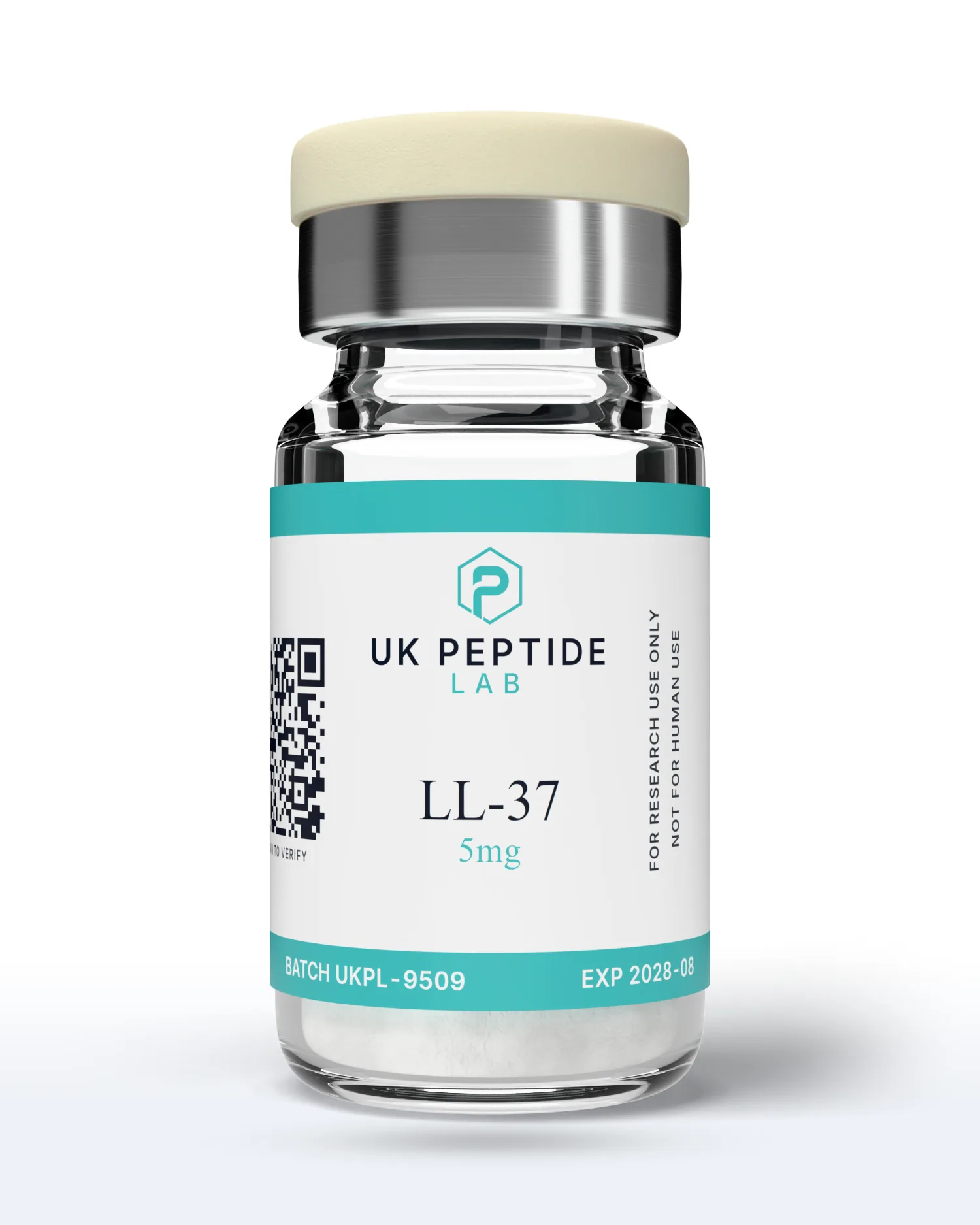
LL-37
5mg
37-residue human cathelicidin peptide. Antimicrobial research.
99.97% purity · Supplier-reported analysis · Batch UKPL-9509 · View certificate
- Same-day dispatch before 3pm, Mon to Fri
- Add £34.01 more for free UK delivery
- Cold-chain shipping. Always. Dry-cold pack, Royal Mail Tracked 24
- Lost, damaged or wrong? Replaced free if you tell us within 48 hours.
- Research use only. For in-vitro laboratory research. Not for use in humans or animals, or in food, drugs or diagnostics. Not evaluated by the MHRA or FDA. The buyer is responsible for handling and regulatory compliance.
Bulk Pricing
Counted across your basket, any mix of products.
| Vials in basket | Discount | Per vial |
|---|---|---|
| 1 | None | £34.99 |
| 3-4 | 5% | £33.24 |
| 5-9 | 8% | £32.19 |
| 10-50 | 12% | £30.79 |
Bacteriostatic Water 10ml
Required to reconstitute lyophilised peptides.
What is LL-37?
LL-37 is a 37-residue cathelicidin-derived antimicrobial peptide (LLGDFFRKSKEKIGKEFKRIVQRIKDFLRNLVPRTES), the only human member of the cathelicidin family. Research has examined its broad-spectrum antimicrobial activity, its role in wound healing and angiogenesis, and its immunomodulatory effects on epithelial tissues.
Full description
LL-37 is the C-terminal peptide of hCAP-18, the human cathelicidin precursor. After neutrophils release hCAP-18, the enzyme proteinase 3 cuts LL-37 free (Sorensen et al., Blood, 2001). It was first predicted as FALL-39 from a human bone-marrow cDNA library (Agerberth et al., Proc Natl Acad Sci USA, 1995). Gudmundsson and colleagues (Eur J Biochem, 1996) then isolated the mature peptide from human granulocytes. The name records its two N-terminal leucines and its 37 residues, and its international nonproprietary name is ropocamptide.
Eleven basic and five acidic residues give a net charge of +6 at neutral pH. The sequence has no cysteine, methionine or tryptophan, so there are no disulfides and no oxidation-prone residues. In lipid micelles it forms a curved amphipathic helix-bend-helix across residues 2 to 31, with a disordered C-terminal tail (Wang, J Biol Chem, 2008). Each LL-37 5mg vial holds white lyophilised powder.
LL-37 Research Applications
- Antimicrobial: Turner and colleagues (Antimicrob Agents Chemother, 1998) reported MICs below 10 µg/ml, even in 100 mM NaCl. Targets included Pseudomonas aeruginosa (mucoid and resistant strains too), Escherichia coli, Staphylococcus aureus and vancomycin-resistant enterococci.
- Salt sensitivity: in the same study MRSA, Proteus mirabilis and Candida albicans resisted LL-37 in 100 mM NaCl but were susceptible in low-salt media.
- Angiogenesis: Koczulla and colleagues (J Clin Invest, 2003) reported endothelial proliferation and vessel-like structures, acting through formyl peptide receptor-like 1 (FPRL1).
- Wound models: Carretero and colleagues (J Invest Dermatol, 2008) reported keratinocyte migration in vitro and faster wound closure in ob/ob mice after adenoviral gene transfer.
- Immune signalling: in psoriasis, LL-37 binds self-DNA, and the complexes activate plasmacytoid dendritic cells through Toll-like receptor 9 (Lande et al., Nature, 2007).
Study details
Work has since extended to biofilm and antiviral assays, and to wound closure in airway epithelial cells (Shaykhiev et al., Am J Physiol Lung Cell Mol Physiol, 2005). Most findings are in vitro or preclinical. Human data are limited. In the first-in-man trial of topical LL-37 in 34 people with hard-to-heal venous leg ulcers, the highest concentration showed no difference from placebo (Grönberg et al., Wound Repair Regen, 2014).
LL-37 vs KR-12
KR-12 is the smallest fragment of LL-37 that keeps antimicrobial activity. It spans residues 18 to 29, Lys-Arg-Ile-Val-Gln-Arg-Ile-Lys-Asp-Phe-Leu-Arg (KRIVQRIKDFLR). Wang (J Biol Chem, 2008) solved both structures in lipid micelles, and the pair is now used to map which parts of the full sequence matter. The full-length peptide carries the whole set of reported activities: antimicrobial, angiogenic and immunomodulatory. It also aggregates in solution, and serum weakens its antimicrobial activity (Dürr et al., Biochim Biophys Acta, 2006). KR-12 is easier to keep in solution and cleaner for structure-activity work, but its findings do not automatically transfer. LL-37 is the choice when the endogenous human molecule is the point of the study.
Research Overview
Humans carry one cathelicidin gene, CAMP, which encodes hCAP-18. The gene is compact, 1963 base pairs over four exons, and exon 4 encodes the mature peptide (Gudmundsson et al., Eur J Biochem, 1996). The standard review of its structure and functions is Dürr and colleagues (Biochim Biophys Acta, 2006).
The in-vitro literature is large and the human literature is small. In the venous leg ulcer trial, effects at the two lower concentrations were judged to need further study (Grönberg et al., Wound Repair Regen, 2014). LL-37 is not a licensed medicine in the UK.
Product Specifications
- Sequence
- LLGDFFRKSKEKIGKEFKRIVQRIKDFLRNLVPRTES
- Molecular Formula
- C₂₀₅H₃₄₀N₆₀O₅₃
- Molecular Weight
- 4493.3 g/mol
- CAS Number
- 154947-66-7
- Purity
- 99.97%
- Batch
- UKPL-9509
- Storage
- -20°C lyophilised, 2-8°C reconstituted
- Appearance
- White lyophilised powder
- Form
- Lyophilised powder
Certificate of Analysis
Supplier-reported analysis. Independent third-party verification pending.
- Batch
- UKPL-9509
- Purity
- 99.97%
- Specification
- ≥98.0%
- Method
- RP-HPLC
- Tested
- Sep 2026
Need the certificate for an earlier batch? Request an older CoA
Storage and Reconstitution
Move vials to the freezer on arrival and keep them dark and dry. In solution the risks are aggregation and adsorption to plastic, not oxidation. Keep solutions cold, limit dilution steps in plastic tubes, and freeze single-use aliquots for longer storage.
Vials are sold on their own, without bacteriostatic water for mixing or other supplies.
How to reconstitute and handle
Let the vial reach room temperature. Wipe the stoppers of the peptide vial and the bacteriostatic water vial with an alcohol swab. Add cold water slowly down the inside wall of the vial, not onto the powder. Swirl gently until it dissolves, and do not shake or vortex. LL-37 sticks to plastic, so use glass for transfer steps where practical. It also aggregates in solution, so do not leave it standing before use. The solution should be clear and colourless. Label the vial with the date.
- Make working dilutions fresh on the day instead of storing them.
- Work aseptically with sterile equipment, and avoid repeated freeze-thaw of reconstituted stock.
For the full method, see the peptide reconstitution guide and the reconstitution calculator.
Research References
- LL-37, the only human member of the cathelicidin family of antimicrobial peptides (Dürr et al., Biochim Biophys Acta, 2006)
- An angiogenic role for the human peptide antibiotic LL-37/hCAP-18 (Koczulla et al., J Clin Invest, 2003)
Published research on LL-37 is indexed on PubMed.
LL-37 Price (UK)
LL-37 5mg is for sale at £34.99 per vial, supplied from stock in the UK with a published supplier batch certificate. UK delivery is £4.50 by Royal Mail Tracked 24, free over £69.
| Vial | Price | Cost per mg | Availability |
|---|---|---|---|
| LL-37 5mgThis page | £34.99 | £7.00 | In stock |
Prices are in GBP per vial and match the basket. See the FAQ for delivery and payment options, and quality & testing for how each batch is checked.
Frequently Asked Questions
Why is LL-37 described as the only human cathelicidin?
Because humans have a single cathelicidin gene, CAMP. It encodes the precursor hCAP-18, and LL-37 is its only antimicrobial peptide product (Dürr et al., Biochim Biophys Acta, 2006). It was first predicted as FALL-39 (Agerberth et al., 1995), isolated from granulocytes (Gudmundsson et al., 1996) and shown to be released by proteinase 3 (Sorensen et al., 2001).
What does LL-37 do in antimicrobial research?
It shows broad-spectrum activity in vitro against Gram-negative and Gram-positive bacteria. Turner and colleagues (Antimicrob Agents Chemother, 1998) tested Pseudomonas aeruginosa, Escherichia coli, Staphylococcus aureus and vancomycin-resistant enterococci. Later work covers biofilm and antiviral assays. Serum reduces its activity (Dürr et al., 2006).
What is the molecular weight of LL-37?
LL-37 has a molecular weight of 4493.3 g/mol, molecular formula C₂₀₅H₃₄₀N₆₀O₅₃ and CAS number 154947-66-7. The 37-residue chain carries a net charge of +6 at neutral pH. It contains no cysteine, methionine or tryptophan.
Where can I buy LL-37 in the UK?
UK Peptide Lab sells LL-37 5mg vials from UK stock. Orders placed before 3pm on a working day are dispatched the same day by Royal Mail Tracked, and UK delivery is free over £69. It is sold for in-vitro research only, to buyers aged 18 or over.
Is your LL-37 supplier-tested, with independent verification in progress?
Yes. The supplier's analysis of batch UKPL-9509 reports 99.97% purity by RP-HPLC and 5.11mg measured content against the 5mg label. Independent third-party testing is pending. The certificate is published with this listing, and its batch number matches the one printed on the vial.
What is LL-37 used for in research?
Three main areas. Antimicrobial assays against Gram-negative and Gram-positive bacteria (Turner et al., 1998). Wound-healing and angiogenesis models (Koczulla et al., 2003; Carretero et al., 2008). Epithelial and immune signalling, including self-DNA sensing by dendritic cells (Lande et al., Nature, 2007).
Related Products