Peptides
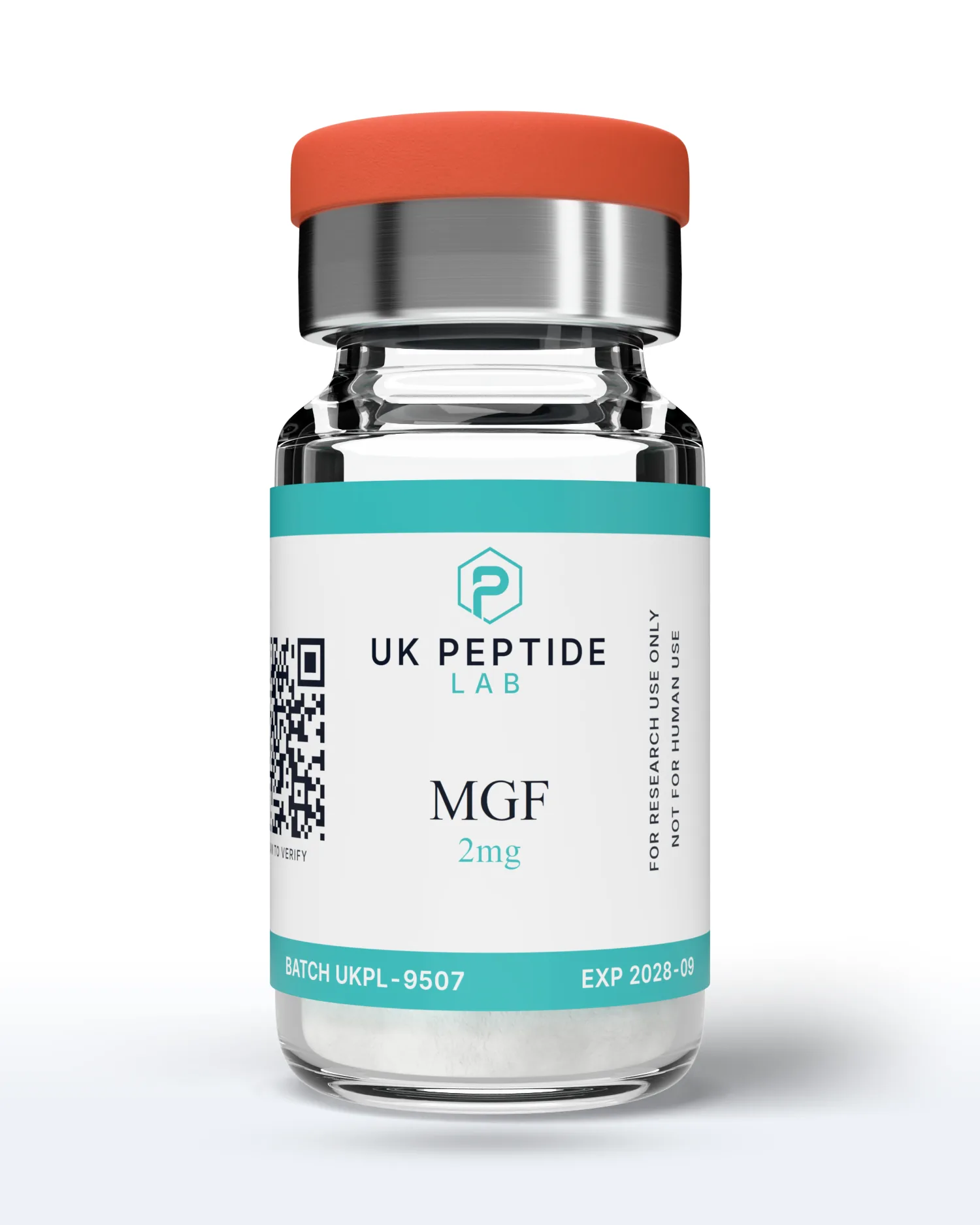
MGF
2mg
24-residue IGF-1Ec splice-variant peptide. Muscle research.
99.36% purity · Supplier-reported analysis · Batch UKPL-9507 · View certificate
- Same-day dispatch before 3pm, Mon to Fri
- Add £51.01 more for free UK delivery
- Cold-chain shipping. Always. Dry-cold pack, Royal Mail Tracked 24
- Lost, damaged or wrong? Replaced free if you tell us within 48 hours.
- Research use only. For in-vitro laboratory research. Not for use in humans or animals, or in food, drugs or diagnostics. Not evaluated by the MHRA or FDA. The buyer is responsible for handling and regulatory compliance.
Bulk Pricing
Counted across your basket, any mix of products.
| Vials in basket | Discount | Per vial |
|---|---|---|
| 1 | None | £17.99 |
| 3-4 | 5% | £17.09 |
| 5-9 | 8% | £16.55 |
| 10-50 | 12% | £15.83 |
Bacteriostatic Water 10ml
Required to reconstitute lyophilised peptides.
What is MGF?
Mechano growth factor (MGF) is the 24-residue E-domain peptide released from IGF-1Ec after exercise-induced splicing in muscle tissue (Tyr-Gln-Pro-Pro-Ser-Thr-Asn-Lys-Asn-Thr-Lys-Ser-Gln-Arg-Arg-Lys-Gly-Ser-Thr-Phe-Glu-Glu-His-Lys). Research has examined its role in satellite cell activation and muscle cell proliferation following mechanical load.
Full description
MGF, short for mechano growth factor, is the 24-residue C-terminal E-domain peptide of the IGF-1Ec splice variant of insulin-like growth factor 1. It is proposed to be cut from the IGF-1 precursor when the mature 70-residue hormone is processed. No natural MGF peptide has yet been isolated from cells, tissues or body fluids (Matheny, Nindl and Adamo, Endocrinology, 2010). Yang and colleagues (J Muscle Res Cell Motil, 1996) cloned the splice variant from stretched rabbit muscle. The MGF name was given first to that mRNA and later to the synthetic peptide.
The peptide is strongly basic, with four lysines and two arginines. It has no methionine, cysteine or tryptophan, so it carries none of the oxidation-prone residues found in many research peptides. Each MGF 2mg vial holds white lyophilised powder.
MGF Research Applications
- Myoblasts: Yang and Goldspink (FEBS Lett, 2002) reported that the E domain increased myoblast proliferation and inhibited terminal differentiation, unlike mature IGF-1.
- Receptor: in the same study an IGF-1 receptor antibody did not block the effect, which points to a different receptor.
- Muscle damage: in damaged rat muscle, MGF mRNA rose quickly and fell within days, alongside satellite cell activation markers. Splicing then moved towards IGF-1Ea (Hill and Goldspink, J Physiol, 2003).
- Mechanical load: Yang and colleagues (1996) detected the splice variant within 2 hours to 6 days of altered activity, with very little in control muscle.
- Ageing: under mechanical overload, aged rat muscle expressed much less MGF than young muscle (Owino, Yang and Goldspink, FEBS Lett, 2001).
Study details
Typical in-vitro endpoints are proliferation and activation assays in myogenic cell lines and primary muscle stem cells. The evidence has limits. The positive data come mostly from one group. Fornaro and colleagues (Am J Physiol Endocrinol Metab, 2014) found that MGF at up to 500 ng/ml did not increase proliferation of C2C12 cells or primary human myoblasts. Every cell type in that study responded to mature IGF-1. No dedicated receptor has been identified, and there are no clinical data.
MGF vs PEG-MGF
Both products contain the same 24-residue E-domain sequence. MGF is the unmodified peptide, the form used by Yang and Goldspink (FEBS Lett, 2002). PEG-MGF carries a polyethylene glycol chain, a modification designed to slow clearance and protease breakdown. That adds a pharmacokinetic variable on top of biology that is already contested (Matheny, Nindl and Adamo, Endocrinology, 2010). MGF is the right choice for replication work, because it matches the published molecule.
Research Overview
The IGF-1 gene is spliced into several isoforms. Hill and Goldspink (J Physiol, 2003) describe MGF as an autocrine splice form acting locally in muscle, with IGF-1Ea as the systemic form. Goldspink (Physiology, 2005) calls MGF a local growth and repair factor in muscle.
The early findings have not been reproduced consistently. In the Fornaro study, MGF also failed to inhibit myoblast differentiation, and neither native nor stabilised MGF activated p-ERK in cardiac myocytes. Matheny, Nindl and Adamo (Endocrinology, 2010) call MGF a putative product of the IGF-1 gene. That open question is why MGF is still studied. It is not a licensed medicine in the UK.
Product Specifications
- Molecular Weight
- 2866.4 g/mol
- Sequence
- YQPPSTNKNTKSQRRKGSTFEEHK
- Residues
- 24
- Purity
- 99.36%
- Batch
- UKPL-9507
- Storage
- -20°C lyophilised, 2-8°C reconstituted
- Appearance
- White lyophilised powder
- Form
- Lyophilised powder
Certificate of Analysis
Supplier-reported analysis. Independent third-party verification pending.
- Batch
- UKPL-9507
- Purity
- 99.36%
- Specification
- ≥98.0%
- Method
- RP-HPLC
- Tested
- Sep 2026
Need the certificate for an earlier batch? Request an older CoA
Storage and Reconstitution
Move vials to the freezer on arrival and keep them dark and dry. With no labile residues in the sequence, sterility sets the in-use limit more than chemistry. Split reconstituted stock into single-use aliquots instead of puncturing one vial again and again.
Vials are sold on their own, without bacteriostatic water for mixing or other supplies.
How to reconstitute and handle
Let the vial reach room temperature. Wipe the stoppers of the peptide vial and the bacteriostatic water vial with an alcohol swab. Add the water slowly down the inside wall of the vial, not onto the powder. Swirl gently until it dissolves, and do not shake or vortex. MGF dissolves readily to a clear, colourless solution. Label the vial with the date.
- Work aseptically with sterile equipment throughout reconstitution and aliquoting, and keep the stopper open for as little time as possible.
For the full method, see the peptide reconstitution guide and the reconstitution calculator.
Research References
- Different roles of the IGF-I Ec peptide (MGF) and mature IGF-I in myoblast proliferation and differentiation (Yang and Goldspink, FEBS Lett, 2002)
- Expression and splicing of the insulin-like growth factor gene in rodent muscle is associated with muscle satellite (stem) cell activation following local tissue damage (Hill and Goldspink, J Physiol, 2003)
- Minireview: Mechano-growth factor: a putative product of IGF-I gene expression involved in tissue repair and regeneration (Matheny et al., Endocrinology, 2010)
Published research on MGF is indexed on PubMed.
MGF Price (UK)
MGF 2mg is for sale at £17.99 per vial, supplied from stock in the UK with a published supplier batch certificate. UK delivery is £4.50 by Royal Mail Tracked 24, free over £69.
| Vial | Price | Cost per mg | Availability |
|---|---|---|---|
| MGF 2mgThis page | £17.99 | £8.99 | In stock |
Prices are in GBP per vial and match the basket. See the FAQ for delivery and payment options, and quality & testing for how each batch is checked.
Frequently Asked Questions
What is MGF (mechano growth factor)?
MGF is the 24-residue E-domain peptide at the C-terminus of the IGF-1Ec splice variant of insulin-like growth factor 1. The Goldspink group cloned the splice variant from stretched rabbit muscle (Yang et al., J Muscle Res Cell Motil, 1996). The mechano growth factor name was later applied to the mRNA and to the synthetic peptide (Matheny et al., Endocrinology, 2010).
How is MGF produced from the IGF-1 gene?
By alternative splicing. The IGF-1 gene is transcribed as a precursor that is spliced into several isoforms. After mechanical load, muscle expresses an exercise-sensitive form, IGF-1Ec in humans, whose distinguishing product is the E-domain peptide. MGF is proposed to act locally in muscle, while IGF-1Ea acts systemically (Hill and Goldspink, J Physiol, 2003).
What has MGF research examined in muscle tissue?
Satellite cell activation and muscle cell proliferation after mechanical load. The E domain increased myoblast proliferation (Yang and Goldspink, FEBS Lett, 2002), and MGF expression tracked satellite cell activation after damage (Hill and Goldspink, J Physiol, 2003). Aged muscle showed a weaker MGF response to overload (Owino et al., FEBS Lett, 2001). A later study found no effect on myoblasts or muscle stem cells (Fornaro et al., 2014).
What is the sequence and molecular weight of MGF?
MGF is the 24-residue peptide YQPPSTNKNTKSQRRKGSTFEEHK, written in full as Tyr-Gln-Pro-Pro-Ser-Thr-Asn-Lys-Asn-Thr-Lys-Ser-Gln-Arg-Arg-Lys-Gly-Ser-Thr-Phe-Glu-Glu-His-Lys. The batch certificate lists a molecular weight of 2866.4 g/mol.
Where can I buy MGF in the UK?
UK Peptide Lab sells MGF 2mg vials from UK stock. Orders placed before 3pm on a working day are dispatched the same day by Royal Mail Tracked, and UK delivery is free over £69. It is sold for in-vitro research only, to buyers aged 18 or over.
Is your MGF supplier-tested, with independent verification in progress?
Yes. The supplier's analysis of batch UKPL-9507 reports 99.36% purity by RP-HPLC and 2.32mg measured content against the 2mg label. Independent third-party testing is pending. The certificate is published with this listing, and its batch number matches the one printed on the vial.
What is MGF used for in research?
Muscle biology. Published models look at satellite cell activation and myoblast proliferation after mechanical load (Yang and Goldspink, 2002; Hill and Goldspink, 2003). Others study exercise-induced IGF-1 splicing and the weaker MGF response of aged muscle to overload (Owino et al., FEBS Lett, 2001).
Related Products