Peptides
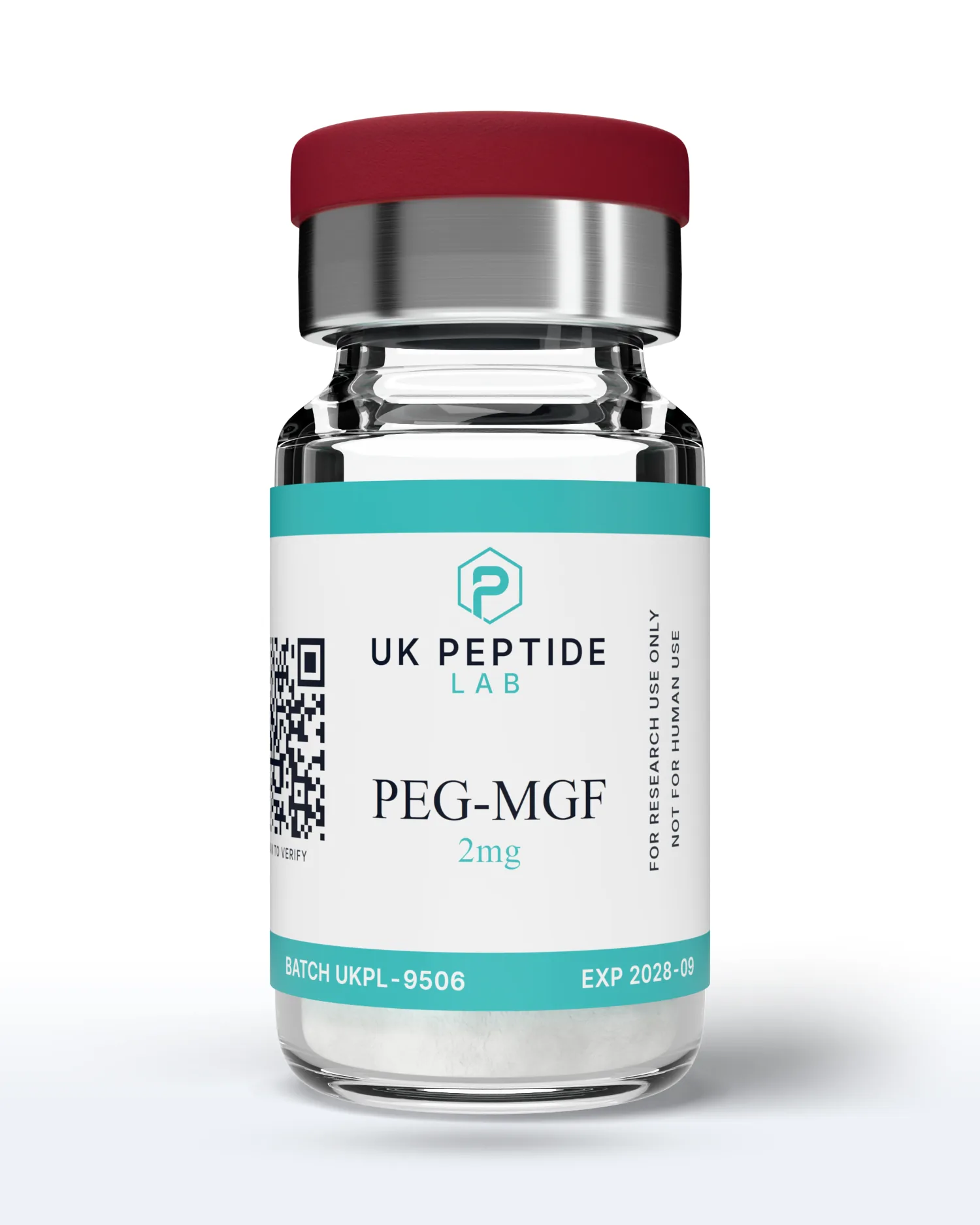
PEG-MGF
2mg
PEGylated mechano growth factor, 2mg vial. Muscle research.
99.77% purity · Supplier-reported analysis · Batch UKPL-9506 · View certificate
- Same-day dispatch before 3pm, Mon to Fri
- Add £44.01 more for free UK delivery
- Cold-chain shipping. Always. Dry-cold pack, Royal Mail Tracked 24
- Lost, damaged or wrong? Replaced free if you tell us within 48 hours.
- Research use only. For in-vitro laboratory research. Not for use in humans or animals, or in food, drugs or diagnostics. Not evaluated by the MHRA or FDA. The buyer is responsible for handling and regulatory compliance.
Bulk Pricing
Counted across your basket, any mix of products.
| Vials in basket | Discount | Per vial |
|---|---|---|
| 1 | None | £24.99 |
| 3-4 | 5% | £23.74 |
| 5-9 | 8% | £22.99 |
| 10-50 | 12% | £21.99 |
Bacteriostatic Water 10ml
Required to reconstitute lyophilised peptides.
What is PEG-MGF?
PEG-MGF is a PEGylated form of mechano growth factor, the IGF-1Ec splice-variant peptide expressed in muscle tissue in response to mechanical load. PEGylation of the 24-residue sequence slows clearance relative to the unmodified peptide, and research has examined both forms in models of muscle cell proliferation and satellite cell activation.
Full description
The peptide is the 24-residue E domain of the IGF-1Ec splice variant: Tyr-Gln-Pro-Pro-Ser-Thr-Asn-Lys-Asn-Thr-Lys-Ser-Gln-Arg-Arg-Lys-Gly-Ser-Thr-Phe-Glu-Glu-His-Lys (YQPPSTNKNTKSQRRKGSTFEEHK). The batch certificate lists the conjugate at roughly 9.8 kDa. As a polymer conjugate it has no CAS number. Yang, Alnaqeeb, Simpson and Goldspink (J Muscle Res Cell Motil, 1996) cloned the splice variant from stretched rabbit muscle.
In the literature, MGF can mean the splice-variant mRNA or the synthetic E-domain peptide (Matheny, Nindl and Adamo, Endocrinology, 2010). PEG-MGF, also written pegylated MGF, is the E-domain peptide with a PEG chain attached. Each vial holds 2mg of white lyophilised powder.
PEG-MGF Research Applications
- Myoblast proliferation: Yang and Goldspink (FEBS Lett, 2002) reported that the E domain increased myoblast proliferation and inhibited terminal differentiation, unlike mature IGF-1.
- Satellite cells: Hill and Goldspink (J Physiol, 2003) found the MGF splice form expressed as an early pulse after local muscle damage, alongside satellite cell activation.
- Human muscle cells: Kandalla and colleagues (Mech Ageing Dev, 2011) reported more proliferation and later senescence in cultures from neonatal and young adult donors, but not from old adults.
- Negative data: Fornaro and colleagues (Am J Physiol Endocrinol Metab, 2014) found no effect at up to 500 ng/ml. They tested C2C12 cells, primary human myoblasts and primary mouse muscle stem cells.
Study details
All of these studies used the unmodified E peptide. No peer-reviewed paper has tested the PEGylated form, so its behaviour in an assay is an extrapolation. Other published models use progenitor cells from normal, dystrophic and ALS muscle (Ates et al., FEBS Lett, 2007). Mills and colleagues (Am J Transplant, 2007) studied engraftment of human myogenic precursor cells in mice. There are no clinical trials.
PEG-MGF vs MGF
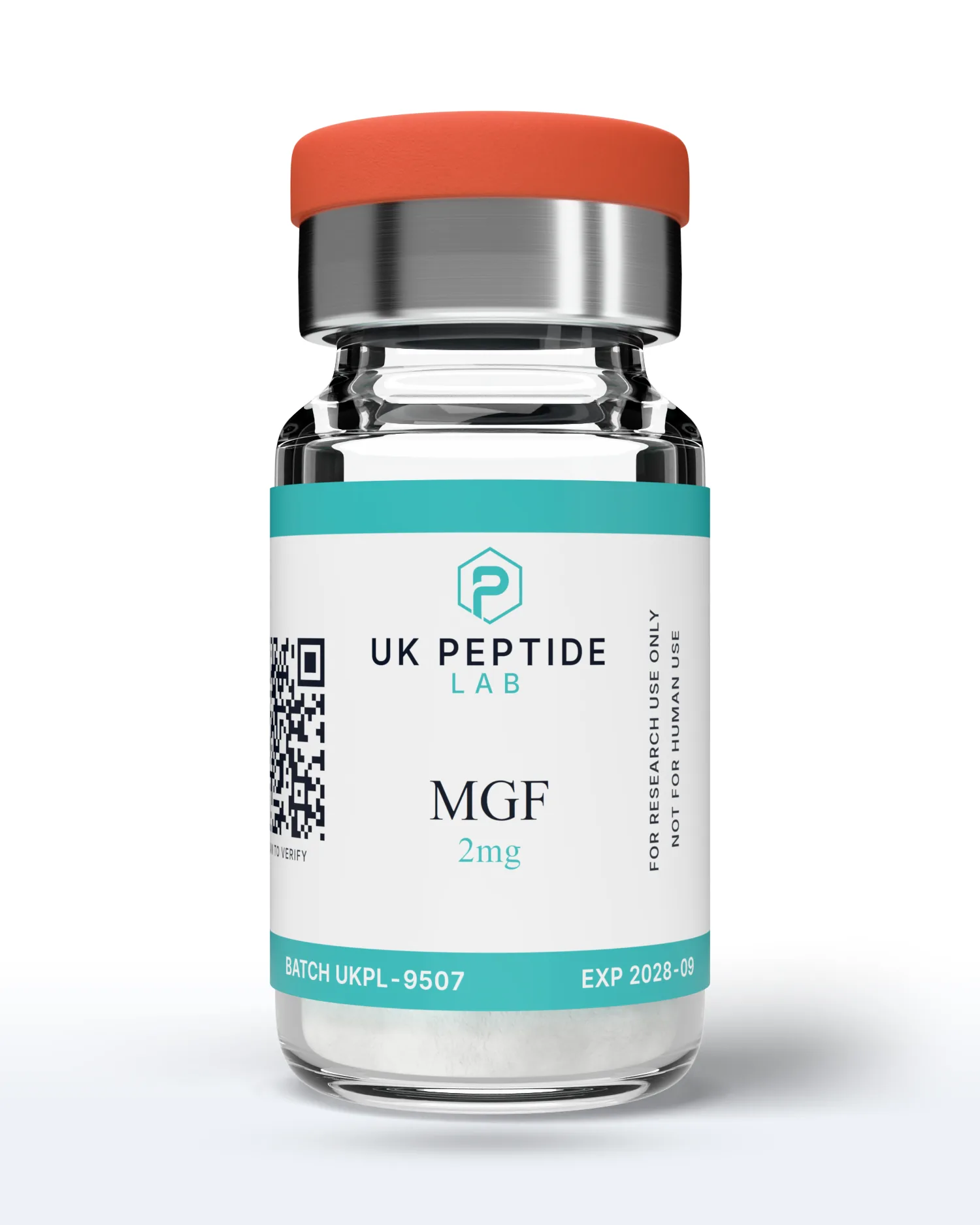
Both contain the same 24-residue E-domain peptide. MGF is the unmodified peptide, the molecule used in every published study cited here. PEG-MGF adds polyethylene glycol, which raises the mass to roughly 9.8 kDa. The polymer also changes how the conjugate behaves in the lab. It runs at a higher apparent mass on size-exclusion columns and can interfere with antibody-based detection. MGF is the choice for replicating published work. With PEG-MGF, count the PEG chain as an extra variable to control.
Research Overview
The splice biology defines the molecule. The IGF-1Ec transcript carries a 49-base insert in humans and 52 bases in rodents, which shifts the reading frame (Kandalla et al., Mech Ageing Dev, 2011). After muscle damage, MGF is expressed first and splicing later moves towards IGF-1Ea (Hill and Goldspink, J Physiol, 2003).
The evidence is contested. The positive in-vitro findings come mostly from one group. A study run at two pharmaceutical companies found no effect of MGF on proliferation or differentiation in three muscle cell systems (Fornaro et al., 2014). Its authors questioned whether MGF has a physiological role at all. The field's own review calls MGF a putative repair factor (Matheny, Nindl and Adamo, Endocrinology, 2010). PEG-MGF is not a licensed medicine in the UK.
Product Specifications
- Sequence
- YQPPSTNKNTKSQRRKGSTFEEHK (24-residue IGF-1Ec E domain)
- Molecular Weight
- ~9.8 kDa PEGylated (unmodified peptide ~2866 g/mol)
- Purity
- 99.77% (HPLC, supplier-tested; independent verification pending)
- Batch
- UKPL-9506
- Content
- 2mg per vial
- Storage
- -20°C lyophilised, 2-8°C reconstituted
- Appearance
- White lyophilised powder
- Form
- Lyophilised powder
Certificate of Analysis
Supplier-reported analysis. Independent third-party verification pending.
- Batch
- UKPL-9506
- Purity
- 99.77%
- Specification
- ≥98.0%
- Method
- RP-HPLC
- Tested
- Sep 2026
Need the certificate for an earlier batch? Request an older CoA
Storage and Reconstitution
Move vials to the freezer on arrival and keep them dark and dry. Freeze reconstituted stock in single-use aliquots and thaw each one once. PEG conjugates still aggregate under repeated freeze-thaw. Keep the solution away from oxidising agents and organic solvents.
Vials are sold on their own, without bacteriostatic water for mixing or other supplies.
How to reconstitute and handle
Let the vial and the bacteriostatic water reach room temperature. Wipe both stoppers with an alcohol swab. Add the water slowly down the inside wall of the vial, not onto the powder. Swirl gently until it dissolves, and do not shake or vortex. The solution should be clear and colourless. The peptide has no methionine, cysteine or tryptophan, so there is no disulfide or oxidation chemistry to manage. Label the vial with the date.
- The PEG chain is hydrophilic but polymer-sized, so expect the conjugate to behave differently from a small peptide on membrane filters and chromatography columns.
- Work aseptically with sterile syringes, and label each aliquot with the reconstitution date.
For the full method, see the peptide reconstitution guide and the reconstitution calculator.
Research References
- Different roles of the IGF-I Ec peptide (MGF) and mature IGF-I in myoblast proliferation and differentiation (Yang and Goldspink, FEBS Lett, 2002)
- Expression and splicing of the insulin-like growth factor gene in rodent muscle is associated with muscle satellite (stem) cell activation following local tissue damage (Hill and Goldspink, J Physiol, 2003)
- Mechano Growth Factor E peptide (MGF-E), derived from an isoform of IGF-1, activates human muscle progenitor cells and induces an increase in their fusion potential at different ages (Kandalla et al., Mech Ageing Dev, 2011)
- Mechano-growth factor peptide, the COOH terminus of unprocessed insulin-like growth factor 1, has no apparent effect on myoblasts or primary muscle stem cells (Fornaro et al., Am J Physiol Endocrinol Metab, 2014)
Published research on PEG-MGF is indexed on PubMed.
PEG-MGF Price (UK)
PEG-MGF 2mg is for sale at £24.99 per vial, supplied from stock in the UK with a published supplier batch certificate. UK delivery is £4.50 by Royal Mail Tracked 24, free over £69.
| Vial | Price | Cost per mg | Availability |
|---|---|---|---|
| PEG-MGF 2mgThis page | £24.99 | £12.49 | In stock |
Prices are in GBP per vial and match the basket. See the FAQ for delivery and payment options, and quality & testing for how each batch is checked.
Frequently Asked Questions
What is the difference between MGF and PEG-MGF?
The peptide sequence is the same; only the polyethylene glycol differs. MGF is the unmodified 24-residue E-domain peptide and is the form used in published studies. PEG-MGF carries a PEG chain, and its certificate lists roughly 9.8 kDa. No peer-reviewed paper has studied the PEGylated form directly.
Why is PEGylation used?
To keep a peptide intact for longer. Harris and Chess (Nat Rev Drug Discov, 2003) review PEGylation as a way around rapid renal clearance and protease breakdown. The PEG chain raises molecular mass and shields the peptide from proteolytic enzymes. No published study has measured this for PEG-MGF itself.
What is the molecular weight and sequence of PEG-MGF?
The batch certificate lists the PEGylated conjugate at roughly 9.8 kDa. The peptide inside is the 24-residue sequence YQPPSTNKNTKSQRRKGSTFEEHK. PEG-MGF is a polymer conjugate, not a single defined molecule, so it has no CAS registry number.
Where can I buy PEG-MGF in the UK?
UK Peptide Lab sells PEG-MGF 2mg vials from UK stock. Orders placed before 3pm on a working day are dispatched the same day by Royal Mail Tracked, and UK delivery is free over £69. It is sold for in-vitro research only, to buyers aged 18 or over.
Is your PEG-MGF supplier-tested, with independent verification in progress?
Yes. The supplier's analysis of batch UKPL-9506 reports 99.77% purity by RP-HPLC and 2.02mg measured content against the 2mg label. Independent third-party testing is pending. The certificate is published with this listing, and its batch number matches the one printed on the vial.
What is PEG-MGF used for in research?
It is bought for muscle-cell research on the IGF-1Ec splice variant: myoblast proliferation, satellite cell activation and myogenic precursor engraftment. The published studies behind those models used unmodified MGF (Yang and Goldspink, 2002; Hill and Goldspink, 2003; Mills et al., 2007). The PEGylated form has no dedicated peer-reviewed literature.
What does the PEGylation do?
It attaches a polyethylene glycol chain to the 24-residue peptide, which the certificate lists by sequence. PEGylation raises molecular mass, and in drug development it is used to reduce renal clearance and protease breakdown (Harris and Chess, Nat Rev Drug Discov, 2003). In the lab it also shifts apparent mass on columns and gels.
Related Products