Growth Hormone Secretagogues
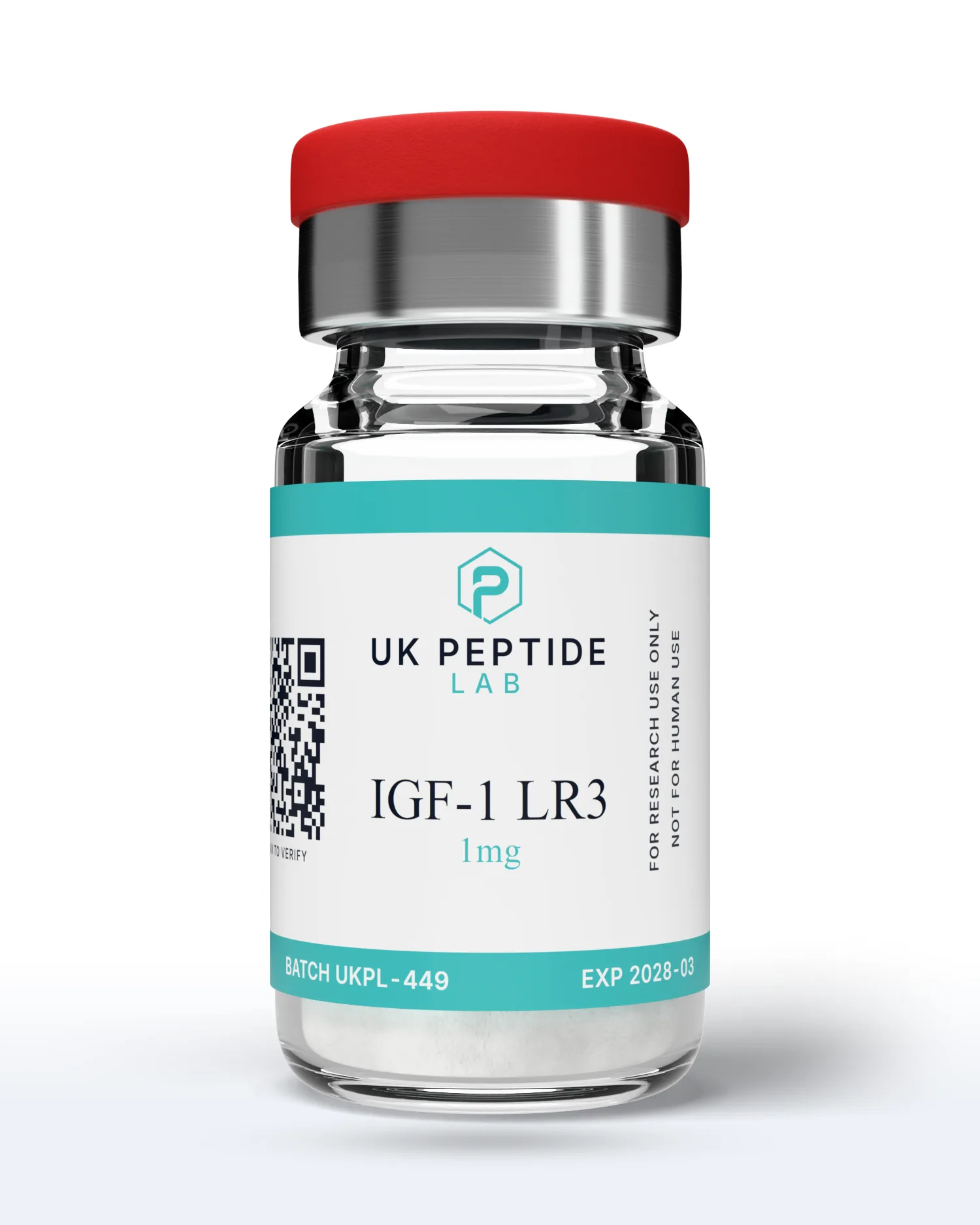
IGF-1 LR3
1mg
83 amino acid IGF-1 analogue with extended half-life. IGF-1 receptor research.
98.134% purity · Third-party tested · Batch UKPL-449 · View certificate
- Same-day dispatch before 3pm, Mon to Fri
- Add £19.01 more for free UK delivery
- Cold-chain shipping. Always. Dry-cold pack, Royal Mail Tracked 24
- Lost, damaged or wrong? Replaced free if you tell us within 48 hours.
- Research use only. For in-vitro laboratory research. Not for use in humans or animals, or in food, drugs or diagnostics. Not evaluated by the MHRA or FDA. The buyer is responsible for handling and regulatory compliance.
Bulk Pricing
Counted across your basket, any mix of products.
| Vials in basket | Discount | Per vial |
|---|---|---|
| 1 | None | £49.99 |
| 3-4 | 5% | £47.49 |
| 5-9 | 8% | £45.99 |
| 10-50 | 12% | £43.99 |
Bacteriostatic Water 10ml
Required to reconstitute lyophilised peptides.
What is IGF-1 LR3?
IGF-1 LR3 (Long R3 IGF-1) is an 83 amino acid analogue of human insulin-like growth factor 1, supplied as a 1mg lyophilised powder. An Arg3 substitution and a 13 residue N-terminal extension cut its binding to IGF binding proteins about 1000-fold. That makes it a standard reagent for IGF-1 receptor research and serum-free cell culture.
Full description
The literature writes it as Long-[Arg3]-IGF-I or LR3IGF-I. It is native 70 residue IGF-I with two changes: arginine replaces glutamate at position 3, and a 13 residue extension, MFPAMPLLSLFVN, sits on the N-terminus. The extension is the first 11 residues of methionyl porcine growth hormone plus Val-Asn. It is left over from the fusion used to express the protein in Escherichia coli (Francis et al., J Mol Endocrinol, 1992). Both changes sit in the region that IGF binding proteins contact.
IGF-1 LR3 Research Applications
- Serum-free culture: LongR3 sustained the viability of two recombinant CHO cell lines better than insulin under production conditions (Morris and Schmid, 2000).
- Receptor signalling: a reagent for type 1 IGF receptor activation and downstream PI3K and MAPK signalling.
- Binding protein biology: separating IGFBP sequestration from receptor pharmacology, the comparison the analogue was built to make.
Study details
Published in-vivo work is confined to animal models. There are no human clinical trials of IGF-1 LR3.
IGF-1 LR3 vs Native IGF-1 and the IGF Binding Protein Problem
Native IGF-I does not circulate free. Most of it is held by IGF binding proteins, mainly IGFBP-3, which limit its access to the receptor. In any system containing serum or secreted IGFBPs, the concentration you add is not the concentration the receptor sees. Ballard et al. (Growth Regulation, 1993) found IGF-I binds IGFBP-3 with about 1000-fold higher affinity than LR3IGF-I. In L6 myoblasts, that gave LR3IGF-I 5 to 10-fold greater potency.
The gain depends on the binding proteins. In chicken embryo fibroblasts, which secrete no detectable IGFBPs, Long [Arg3]-IGF-I was less potent than IGF-I (Francis et al., 1992). The trade-off is that IGF-1 LR3 is a poor model of native IGF-I physiology. Use it for receptor pharmacology and serum-free culture, and native IGF-I to study the binding protein axis itself.
Research Overview
Francis et al. (J Mol Endocrinol, 1992) expressed the Long IGF-I analogues in E. coli as fusions carrying the first 11 residues of methionyl porcine growth hormone. The hydrophobic N-terminal extension appeared to help the analogues fold correctly, giving high yields of active protein. In L6 rat myoblasts, every Long analogue was more potent than IGF-I at stimulating protein and DNA synthesis and at inhibiting protein breakdown. In H35 hepatoma cells, where IGFs act through the insulin receptor, the Long analogues kept a similar potency relative to IGF-I.
Ballard et al. (Growth Regulation, 1993) carried the comparison into rats. Over 14 days, LR3IGF-I was 6-fold more potent than IGF-I in growth measurements, matching the in-vitro difference. It was also cleared from plasma much more rapidly, because it binds plasma IGFBPs poorly. In pregnant rats, where IGFBP levels fall, IGF-I clearance sped up to almost the LR3IGF-I rate.
The three disulfide bridges of the IGF-I core are retained. The formula carries nine sulfur atoms: six from cysteines and three from methionines.
Product Specifications
- Molecular Formula
- C₄₀₀H₆₂₅N₁₁₁O₁₁₅S₉
- Molecular Weight
- 9112.0 g/mol (values between 9111 and 9118 are reported across sources)
- CAS Number
- 946870-92-4
- Sequence
- 83 residues, [Arg3]IGF-I(1-70) carrying a 13 residue N-terminal extension, MFPAMPLLSLFVN
- Native IGF-I (comparison)
- 70 residues, approximately 7649 g/mol
- Disulfide Bonds
- 3, the IGF-I core folding pattern is retained
- Purity
- 98.134% by HPLC
- Batch
- UKPL-449
- Storage
- -20°C lyophilised, 2-8°C reconstituted
- Appearance
- White lyophilised powder
- Form
- Lyophilised powder
Certificate of Analysis
Third-party tested
- Batch
- UKPL-449
- Purity
- 98.134%
- Specification
- ≥98.0%
- Method
- HPLC-UV/MS
- Tested
- Mar 2026
Need the certificate for an earlier batch? Request an older CoA
Storage and Reconstitution
Store the sealed 1mg vial at -20°C. Three methionines, two of them in the N-terminal extension, make dilute solutions prone to oxidation, so minimise headspace air and keep solutions cold and dark. Freeze-thaw cycles promote aggregation in disulfide-bonded proteins more than in short peptides, so freeze single-use aliquots.
Vials are sold on their own, without bacteriostatic water for mixing or other supplies.
How to reconstitute and handle
IGF-1 LR3 is a folded 9.1 kDa protein with three disulfide bridges, so agitation is the main hazard. Let the vial reach room temperature, run bacteriostatic water slowly down the inside wall and swirl gently until clear. Never shake: shear and air-liquid interface exposure drive aggregation. Dilute working solutions lose material to untreated plastic and glass, so use low-binding labware and prepare dilutions just before use.
- State whether molar calculations use the 9112.0 g/mol of IGF-1 LR3 or the roughly 7649 g/mol of native IGF-I.
- Swab the stopper of both vials with alcohol before each needle entry and work aseptically.
For the full method, see the peptide reconstitution guide and the reconstitution calculator.
Research References
- Novel recombinant fusion protein analogues of insulin-like growth factor (IGF)-I indicate the relative importance of IGF-binding protein and receptor binding for enhanced biological potency (J Mol Endocrinol, 1992)
- Effects of interactions between IGFBPs and IGFs on the plasma clearance and in vivo biological activities of IGFs and IGF analogs (Growth Regul, 1993)
- Effects of insulin and LongR3 on serum-free Chinese hamster ovary cell cultures expressing two recombinant proteins (Biotechnol Prog, 2000)
Published research on IGF-1 LR3 is indexed on PubMed. See our full UK buyer's guide for IGF-1 LR3.
IGF-1 LR3 Price (UK)
IGF-1 LR3 1mg is for sale at £49.99 per vial, supplied from stock in the UK with a published third-party HPLC certificate. UK delivery is £4.50 by Royal Mail Tracked 24, free over £69.
| Vial | Price | Cost per mg | Availability |
|---|---|---|---|
| IGF-1 LR3 1mgThis page | £49.99 | £49.99 | In stock |
Prices are in GBP per vial and match the basket. See the FAQ for delivery and payment options, and quality & testing for how each batch is checked.
Frequently Asked Questions
What is the difference between IGF-1 LR3 and IGF-1?
IGF-1 LR3 has 83 residues instead of 70: a 13 residue N-terminal extension plus arginine for glutamate at position 3. That raises the molecular weight from about 7649 to 9112.0 g/mol. Both changes cut binding to IGF binding proteins, so the two molecules behave differently in any medium containing serum or secreted IGFBPs.
Is IGF 1 LR3 the same as Long R3 IGF-1 or LR3IGF-I?
Yes. IGF 1 LR3, IGF-1 LR3, Long R3 IGF-1, Long-[Arg3]-IGF-I and LR3IGF-I all name the same 83 residue analogue. Cell culture suppliers market it as LONG R3 IGF-I. Quote CAS 946870-92-4 to avoid ambiguity when sourcing reference material.
Why does IGF-1 LR3 bind IGF binding proteins so weakly?
Both of its modifications sit in the N-terminal region that IGF binding proteins contact. The 13 residue hydrophobic extension and the swap of acidic Glu3 for basic Arg3 disrupt that interface. Ballard et al. (Growth Regulation, 1993) measured about 1000-fold lower affinity than native IGF-I for IGFBP-3, IGFBP-4 and total rat plasma binding proteins.
What is the half-life of IGF-1 LR3?
No human half-life has been published, because IGF-1 LR3 has never been through a human trial. Multi-day or 20-plus-hour figures quoted online trace to no peer-reviewed human data. In rats, Ballard et al. (1993) found LR3IGF-I was cleared from plasma much more rapidly than IGF-I, because it binds plasma IGFBPs poorly. Any half-life value used in a design should come from the model system being studied.
Has IGF-1 LR3 been studied in humans?
No. Published IGF-1 LR3 research is preclinical: cell culture and animal models. It is not an approved medicine anywhere and holds no marketing authorisation. It is also prohibited in sport under section S2 of the WADA Prohibited List, which covers insulin-like growth factor 1 and its analogues.
What is IGF-1 LR3 studied for in the laboratory?
Its most established use is as a growth factor in serum-free mammalian cell culture. Morris and Schmid (Biotechnology Progress, 2000) found LongR3 sustained two recombinant CHO cell lines better than insulin under production conditions. It is also a reagent for IGF-1 receptor signalling, including the PI3K and MAPK pathways, and for separating binding protein effects from receptor effects.
Where can I buy IGF-1 LR3 in the UK?
UK Peptide Lab sells IGF-1 LR3 1mg online as a lyophilised powder, dispatched from the UK. The current batch, UKPL-449, has a third-party certificate covering identity, HPLC purity, mass spectrometry and content. With an 83 residue protein the best place to confirm what you are buying is that mass spectrometry line. Orders placed before 3pm on a working day are dispatched the same day, with free UK delivery over £69.
What purity is your IGF-1 LR3 1mg?
Batch UKPL-449 tested at 98.134% purity by HPLC against a ≥98.0% specification. Mass spectrometry found [M+H]+ at 9113.0 m/z, matching the 9112.0 g/mol molecular weight, and content was 1.08mg against 1mg declared. The certificate is published in the certificate section so you can check it before ordering.
Is IGF 1 LR3 legal to buy in the UK?
IGF-1 LR3 holds no marketing authorisation in the UK or anywhere else. UK Peptide Lab supplies it only as a reference material for in-vitro research. It is not a medicine and not for human or veterinary use. Buyers must be 18 or over and confirm research-only use. This is background, not legal advice, so check the rules for your own institution.
What is the IGF 1 peptide difference between LR3 and des(1-3) IGF-1?
Both bind IGF binding proteins weakly, by opposite routes. des(1-3)IGF-I deletes the first three residues of IGF-I. IGF-1 LR3 keeps all 70, substitutes Arg3 and adds a 13 residue N-terminal extension. Francis et al. (1992) found Long [Arg3]-IGF-I and des(1-3)IGF-I were the two most potent analogues in cell lines that secrete IGFBPs.
Related Products