Peptides
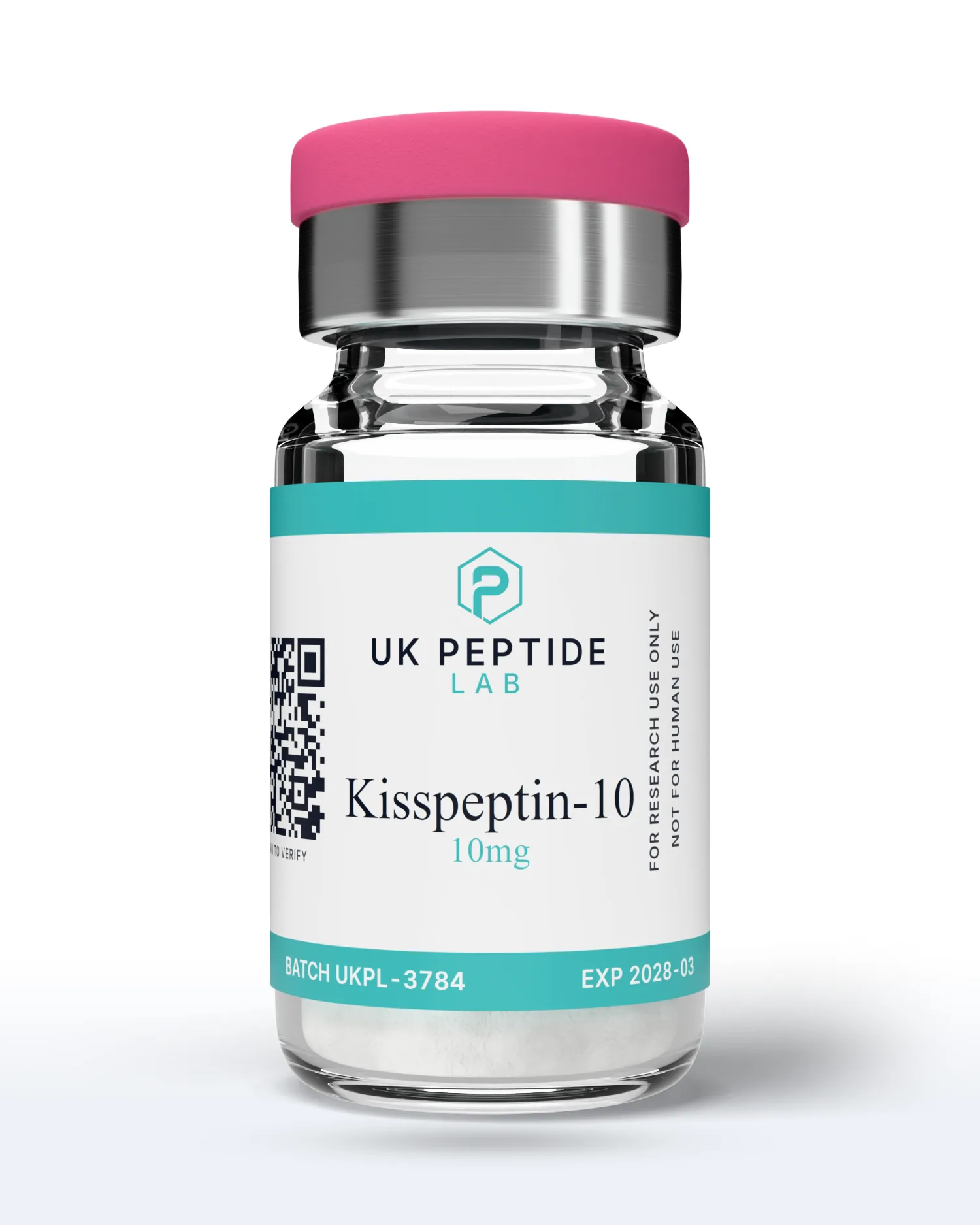
Kisspeptin-10
10mg
GPR54 agonist decapeptide. Reproductive endocrinology research.
99.225% purity · Third-party tested · Batch UKPL-3784 · View certificate
- Same-day dispatch before 3pm, Mon to Fri
- Add £34.01 more for free UK delivery
- Cold-chain shipping. Always. Dry-cold pack, Royal Mail Tracked 24
- Lost, damaged or wrong? Replaced free if you tell us within 48 hours.
- Research use only. For in-vitro laboratory research. Not for use in humans or animals, or in food, drugs or diagnostics. Not evaluated by the MHRA or FDA. The buyer is responsible for handling and regulatory compliance.
Bulk Pricing
Counted across your basket, any mix of products.
| Vials in basket | Discount | Per vial |
|---|---|---|
| 1 | None | £34.99 |
| 3-4 | 5% | £33.24 |
| 5-9 | 8% | £32.19 |
| 10-50 | 12% | £30.79 |
Bacteriostatic Water 10ml
Required to reconstitute lyophilised peptides.
What is Kisspeptin-10?
Kisspeptin-10 (KP-10, metastin 45-54) is the C-terminal decapeptide of human kisspeptin, supplied as a 10mg lyophilised powder. Its receptor, KISS1R, is the receptor formerly called GPR54.
Full description
Its sequence is Tyr-Asn-Trp-Asn-Ser-Phe-Gly-Leu-Arg-Phe-NH₂ (YNWNSFGLRF-NH₂), 1302.5 g/mol, CAS 374675-21-5, also catalogued as kisspeptin-112-121 or metastin (45-54). KISS1R is a class A G protein-coupled receptor coupling mainly through Gq/11 and phospholipase C. Kisspeptins are RFamide peptides, named for the C-terminal arginine-phenylalanine-amide motif that carries the pharmacophore. Ohtaki et al. (Nature, 2001) isolated the parent peptide from human placenta.
Kisspeptin-10 Research Applications
- Receptor assays: kisspeptins bound rat and human GPR54 in CHO-K1 cells with low nanomolar affinity. They triggered PIP₂ hydrolysis, calcium mobilisation and ERK1/2 phosphorylation (Kotani et al., 2001).
- Structure-activity: Ala substitution at position 6 or 10 of rat kp-10 raised EC₅₀ from the 10⁻⁸ M range to above 6.46 × 10⁻⁶ M (Gutiérrez-Pascual et al., 2009).
- Conformation: NMR modelling showed a helix between Asn4 and Tyr10, which an Ala10 substitution disrupted completely (Gutiérrez-Pascual et al., 2009).
- Reproductive axis: loss-of-function GPR54 mutations cause hypogonadotropic hypogonadism (de Roux et al., PNAS, 2003).
Study details
Kisspeptin-10 is the reference agonist at KISS1R in vitro. Typical assays are radioligand binding and competition, inositol phosphate accumulation, intracellular calcium mobilisation, ERK1/2 phosphorylation, and receptor desensitisation and internalisation. KISS1 was first characterised as a melanoma metastasis-suppressor gene, and KISS1R signalling is still studied in invasion and metastasis models.
Kisspeptin-10 vs Kisspeptin-54 (Metastin)
They are different molecules cut from the same KISS1 gene product, not two names for one compound. Kotani et al. (J Biol Chem, 2001) isolated 54, 14 and 13 residue peptides from human placenta, all sharing the C-terminal RF-amide. Ohtaki et al. (Nature, 2001) named the 54 residue form metastin. Kisspeptin-10 is the last ten residues, 1302.5 g/mol, roughly a fifth of that mass.
Both act at the same receptor because the decapeptide carries the pharmacophore. Gutiérrez-Pascual et al. (Mol Pharmacol, 2009) noted that Kp-10 has higher receptor affinity and biopotency than the longer forms. They differ in synthesis cost, solubility and clearance, which is why the short form dominates in-vitro pharmacology. Cite findings for the form actually used.
Research Overview
Ohtaki et al. (Nature, 2001) isolated a C-terminally amidated 54 residue peptide from human placenta as the ligand of the orphan receptor hOT7T175, now KISS1R, and named it metastin. It inhibited chemotaxis and invasion of transfected CHO cells and reduced pulmonary metastasis of transfected B16-BL6 melanoma in mice. Kotani et al. (J Biol Chem, 2001) found human GPR54 highly expressed in placenta, pituitary, pancreas and spinal cord. They also reported that kisspeptins stimulated oxytocin secretion in rats while inhibiting cell proliferation.
de Roux et al. (PNAS, 2003) studied a large consanguineous family with five affected siblings and found a homozygous 155 nucleotide deletion in GPR54 spanning the intron 4 to exon 5 splice acceptor site. That result placed the receptor in the gonadotropic axis.
Product Specifications
- Molecular Formula
- C₆₃H₈₃N₁₇O₁₄
- Molecular Weight
- 1302.5 g/mol
- CAS Number
- 374675-21-5
- Sequence
- YNWNSFGLRF-NH₂ (Tyr-Asn-Trp-Asn-Ser-Phe-Gly-Leu-Arg-Phe-amide)
- Also Catalogued As
- Kisspeptin-112-121, metastin (45-54), KP-10
- Receptor
- KISS1R (formerly GPR54), class A GPCR, Gq/11-coupled
- Peptide Family
- RFamide, C-terminal Arg-Phe-amide motif
- Purity
- 99.225% by HPLC
- Batch
- UKPL-3784
- Storage
- -20°C lyophilised, 2-8°C reconstituted, protect from light
- Appearance
- White to off-white lyophilised powder
- Form
- Lyophilised powder
Certificate of Analysis
Third-party tested
- Batch
- UKPL-3784
- Purity
- 99.225%
- Specification
- ≥98.0%
- Method
- RP-HPLC
- Lab
- Janoshik Analytical
- Tested
- Sep 2026
Need the certificate for an earlier batch? Request an older CoA
Storage and Reconstitution
Store the sealed 10mg vial at -20°C, dry and away from light. Keep reconstituted solution at 2-8°C in a light-protected container and freeze single-use aliquots for longer storage. Two degradation routes matter here: tryptophan oxidation, and hydrolysis of the C-terminal phenylalanine amide, which gives a free acid one mass unit heavier and much less active at KISS1R. Mass spectrometry after long storage is the practical check.
Vials are sold on their own, without bacteriostatic water for mixing or other supplies.
How to reconstitute and handle
Let the vial reach room temperature. Run bacteriostatic water slowly down the inside wall of the vial and swirl gently until clear and colourless, without shaking. Work away from direct sunlight and fluorescent light: tryptophan 3 is the most oxidation-sensitive residue and its oxidation shows up as a new RP-HPLC peak. Label the vial with the reconstitution date and refrigerate it.
- Positions 6 and 10 are the critical residues for activity at KISS1R, so check the full sequence on a certificate as well as the mass.
- Kisspeptin is cleaved by proteases, so incubation time and serum content of the medium both affect the concentration reaching the receptor.
- Swab both stoppers with alcohol before each needle entry and work aseptically.
For the full method, see the peptide reconstitution guide and the reconstitution calculator.
Research References
- Metastasis suppressor gene KiSS-1 encodes peptide ligand of a G-protein-coupled receptor (Ohtaki et al., Nature, 2001)
- The metastasis suppressor gene KiSS-1 encodes kisspeptins, the natural ligands of the orphan G protein-coupled receptor GPR54 (Kotani et al., J Biol Chem, 2001)
- Hypogonadotropic hypogonadism due to loss of function of the KiSS1-derived peptide receptor GPR54 (de Roux et al., PNAS, 2003)
- In vivo and in vitro structure-activity relationships and structural conformation of Kisspeptin-10-related peptides (Gutiérrez-Pascual et al., Mol Pharmacol, 2009)
Published research on Kisspeptin-10 is indexed on PubMed. See our full UK buyer's guide for Kisspeptin-10.
Kisspeptin-10 Price (UK)
Kisspeptin-10 10mg is for sale at £34.99 per vial, supplied from stock in the UK with a published third-party HPLC certificate. UK delivery is £4.50 by Royal Mail Tracked 24, free over £69.
| Vial | Price | Cost per mg | Availability |
|---|---|---|---|
| Kisspeptin-10 10mgThis page | £34.99 | £3.50 | In stock |
Prices are in GBP per vial and match the basket. See the FAQ for delivery and payment options, and quality & testing for how each batch is checked.
Frequently Asked Questions
What is the difference between kisspeptin-10 and kisspeptin-54?
They are different molecules from the same precursor. Kotani et al. (J Biol Chem, 2001) isolated 54, 14 and 13 residue peptides from human placenta, all sharing the C-terminal RF-amide. Kisspeptin-54, or metastin, is the 54 residue form. Kisspeptin-10 is the C-terminal decapeptide at 1302.5 g/mol, about a fifth of that mass. Do not quote a study of one as if it used the other.
What receptor does kisspeptin-10 bind, and is GPR54 the same as KISS1R?
Yes, GPR54 and KISS1R are the same receptor under old and current names, reported as hOT7T175 in the original Nature paper. It is a class A G protein-coupled receptor signalling mainly through Gq/11 and phospholipase C. Kotani et al. (2001) measured PIP₂ hydrolysis, calcium mobilisation, arachidonic acid release, and ERK1/2 and p38 phosphorylation as downstream readouts.
Why does the C-terminal amide matter for kisspeptin-10 activity?
It is part of the pharmacophore. Kisspeptins are RFamide peptides, defined by the C-terminal arginine-phenylalanine-amide. Gutiérrez-Pascual et al. (Mol Pharmacol, 2009) found that substituting alanine at position 10 eliminated the luteinising hormone response in rats and disrupted the C-terminal helix. So the free-acid form is not interchangeable with the amide, and amide hydrolysis in storage is a real loss of activity.
What established the role of KISS1R in the GnRH axis?
Human genetics. de Roux et al. (PNAS, 2003) mapped a locus on chromosome 19p13 in a consanguineous family with isolated hypogonadotropic hypogonadism. All five affected siblings carried a homozygous 155 nucleotide deletion in GPR54. That put the receptor, and the KISS1-derived peptides, into the physiology of the gonadotropic axis.
Why is KISS1 described as a metastasis suppressor gene?
That is how it was first identified, as a gene suppressing metastasis of human melanomas and breast carcinomas without affecting tumorigenicity. Its peptide product was therefore named metastin. Ohtaki et al. (2001) reported that metastin inhibited chemotaxis and invasion of transfected CHO cells and reduced pulmonary metastasis of transfected melanoma in mice. Tumour biology and neuroendocrinology remain two largely separate literatures for this peptide.
Where can I buy kisspeptin in the UK for research?
UK Peptide Lab sells Kisspeptin-10 10mg online for laboratory research, dispatched from the UK. The current batch, UKPL-3784, has its third-party certificate published with the listing. Kisspeptin-10 is not an approved medicine in any jurisdiction, and buyers must be 18 or over.
Where can I buy kisspeptin in the UK?
UK Peptide Lab has Kisspeptin-10 10mg for sale online, batch UKPL-3784, dispatched from the UK. Orders placed before 3pm on a working day are dispatched the same day, with free UK delivery over £69.
Is your Kisspeptin-10 10mg third-party tested?
Yes. Batch UKPL-3784 was tested by Janoshik Analytical at 99.225% purity by RP-HPLC, against a ≥98.0% specification. Content quantification found 10.63mg against 10mg declared. The report, #229875, can be checked online with the lab.
Is kisspeptin-10 legal to buy in the UK for research?
Kisspeptin-10 is not an approved medicine in the UK or anywhere else. It may be bought here only for in-vitro laboratory research, and not for human or veterinary use. Buyers must be 18 or over and confirm research-only use at checkout.
Related Products