Metabolic Research
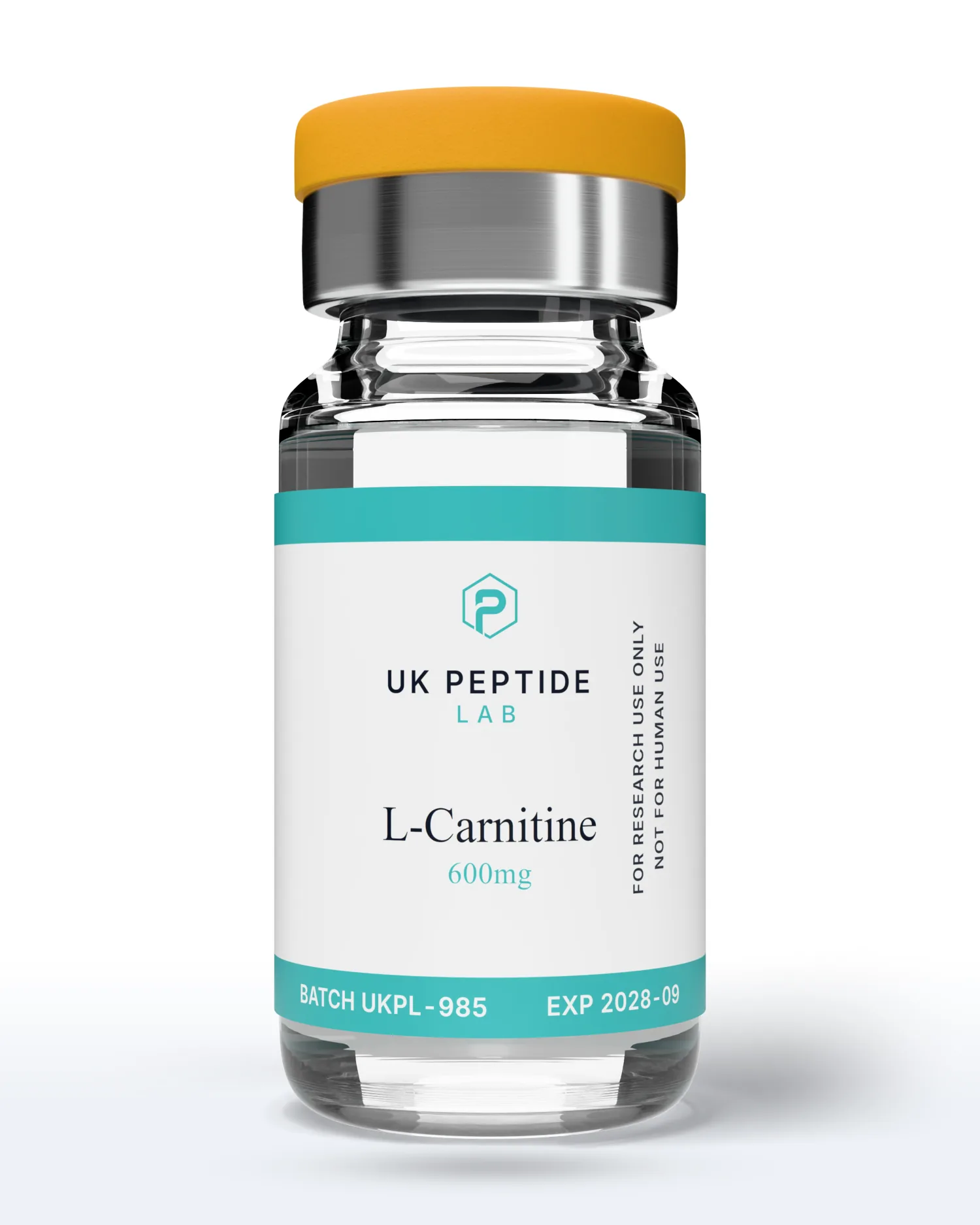
L-Carnitine
600mg/ml, 10ml
Quaternary ammonium compound. 600mg/ml solution for mitochondrial fatty acid transport research.
≥98% purity specification · Batch UKPL-985
- Same-day dispatch before 3pm, Mon to Fri
- Add £39.01 more for free UK delivery
- Cold-chain shipping. Always. Dry-cold pack, Royal Mail Tracked 24
- Lost, damaged or wrong? Replaced free if you tell us within 48 hours.
- Research use only. For in-vitro laboratory research. Not for use in humans or animals, or in food, drugs or diagnostics. Not evaluated by the MHRA or FDA. The buyer is responsible for handling and regulatory compliance.
Bulk Pricing
Counted across your basket, any mix of products.
| Vials in basket | Discount | Per vial |
|---|---|---|
| 1 | None | £29.99 |
| 3-4 | 5% | £28.49 |
| 5-9 | 8% | £27.59 |
| 10-50 | 12% | £26.39 |
What is L-Carnitine?
L-Carnitine is a quaternary ammonium compound derived from the amino acids lysine and methionine, biosynthesised in the liver and kidneys. Research has investigated its role in fatty acid transport across the inner mitochondrial membrane via the carnitine shuttle, as well as effects on mitochondrial bioenergetics and oxidative metabolism. Supplied as a ready-to-use 600mg/ml solution in a 10ml vial, for research use only.
Full description
L-Carnitine is not a peptide. It is a small zwitterionic metabolite, (R)-3-hydroxy-4-(trimethylazaniumyl)butanoate, formula C₇H₁₅NO₃. It is stocked beside the peptide range because it is a standard reagent in mitochondrial research.
Its established job is the carnitine shuttle, which moves long-chain fatty acids into mitochondria. That shuttle is the rate-limiting entry step for long-chain fatty-acid oxidation.
L-Carnitine Research Applications
L-Carnitine is used as a defined substrate and pathway probe in mitochondrial bioenergetics. Typical work includes carnitine palmitoyltransferase activity assays, acylcarnitine profiling by tandem mass spectrometry, and fatty-acid oxidation flux in cells or isolated mitochondria. It also serves in models of carnitine shuttle deficiency, in skeletal muscle energetics work, and as a reference standard in the acylcarnitine methods behind newborn screening for fatty-acid oxidation disorders. No claim is made about supplementation in humans.
Research Overview
The liver and kidneys make L-Carnitine from lysine and methionine. The route runs through trimethyllysine and gamma-butyrobetaine, and gamma-butyrobetaine dioxygenase catalyses the final hydroxylation.
Long-chain acyl-CoA cannot cross the inner mitochondrial membrane on its own. Carnitine palmitoyltransferase 1 (CPT1) on the outer membrane moves the acyl group onto carnitine. Carnitine-acylcarnitine translocase carries the acylcarnitine across the inner membrane. Carnitine palmitoyltransferase 2 then rebuilds acyl-CoA in the matrix for beta-oxidation. Malonyl-CoA inhibits CPT1, which couples fatty-acid oxidation to fatty-acid synthesis.
Cells take up carnitine through OCTN2, the sodium-dependent transporter encoded by SLC22A5. Loss-of-function mutations in that gene cause primary systemic carnitine deficiency, a genetic model that underpins much of what is known about the shuttle.
A separate literature concerns gut bacteria. Koeth and colleagues (Nat Med, 2013) showed that intestinal microbes turn dietary L-carnitine into trimethylamine, which the liver oxidises to trimethylamine-N-oxide (TMAO). In mice, this accelerated atherosclerosis, but not when the gut microbiota was suppressed.
L-Carnitine is supplied here as a ready-to-use solution at 600mg/ml in a 10ml vial. In this presentation it is not a licensed medicine in the UK. It is not supplied for human consumption, veterinary use or any therapeutic purpose.
Product Specifications
- CAS Number
- 541-15-1
- Molecular Formula
- C₇H₁₅NO₃
- Molecular Weight
- 161.20 g/mol
- IUPAC Name
- (R)-3-hydroxy-4-(trimethylazaniumyl)butanoate
- Purity
- ≥98% by HPLC (batch UKPL-985)
- Concentration
- 600mg/ml
- Volume
- 10ml
- Storage
- Sealed at room temperature, protected from light. Refrigerate at 2-8°C once pierced
- Form
- Ready-to-use solution, no reconstitution required
Certificate of Analysis
No certificate is currently published for this batch.
Supplied against a ≥98% purity specification.
Request lab certificateStorage and Handling
Store the sealed vial at room temperature, protected from light. It does not need freezing or -20°C storage. Once the stopper has been pierced, keep the vial at 2-8°C. Inspect the solution before each use and discard it if it turns cloudy, discoloured or shows particulates. It has no secondary structure to lose and no thiol or thioether to oxidise.
How to handle
L-Carnitine comes as a ready-to-use solution at 600mg/ml in a 10ml vial, so there is nothing to mix. The concentrated solution is viscous when cold. Let a refrigerated vial reach room temperature and draw slowly. Swab the stopper with 70% isopropyl alcohol before every needle entry and let it dry. Use a fresh sterile needle and syringe for each withdrawal, and never return solution to the vial. Label the vial with the date of first puncture.
To mix a peptide, see the peptide reconstitution guide and the reconstitution calculator.
Research References
Published research on L-Carnitine is indexed on PubMed.
L-Carnitine Price (UK)
L-Carnitine 600mg/ml, 10ml is for sale at £29.99 per vial, supplied from stock in the UK. UK delivery is £4.50 by Royal Mail Tracked 24, free over £69.
| Vial | Price | Availability |
|---|---|---|
| L-Carnitine 600mg/ml, 10mlThis page | £29.99 | Low stock |
Prices are in GBP per vial of ready-to-use solution and match the basket. See the FAQ for delivery and payment options, and quality & testing for how each batch is checked.
Frequently Asked Questions
Does L-Carnitine need reconstituting?
No. It comes as a ready-to-use solution at 600mg/ml in a 10ml vial. There is nothing to dissolve and no bacteriostatic water is needed.
How does the carnitine shuttle work?
Long-chain acyl-CoA cannot cross the inner mitochondrial membrane. CPT1 on the outer membrane transfers the acyl group to carnitine, forming acylcarnitine. A translocase carries that across the inner membrane, and CPT2 rebuilds acyl-CoA in the matrix for beta-oxidation. CPT1 is the rate-limiting step and is inhibited by malonyl-CoA.
Is L-Carnitine a peptide?
No. L-Carnitine is a quaternary ammonium compound of 161.20 g/mol, made in the body from lysine and methionine. It has no peptide bonds. It is stocked with the peptide range because it is a standard reagent in mitochondrial and fatty-acid oxidation research.
What is the TMAO research on L-Carnitine?
Koeth and colleagues (Nat Med, 2013) showed that gut bacteria convert dietary L-carnitine to trimethylamine, which the liver oxidises to TMAO. In mice this accelerated atherosclerosis, and suppressing the gut microbiota prevented it. It is a finding about microbial metabolism of eaten carnitine, not about this product, which is supplied for in-vitro use only.
How should L-Carnitine be stored?
Keep the sealed vial at room temperature, protected from light. It does not need freezing or -20°C storage. Once the stopper has been pierced, date the vial, keep it at 2-8°C and use aseptic technique for every withdrawal. Discard the solution if it turns cloudy, discoloured or shows particulates.
Where can I buy L-Carnitine in the UK for research?
UK Peptide Lab sells L-Carnitine from UK stock as a ready-to-use 600mg/ml solution in a 10ml vial. Batch UKPL-985 is supplied against a ≥98% purity specification. In-stock orders placed before 3pm UK time on a working day are dispatched the same day. UK Royal Mail Tracked delivery is free over £69. Buyers must be 18 or over.
Is your L-Carnitine third-party tested?
No. No certificate is published for this batch yet. It is supplied against a ≥98% purity specification, and we publish certificates only for batches that have been laboratory tested. Identity rests on CAS 541-15-1 and a molecular weight of 161.2 g/mol.
Related Products