Growth Hormone Secretagogues
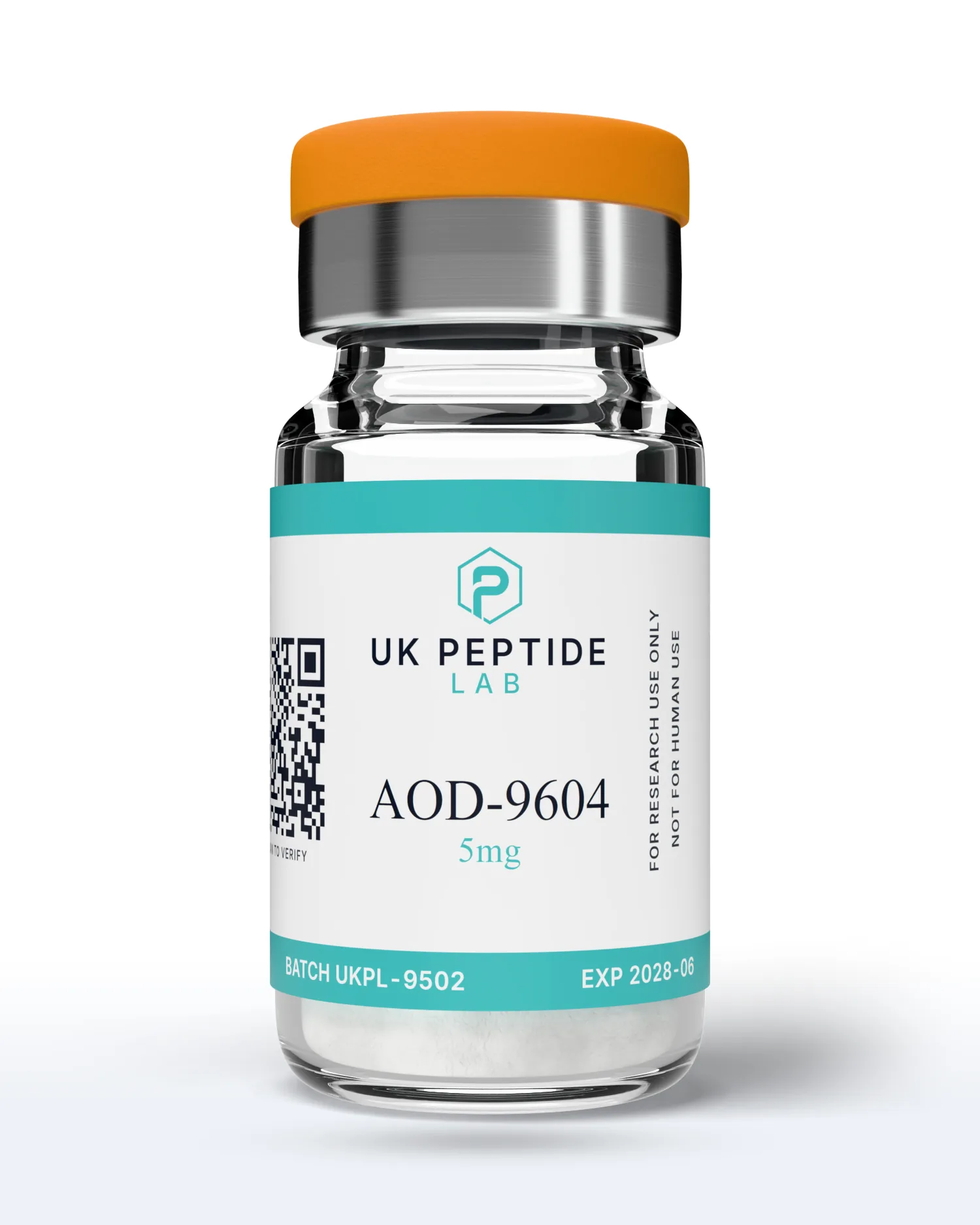
AOD-9604
5mg
Modified hGH fragment (177-191). Lipolysis research peptide.
99.92% purity · Supplier-reported analysis · Batch UKPL-9502 · View certificate
- Same-day dispatch before 3pm, Mon to Fri
- Add £34.01 more for free UK delivery
- Cold-chain shipping. Always. Dry-cold pack, Royal Mail Tracked 24
- Lost, damaged or wrong? Replaced free if you tell us within 48 hours.
- Research use only. For in-vitro laboratory research. Not for use in humans or animals, or in food, drugs or diagnostics. Not evaluated by the MHRA or FDA. The buyer is responsible for handling and regulatory compliance.
Bulk Pricing
Counted across your basket, any mix of products.
| Vials in basket | Discount | Per vial |
|---|---|---|
| 1 | None | £34.99 |
| 3-4 | 5% | £33.24 |
| 5-9 | 8% | £32.19 |
| 10-50 | 12% | £30.79 |
Bacteriostatic Water 10ml
Required to reconstitute lyophilised peptides.
What is AOD-9604?
AOD-9604 is a modified fragment of human growth hormone: residues 177-191 with a tyrosine added at the N-terminus. Research has examined lipolysis and fatty-acid oxidation in animal models, without the growth-promoting and insulin-resistance effects of intact growth hormone.
Full description
The sequence is Tyr-Leu-Arg-Ile-Val-Gln-Cys-Arg-Ser-Val-Glu-Gly-Ser-Cys-Gly-Phe (YLRIVQCRSVEGSCGF). The literature writes it as Tyr-hGH(177-191), AOD9604 or AOD 9604. Its molecular weight is 1815.12 g/mol and its CAS number 221231-10-3. The cysteines at positions 7 and 14 form an intrachain disulfide, matching Cys182 and Cys189 of the parent hormone.
Each AOD-9604 5mg vial holds white lyophilised powder.
AOD-9604 Research Applications
- Lipolysis in obese rats: Ng and colleagues (Horm Res, 2000) reported higher lipolytic activity in adipose tissue of obese Zucker rats given oral AOD9604. Body-weight gain was less than half that of controls, and insulin sensitivity did not change.
- Beta-3 adrenergic receptors: in obese mice, 14 days of treatment reduced body weight and fat and restored beta-3 receptor RNA to lean levels. In beta-3 receptor knock-out mice chronic treatment had no such effect (Heffernan et al., Endocrinology, 2001).
- Structure: Ogru and colleagues (J Pept Res, 2000) found type I beta-turns in the disulfide-bridged fragment by NMR, and lipolytic activity in rodent, porcine and human adipose tissue in vitro.
- Human trials: six randomised, double-blind, placebo-controlled trials reported no change in serum IGF-1 and no negative effect on carbohydrate metabolism (Stier, Vos and Kenley, J Endocrinol Metab, 2013).
Study details
Typical designs are lipolysis and fatty-acid oxidation assays in adipocytes and rodent models, and comparisons of intact hGH with its C-terminal fragments. A related fragment, AOD-9401, raised lipolysis and reduced lipogenesis in isolated human adipose tissue in vitro (Heffernan et al., Am J Physiol Endocrinol Metab, 2000). Efficacy in obesity was never established in humans. AOD-9604 has no marketing authorisation as a medicine.
AOD-9604 vs hGH Fragment 177-191
hGH Fragment 177-191 is the 15-residue chain Leu-Arg-Ile-Val-Gln-Cys-Arg-Ser-Val-Glu-Gly-Ser-Cys-Gly-Phe. AOD-9604 is the same chain with a tyrosine added at the N-terminus, giving 16 residues and 1815.12 g/mol. Both carry the disulfide loop of the hGH C-terminus. Ogru and colleagues (J Pept Res, 2000) did their NMR work on the 15-residue form, where the cysteines sit at positions 6 and 13. The main metabolic studies and the human trials used AOD-9604 itself (Ng et al., 2000; Heffernan et al., 2001; Stier et al., 2013). Because residue 176 of hGH is a tyrosine, AOD-9604 has the same sequence as HGH Fragment 176-191, which we also stock. Head-to-head data are scarce, so the added tyrosine is the variable under test.
Research Overview
The aim behind AOD-9604 was to separate the fat-mobilising activity of hGH from its growth-promoting and insulin-resistance effects. The fragment keeps only the C-terminal region of the hormone.
In beta-3 adrenergic receptor knock-out mice, acute treatment still raised energy expenditure and fat oxidation. Heffernan and colleagues (Endocrinology, 2001) concluded that its lipolytic action is not mediated directly through that receptor. The human trials were summarised by Stier, Vos and Kenley (J Endocrinol Metab, 2013). AOD-9604 has no marketing authorisation as a medicine in the UK.
Product Specifications
- Molecular Formula
- C₇₈H₁₂₃N₂₃O₂₃S₂
- Molecular Weight
- 1815.12 g/mol
- CAS Number
- 221231-10-3
- Sequence
- Tyr-Leu-Arg-Ile-Val-Gln-Cys-Arg-Ser-Val-Glu-Gly-Ser-Cys-Gly-Phe (YLRIVQCRSVEGSCGF), intrachain disulfide Cys7-Cys14
- Purity
- 99.92% (RP-HPLC, supplier-reported)
- Batch
- UKPL-9502
- Storage
- -20°C lyophilised, 2-8°C reconstituted
- Appearance
- White lyophilised powder
- Form
- Lyophilised powder
Certificate of Analysis
Supplier-reported analysis. Independent third-party verification pending.
- Batch
- UKPL-9502
- Purity
- 99.92%
- Specification
- ≥98.0%
- Method
- RP-HPLC
- Tested
- Sep 2026
Need the certificate for an earlier batch? Request an older CoA
Storage and Reconstitution
Move vials to the freezer on arrival; the powder tolerates short transit at room temperature. To protect the disulfide, keep vials tightly sealed with little headspace, away from light and oxidising agents. Freeze single-use aliquots and thaw each one once, because repeated freeze-thaw drives aggregation.
Vials are sold on their own, without bacteriostatic water for mixing or other supplies.
How to reconstitute and handle
Let the vial reach room temperature. Wipe the stoppers of the peptide vial and the bacteriostatic water vial with an alcohol swab. Add the water slowly down the inside wall of the vial, not onto the powder. Swirl gently until the solution is clear and colourless; do not shake or vortex, because shear and foaming damage the peptide. The Cys7 to Cys14 disulfide is the part to protect, so avoid drawing in extra air and re-seal promptly. Record the date, water volume and concentration on the label.
- Minimise air exposure and headspace, and re-seal vials promptly to protect the disulfide.
- Aliquot reconstituted stock into single-use volumes, label each with the date, and work aseptically.
For the full method, see the peptide reconstitution guide and the reconstitution calculator.
Research References
- Metabolic studies of a synthetic lipolytic domain (AOD9604) of human growth hormone (Ng et al., Horm Res, 2000)
- The effects of human GH and its lipolytic fragment (AOD9604) on lipid metabolism following chronic treatment in obese mice and beta(3)-AR knock-out mice (Heffernan et al., Endocrinology, 2001)
Published research on AOD-9604 is indexed on PubMed.
AOD-9604 Price (UK)
AOD-9604 5mg is for sale at £34.99 per vial, supplied from stock in the UK with a published supplier batch certificate. UK delivery is £4.50 by Royal Mail Tracked 24, free over £69.
| Vial | Price | Cost per mg | Availability |
|---|---|---|---|
| AOD-9604 5mgThis page | £34.99 | £7.00 | In stock |
Prices are in GBP per vial and match the basket. See the FAQ for delivery and payment options, and quality & testing for how each batch is checked.
Frequently Asked Questions
How does AOD-9604 differ from full-length HGH?
It is a 16-residue fragment, while human growth hormone is a 191-residue protein. AOD-9604 keeps only the C-terminal region, residues 177 to 191, plus an added tyrosine. In human trials it did not change serum IGF-1 or carbohydrate metabolism (Stier et al., J Endocrinol Metab, 2013). In obese rats it raised adipose lipolysis without affecting insulin sensitivity (Ng et al., Horm Res, 2000).
What research areas use AOD-9604?
Preclinical metabolic research on the lipolytic region of hGH. That covers lipolysis and fatty-acid oxidation assays, structure work on the disulfide-bridged C-terminus (Ogru et al., J Pept Res, 2000), and comparisons of intact hGH with its fragments. In obese mice it reduced body weight and fat and restored beta-3 adrenergic receptor expression (Heffernan et al., Endocrinology, 2001).
Does AOD-9604 raise IGF-1?
Not in the published human trials. A summary of six randomised, double-blind, placebo-controlled trials reported no effect on serum IGF-1 and no negative effect on carbohydrate metabolism (Stier, Vos and Kenley, J Endocrinol Metab, 2013). Intact growth hormone does raise IGF-1. AOD-9604 is sold here for in-vitro research only.
Where can I buy AOD-9604 in the UK?
UK Peptide Lab has AOD-9604 for sale in the UK as a 5mg vial of lyophilised powder, shipped from UK stock. Orders placed before 3pm on a working day are dispatched the same day by Royal Mail Tracked, and UK delivery is free over £69. The supplier's certificate for batch UKPL-9502 reports 99.92% purity by RP-HPLC, with independent testing pending. Buyers must be 18 or over.
What is AOD-9604 used for in research?
Lipolysis and fat-oxidation research on the C-terminal region of hGH. Typical models are adipocyte assays and obese rodents (Ng et al., Horm Res, 2000; Heffernan et al., Endocrinology, 2001). Efficacy in humans was never established, and it is not an approved medicine. It is sold here for in-vitro research only.
Related Products