Growth Hormone Secretagogues
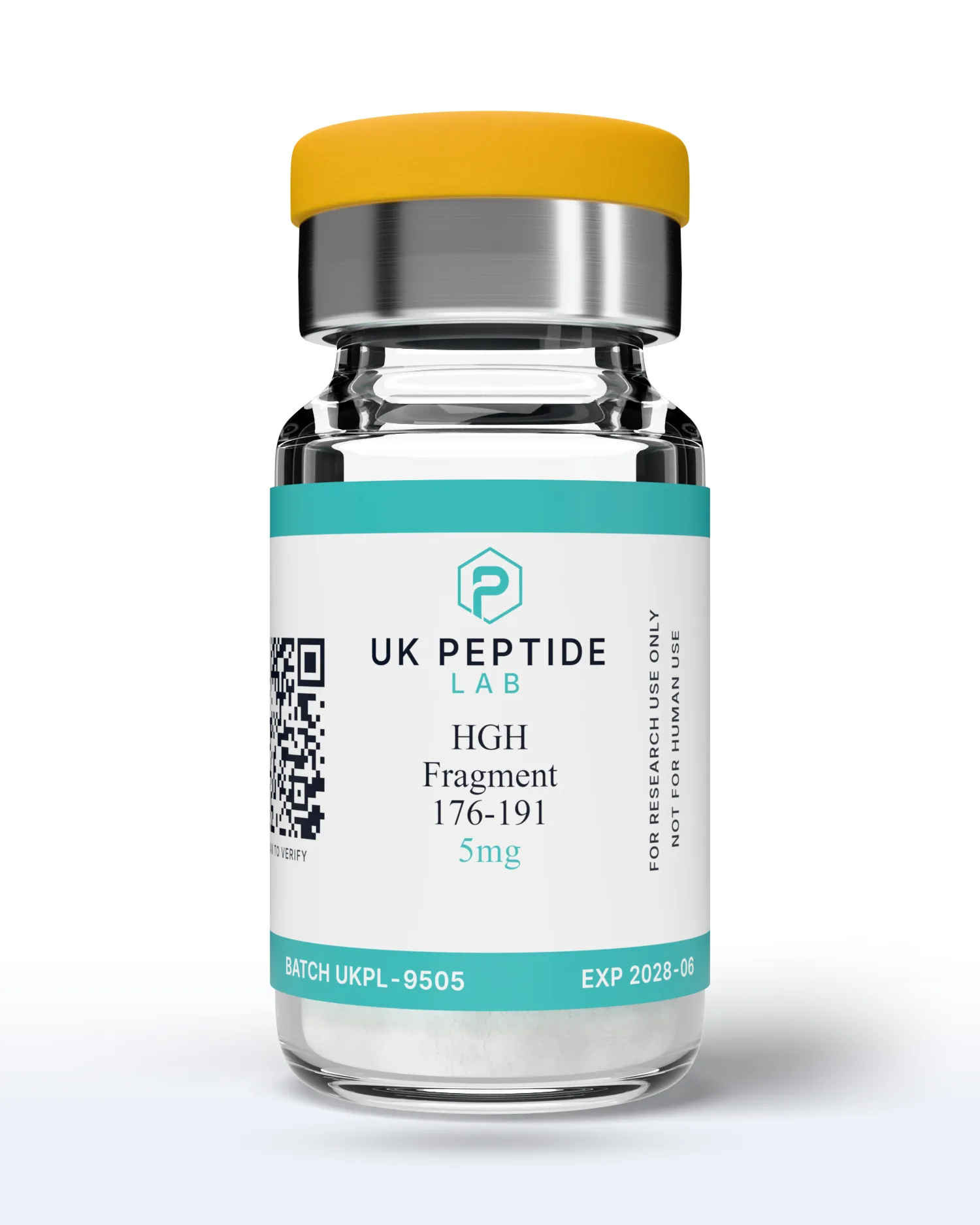
HGH Fragment 176-191
5mg
C-terminal 16-residue fragment of human growth hormone. Lipolytic-domain research.
99.57% purity · Supplier-reported analysis · Batch UKPL-9505 · View certificate
- Same-day dispatch before 3pm, Mon to Fri
- Add £39.01 more for free UK delivery
- Cold-chain shipping. Always. Dry-cold pack, Royal Mail Tracked 24
- Lost, damaged or wrong? Replaced free if you tell us within 48 hours.
- Research use only. For in-vitro laboratory research. Not for use in humans or animals, or in food, drugs or diagnostics. Not evaluated by the MHRA or FDA. The buyer is responsible for handling and regulatory compliance.
Bulk Pricing
Counted across your basket, any mix of products.
| Vials in basket | Discount | Per vial |
|---|---|---|
| 1 | None | £29.99 |
| 3-4 | 5% | £28.49 |
| 5-9 | 8% | £27.59 |
| 10-50 | 12% | £26.39 |
Bacteriostatic Water 10ml
Required to reconstitute lyophilised peptides.
What is HGH Fragment 176-191?
HGH Fragment 176-191, also sold as HGH Frag 176-191, is a 16-residue peptide from the C-terminal end of human growth hormone. The sequence on its certificate is YLRIVQCRSVEGSCGF. Each 5mg vial holds white lyophilised powder.
Full description
Native human growth hormone has phenylalanine at position 176, so its 176-191 stretch reads FLRIVQCRSVEGSCGF. The peptide sold under this name carries tyrosine at that first position instead. That makes it Tyr-hGH(177-191), the same primary sequence as AOD-9604.
The cysteines at positions 7 and 14 (hGH residues 182 and 189) can form the disulfide bridge that closes the hormone's small C-terminal loop. Ogru and colleagues (J Pept Res, 2000) solved the solution structure of that cyclic 177-191 peptide by NMR.
HGH Fragment 176-191 Research Applications
- Early fragment work: in rats, hGH 172-191 to 178-191 fragments raised blood glucose and insulin, while 179-191 was inert (Ng and Bornstein, 1978).
- Adipose tissue: the 177-191 domain (AOD9401) stimulated hormone-sensitive lipase and inhibited acetyl-CoA carboxylase in rat fat, without inducing insulin resistance (Ng et al., J Mol Endocrinol, 2000).
- Beta-3 receptors: AOD9604 raised beta-3-adrenergic receptor RNA in obese mice, though its lipolytic action did not run directly through that receptor (Heffernan et al., Endocrinology, 2001).
- Drug delivery: the fragment increased the toxicity of doxorubicin-loaded chitosan nanoparticles to MCF-7 breast cancer cells (Habibullah et al., Drug Des Devel Ther, 2022).
Study details
Typical uses are lipolysis and lipogenesis assays in adipocyte and hepatocyte preparations, and structure-activity work on the C-terminal loop. The human clinical data belong to AOD-9604, not to this product, and efficacy was never established. No marketing authorisation exists anywhere.
HGH Fragment 176-191 vs AOD-9604
AOD-9604 is Tyr-hGH(177-191): residues 177 to 191 with a tyrosine added at the N-terminus. The peptide sold as HGH Fragment 176-191, including this batch, has that same sequence, YLRIVQCRSVEGSCGF. The native hGH 176-191 sequence would start with phenylalanine instead. So the two names describe one primary structure and differ in the literature attached to each. AOD-9604 carried the clinical programme to phase 2b. The fragment name appears in early synthetic fragment work and in a 2022 drug-delivery study.
Research Overview
The certificate for batch UKPL-9505 gives the sequence YLRIVQCRSVEGSCGF and 1817.09 g/mol, the reduced formula C₇₈H₁₂₅N₂₃O₂₃S₂. In UniProt's human growth hormone sequence (P01241), residue 176 is phenylalanine. This peptide is therefore Tyr-hGH(177-191), the sequence of AOD-9604, sold under the fragment name.
The C-terminal region was first probed with synthetic peptides by Ng and Bornstein (Am J Physiol, 1978). Fragments 172-191, 176-191, 177-191 and 178-191 raised blood glucose briefly and plasma insulin for longer in rats. The Monash group later named 177-191 a lipolytic domain. As AOD9401 it stimulated hormone-sensitive lipase and inhibited acetyl-CoA carboxylase in rat adipose tissue (Ng et al., J Mol Endocrinol, 2000). Unlike hGH, it did not cause insulin resistance after chronic treatment. The cyclic 177-191 peptide keeps some of the shape it has in the intact hormone (Ogru et al., J Pept Res, 2000).
The human clinical data belong to AOD-9604, not to this product. Efficacy was never established, the phase 2b programme was wound down and no marketing authorisation exists anywhere.
Product Specifications
- Molecular Formula
- C₇₈H₁₂₅N₂₃O₂₃S₂
- Molecular Weight
- 1817.09 g/mol
- CAS Number
- 66004-57-1
- Sequence
- Tyr-Leu-Arg-Ile-Val-Gln-Cys-Arg-Ser-Val-Glu-Gly-Ser-Cys-Gly-Phe (YLRIVQCRSVEGSCGF), Tyr-hGH(177-191)
- Purity
- 99.57% (HPLC, supplier-tested)
- Batch
- UKPL-9505
- Storage
- -20°C lyophilised, 2-8°C reconstituted
- Appearance
- White lyophilised powder
- Form
- Lyophilised powder
Certificate of Analysis
Supplier-reported analysis. Independent third-party verification pending.
- Batch
- UKPL-9505
- Purity
- 99.57%
- Specification
- ≥98.0%
- Method
- RP-HPLC
- Tested
- Sep 2026
Need the certificate for an earlier batch? Request an older CoA
Storage and Reconstitution
Keep sealed vials at -20°C, away from light and moisture, and move them to the freezer on receipt. After reconstitution, keep the solution at 2-8°C and use it within 4 weeks, or freeze single-use aliquots at -20°C and thaw each once. Keep vials tightly sealed with little headspace and away from oxidising agents.
Vials are sold on their own, without bacteriostatic water for mixing or other supplies.
How to reconstitute and handle
Bring the vial to room temperature and swab both stoppers with alcohol. Add bacteriostatic water slowly down the inside wall, never onto the powder, and swirl until the solution is clear and colourless. Do not shake or vortex. The two cysteines are the oxidation-prone sites, so limit air in the vial and reseal promptly. Discard a vial that stays turbid. Label it with the date, volume and concentration, then refrigerate.
- Work under aseptic conditions with sterile, pyrogen-free consumables, in a laminar flow hood where available.
- Avoid repeated freeze-thaw cycles, which speed aggregation and loss of intact peptide.
For the full method, see the peptide reconstitution guide and the reconstitution calculator.
Research References
- Hyperglycemic action of synthetic C-terminal fragments of human growth hormone (Ng and Bornstein, Am J Physiol, 1978)
- Molecular and cellular actions of a structural domain of human growth hormone (AOD9401) on lipid metabolism in Zucker fatty rats (Ng et al., J Mol Endocrinol, 2000)
- The effects of human GH and its lipolytic fragment (AOD9604) on lipid metabolism following chronic treatment in obese mice and beta(3)-AR knock-out mice (Heffernan et al., Endocrinology, 2001)
- The conformational and biological analysis of a cyclic anti-obesity peptide from the C-terminal domain of human growth hormone (Ogru et al., J Pept Res, 2000)
- Human growth hormone fragment 176-191 peptide enhances the toxicity of doxorubicin-loaded chitosan nanoparticles against MCF-7 breast cancer cells (Habibullah et al., Drug Des Devel Ther, 2022)
Published research on HGH Fragment 176-191 is indexed on PubMed.
HGH Fragment 176-191 Price (UK)
HGH Fragment 176-191 5mg is for sale at £29.99 per vial, supplied from stock in the UK with a published supplier batch certificate. UK delivery is £4.50 by Royal Mail Tracked 24, free over £69.
| Vial | Price | Cost per mg | Availability |
|---|---|---|---|
| HGH Fragment 176-191 5mgThis page | £29.99 | £6.00 | In stock |
Prices are in GBP per vial and match the basket. See the FAQ for delivery and payment options, and quality & testing for how each batch is checked.
Frequently Asked Questions
Is HGH Fragment 176-191 the same as AOD-9604?
In primary structure, the peptide sold under this name is. Its sequence, YLRIVQCRSVEGSCGF, is Tyr-hGH(177-191), which is how AOD-9604 is defined. Native hGH has phenylalanine at position 176, so the tyrosine is a substitution. The names carry different literatures, and the phase 2b clinical programme belongs to AOD-9604.
What is the molecular weight of HGH Fragment 176-191?
1817.09 g/mol, the formula weight of the reduced 16-mer, C₇₈H₁₂₅N₂₃O₂₃S₂. Sources that quote the disulfide-closed form subtract two hydrogens and give about 1815.1 g/mol. Both describe the same peptide. The bridge forms between the cysteines at positions 7 and 14.
Does HGH Fragment 176-191 act like full-length HGH?
No. It is a 16-residue piece of the hormone, not a secretagogue, and it lacks the receptor-binding regions the intact 191-residue hormone uses for growth signalling. In rat adipose tissue the 177-191 domain acted on lipase and acetyl-CoA carboxylase like intact hGH, but unlike hGH it did not cause insulin resistance (Ng et al., 2000).
Is HGH Fragment 176-191 legal to buy in the UK?
Yes, as a research chemical for in-vitro laboratory use. It is not a Controlled Drug and not a licensed medicine anywhere. Under the Human Medicines Regulations 2012 it cannot be sold or supplied for human consumption. Buyers must be 18 or over and confirm research-only use at checkout.
Where can I buy HGH Fragment 176-191 in the UK?
UK Peptide Lab sells HGH Fragment 176-191 5mg from UK stock, batch UKPL-9505. Its supplier-reported certificate is published on the product page, and third-party verification is pending. Orders placed before 3pm UK time on a working day are dispatched the same day, and UK Royal Mail Tracked delivery is free over £69.
How does HGH Fragment 176-191 relate to AOD-9604?
They share one sequence. AOD-9604 is Tyr-hGH(177-191), and the peptide sold as HGH Fragment 176-191 has that same YLRIVQCRSVEGSCGF chain. Native hGH has phenylalanine, not tyrosine, at position 176. The names differ in the literature attached to them: the phase 2b clinical programme belongs to AOD-9604.
What is HGH Fragment 176-191 used for in research?
It is used in metabolic research on the C-terminal domain of human growth hormone. Typical work covers lipolysis and lipogenesis assays in adipose tissue and structure-activity studies of the disulfide loop (Ogru et al., 2000). It also appears in drug-delivery models (Habibullah et al., 2022). Supplied for in-vitro laboratory research only.
Related Products