Peptides
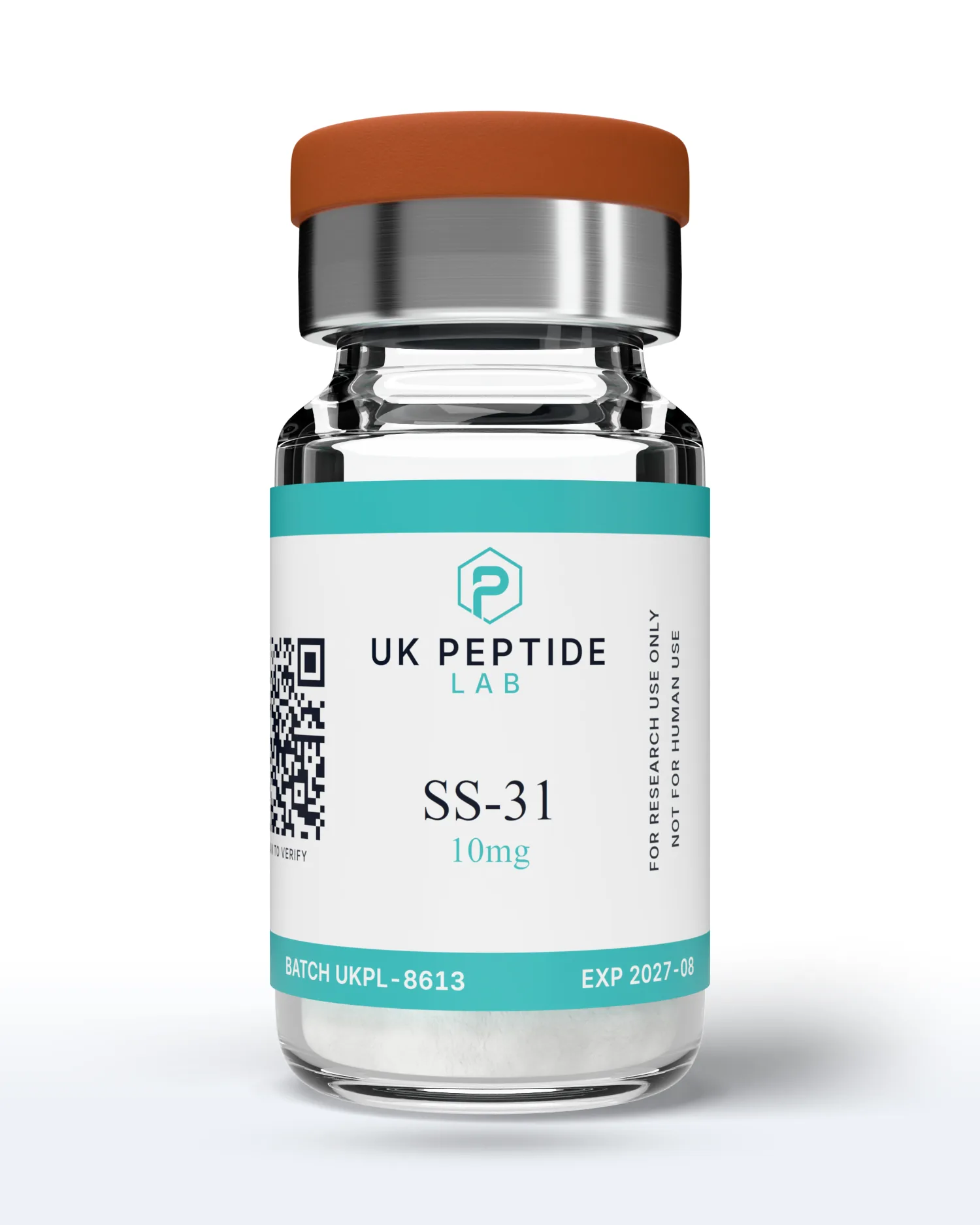
SS-31
10mg
Mitochondria-targeted tetrapeptide. Cardiolipin binding and bioenergetics research.
99.846% purity · Third-party tested · Batch UKPL-8613 · View certificate
- Same-day dispatch before 3pm, Mon to Fri
- Add £36.01 more for free UK delivery
- Cold-chain shipping. Always. Dry-cold pack, Royal Mail Tracked 24
- Lost, damaged or wrong? Replaced free if you tell us within 48 hours.
- Research use only. For in-vitro laboratory research. Not for use in humans or animals, or in food, drugs or diagnostics. Not evaluated by the MHRA or FDA. The buyer is responsible for handling and regulatory compliance.
Bulk Pricing
Counted across your basket, any mix of products.
| Vials in basket | Discount | Per vial |
|---|---|---|
| 1 | None | £32.99 |
| 3-4 | 5% | £31.34 |
| 5-9 | 8% | £30.35 |
| 10-50 | 12% | £29.03 |
Bacteriostatic Water 10ml
Required to reconstitute lyophilised peptides.
What is SS-31?
SS-31, also written SS31, is a synthetic mitochondria-targeted tetrapeptide. In the clinical literature it is elamipretide, and earlier development names were MTP-131 and Bendavia. SS-31 is sold here as white lyophilised powder in 10mg and 50mg vials.
Full description
The sequence is D-Arg-Dmt-Lys-Phe-NH₂, where Dmt is 2′,6′-dimethyltyrosine. Alternating cationic and aromatic residues give it a net positive charge while letting it cross membranes. The D-arginine and the unnatural Dmt residue make the backbone resistant to proteolysis.
Its target is a lipid, not a receptor. SS-31 binds cardiolipin, the phospholipid of the inner mitochondrial membrane that cristae need to form (Birk et al., J Am Soc Nephrol, 2013).
SS-31 Research Applications
- Bioenergetics models: isolated mitochondria and permeabilised-fibre respirometry, membrane potential and ATP recovery assays, and reactive oxygen species measurement.
- Ischaemia-reperfusion: renal and cardiac models built on the cristae-protection findings of Birk and colleagues.
- Cardiolipin chemistry: peptide binding and cytochrome c peroxidase studies in model membranes.
- Clinical literature: a Phase I/II trial in primary mitochondrial myopathy (Karaa et al., Neurology, 2018), then a Phase 3 trial that missed its primary endpoints (Karaa et al., Neurology, 2023).
Study details
In 2025 the US FDA granted elamipretide accelerated approval for Barth syndrome, under the name Forzinity (Bedoyan and Vockley, Cell Metab, 2026). The research-grade SS-31 sold here is not that medicine. It is supplied for in-vitro laboratory research only.
Why Cardiolipin Targeting Is Studied
Most peptides act through a receptor expressed on particular cell types. Cardiolipin sits in the inner membrane of every mitochondrion, so one tool compound can be used in cardiac, renal, skeletal muscle or neuronal preparations. Birk and colleagues showed the SS-31 and cardiolipin complex blocks the peroxidase activity of cytochrome c, which otherwise oxidises cardiolipin during ischaemia. In rat kidney ischaemia, pretreatment protected cristae, prevented mitochondrial swelling and sped ATP recovery on reperfusion. The same ubiquity is a caution: tissue selectivity cannot be assumed, so attribute effects by measurement.
Research Overview
Dmt is a non-proteinogenic tyrosine analogue with methyl groups on the two ring positions next to the phenolic hydroxyl. With D-arginine at position 1, it gives SS-31 its resistance to proteolytic enzymes.
Birk and colleagues (J Am Soc Nephrol, 2013) used a polarity-sensitive fluorescent analogue to show that SS-31 binds cardiolipin with high affinity. The peptide and cardiolipin complex protected the haem iron of cytochrome c and inhibited its peroxidase activity. That activity drives cardiolipin peroxidation and mitochondrial damage during ischaemia. In rats, pretreatment preserved cristae membranes during renal ischaemia, and ATP recovered promptly on reperfusion. Faster ATP recovery was followed by restored actin cytoskeleton and cell polarity, less apoptosis and better tubular barrier function.
The human record has three parts. MMPOWER, a Phase I/II randomised, placebo-controlled trial, enrolled 36 adults with primary mitochondrial myopathy (Karaa et al., Neurology, 2018). MMPOWER-3, a Phase 3 trial of 218 participants, did not meet its primary endpoints (Karaa et al., Neurology, 2023). In 2025 the US FDA granted accelerated approval for Barth syndrome, as Forzinity. The research-grade material sold here is not that medicine and is supplied for in-vitro laboratory research only.
Product Specifications
- Molecular Formula
- C₃₂H₄₉N₉O₅
- Molecular Weight
- 639.79 g/mol
- CAS Number
- 736992-21-5
- Sequence
- D-Arg-Dmt-Lys-Phe-NH₂ (Dmt = 2,6-dimethyltyrosine)
- Purity
- 99.846% (RP-HPLC)
- Batch
- UKPL-8613
- Storage
- -20°C lyophilised, 2-8°C reconstituted
- Appearance
- White lyophilised powder
- Form
- Lyophilised powder
Certificate of Analysis
Third-party tested
- Batch
- UKPL-8613
- Purity
- 99.846%
- Specification
- ≥98.0%
- Method
- RP-HPLC
- Lab
- Janoshik Analytical
- Tested
- Sep 2026
Need the certificate for an earlier batch? Request an older CoA
Storage and Reconstitution
Keep sealed vials at -20°C, away from light and moisture. After reconstitution, keep the solution at 2-8°C and use it within 4 weeks, or freeze single-use aliquots at -20°C. Oxidation of the phenolic Dmt ring is the degradation route to guard against, so store solutions dark with little headspace and avoid repeated freeze-thaw cycles.
Vials are sold on their own, without bacteriostatic water for mixing or other supplies.
How to reconstitute and handle
Bring the vial to room temperature and swab both stoppers with alcohol. Add bacteriostatic water slowly down the inside wall of the vial. SS-31 is highly water-soluble and a clear, colourless solution forms almost at once, so there is no need to shake. The Dmt ring is phenolic, so keep the solution away from strong oxidisers and bright light. Label the vial with the reconstitution date.
- Work under aseptic conditions with sterile syringes and alcohol-swabbed stoppers.
- Split reconstituted stock into single-use aliquots, label each with the date, and avoid repeated freeze-thaw cycles.
For the full method, see the peptide reconstitution guide and the reconstitution calculator.
Research References
- The mitochondrial-targeted compound SS-31 re-energizes ischemic mitochondria by interacting with cardiolipin (Birk et al., J Am Soc Nephrol, 2013)
- Randomized dose-escalation trial of elamipretide in adults with primary mitochondrial myopathy (Karaa et al., Neurology, 2018)
- Efficacy and Safety of Elamipretide in Individuals With Primary Mitochondrial Myopathy: The MMPOWER-3 Randomized Clinical Trial (Karaa et al., Neurology, 2023)
- Is an emerging pharmacotherapeutic era for rare mitochondrial diseases here? (Bedoyan and Vockley, Cell Metab, 2026)
Published research on SS-31 is indexed on PubMed.
SS-31 Price (UK)
SS-31 is for sale in 2 vial sizes, priced from £32.99 for 10mg to £99.99 for 50mg. Every size ships from our UK facility, each with its own batch certificate. UK delivery is £4.50 by Royal Mail Tracked 24, free over £69.
| Vial | Price | Cost per mg | Availability |
|---|---|---|---|
| SS-31 10mgThis page | £32.99 | £3.30 | In stock |
| SS-31 50mg | £99.99 | £2.00Best value | In stock |
Prices are in GBP per vial and match the basket. See the FAQ for delivery and payment options, and quality & testing for how each batch is checked.
Frequently Asked Questions
How does SS-31 work?
SS-31 acts on a lipid, not a cell-surface receptor. Birk and colleagues (J Am Soc Nephrol, 2013) showed it binds cardiolipin in the inner mitochondrial membrane with high affinity. The complex inhibits the peroxidase activity of cytochrome c, and in rat kidney ischaemia it protected cristae and sped ATP recovery. Because cardiolipin is in every mitochondrion, SS-31 is studied across many tissue models.
Is SS-31 the same as elamipretide?
Yes. SS-31, elamipretide, MTP-131 and Bendavia all name the same tetrapeptide, D-Arg-Dmt-Lys-Phe-NH₂ at 639.79 g/mol. SS-31 is the original research code and elamipretide is the international non-proprietary name. MTP-131 and Bendavia were development names.
Has SS-31 been tested in humans?
Yes, as elamipretide. A Phase I/II randomised trial enrolled 36 adults with primary mitochondrial myopathy (Karaa et al., Neurology, 2018). The Phase 3 MMPOWER-3 trial in the same condition did not meet its primary endpoints (Neurology, 2023). In 2025 the US FDA granted accelerated approval for Barth syndrome. The SS-31 sold here is a research chemical, not that medicine.
Is SS-31 legal to buy in the UK?
Yes, as a research chemical for in-vitro laboratory use only. The SS-31 sold here is not a licensed medicine and is not supplied for human consumption, veterinary use or any therapeutic purpose. Buyers must be 18 or over and confirm research-only use at checkout.
What is in an SS-31 vial?
Each SS-31 10mg vial holds white lyophilised powder. The Janoshik Analytical certificate for batch UKPL-8613 reports 99.846% purity by RP-HPLC and 11.68mg measured content against the 10mg label claim. A 50mg vial is also available.
Where can I buy SS-31 in the UK?
You can buy SS-31 online from UK Peptide Lab, in 10mg and 50mg vials from UK stock. Orders placed before 3pm UK time on a working day are dispatched the same day. UK Royal Mail Tracked delivery is free over £69.
Is your SS-31 independently tested?
Yes. Batch UKPL-8613 has a third-party certificate reporting 99.846% purity by RP-HPLC. The full certificate is published on the product page, and the batch number on it matches the one printed on the vial.
What is SS-31 peptide used for in research?
SS-31 is used in preclinical mitochondrial research: cardiolipin binding, cristae structure, ATP recovery, electron transport and reactive oxygen species in ischaemia and bioenergetics models. It is also one of the few research peptides with a randomised trial record, as elamipretide.
Related Products